

© By Linda Banks | Investigative Journalism
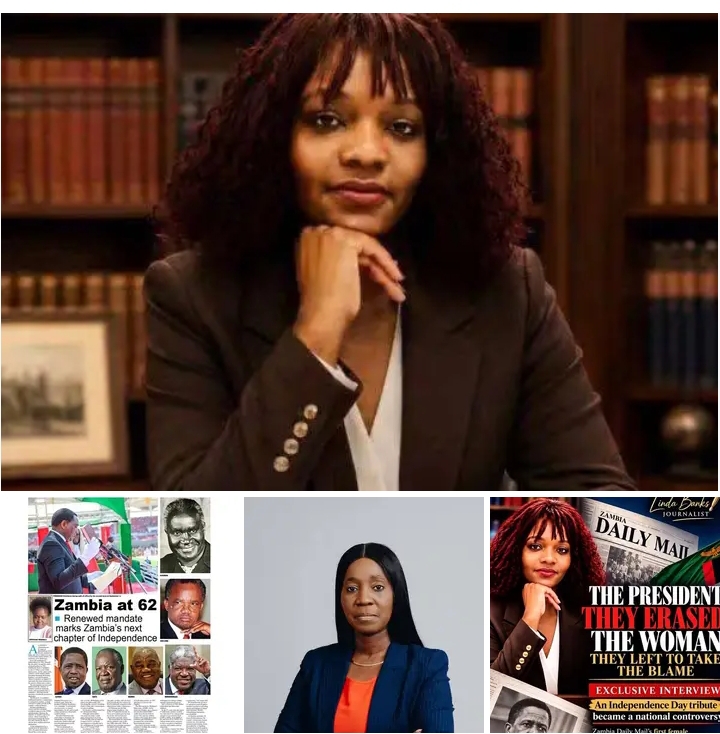
EXCLUSIVE : THE PRESIDENT THEY ERASED, THE WOMAN THEY LEFT TO TAKE THE BLAME
An Independence Day tribute became a national controversy. Now, an exclusive interview with Zambia Daily Mail’s first female managing director reveals the editorial decision behind Edgar Lungu’s omission, the internal disciplinary action that followed, and the troubling power struggles surrounding her historic appointment.
History is not a guest list from which inconvenient names can be quietly removed. Yet, in a country commemorating 62 years of independence, one of its most recognisable national newspapers managed to produce a tribute to Zambia’s presidential history without the man who served as its sixth Republican President.
Dr Edgar Chagwa Lungu had disappeared from the Zambia Daily Mail’s commemorative publication of 23 October 2026.
The omission provoked an immediate public outcry. To many Zambians, it appeared to be something more than an editorial oversight. Against the backdrop of the political controversies surrounding the late President, the missing photograph was interpreted by critics as another attempt to diminish his place in the nation’s history.
But behind the anger, a remarkable story was unfolding within the newspaper itself.
An experienced chief sub-editor had made a decision that senior management says it never authorised. A newly confirmed managing director was left to answer for the consequences. And sources familiar with the institution were raising disturbing questions about personal loyalties, internal resistance and an alleged warning made by her predecessor.
At the centre of it all stood Emeldah Libanga Musonda, the first woman to lead the Zambia Daily Mail in its history.
In an extensive interview with journalist Linda Banks, Ms Musonda provided a detailed account of how the omission occurred, the explanation subsequently given by the editor responsible, and the disciplinary proceedings now underway.
Her testimony opens a window into a controversy that is no longer simply about the absence of one former President’s photograph.
It is also about who exercises authority inside a national institution, what happens when that authority is bypassed, and the difficult position of a woman whose historic appointment has been overshadowed by decisions she says she never sanctioned.
A WOMAN MAKES HISTORY. DAYS LATER, A CRISIS ERUPTS.
On 20 October, the Zambia Daily Mail announced that Ms Musonda had been appointed its substantive managing director, effective 14 October.
It was a landmark moment for an institution whose highest office had been occupied by men for more than seven decades.
Ms Musonda was hardly an outsider parachuted into unfamiliar territory. She had served as managing editor from March 2024 and assumed the acting managing directorship in January 2026. Her appointment represented the culmination of years spent working within the organisation.
Yet within days of its public announcement, the celebration had given way to a controversy that threatened to consume her new administration.
During her interview with Banks, Ms Musonda described an exceptionally demanding period leading up to the Independence Anniversary publication.
She and the managing editor had spent much of the preceding week in lengthy executive coordination meetings, frequently remaining at work until seven or eight in the evening.
The newspaper was effectively preparing two publications simultaneously: its regular edition and the special Independence supplement.
Under those circumstances, she relied on the experience and professional judgement of the editorial staff entrusted with preparing the commemorative pages.
Among them was chief sub-editor Jackson Sitengu, a journalist with approximately two decades of experience.
A senior editor with that level of experience would ordinarily be expected to recognise the significance of a national historical feature, identify omissions and refer politically sensitive decisions to the appropriate authority.
Instead, according to Ms Musonda, Mr Sitengu made the decision not to include Dr Lungu’s photograph without seeking approval from either her or the managing editor.
THE EXPLANATION THAT CHANGED THE STORY
When the controversy erupted, Ms Musonda demanded an explanation.Management had not instructed anyone to remove the former President. How, then, had the newspaper published a commemorative feature that excluded him?
According to Ms Musonda, Mr Sitengu explained that the article supplied by the features editor contained photographs of the other presidents but not Dr Lungu.
She recounted his response in the following words:
“When I received the article from the features editor, it did not have all the photos, the pictures. It only had pictures for the other presidents. We actually discussed it and I felt that since there were all these issues around ECL, it would not be wise to use the picture.”
That explanation is perhaps the most consequential revelation of this investigation.
The absence of a photograph from the original material may explain the initial production problem. But the subsequent decision not to include it was, according to the account given to Ms Musonda, informed by the controversy surrounding the former President.
When Linda Banks asked whether the decision had been made consciously and without further approval, Ms Musonda confirmed that it had.
The distinction matters enormously.
An oversight is one thing, an editor deciding that political controversy makes a former President unsuitable for inclusion in a historical commemoration is quite another.
Newspapers are entitled to criticise presidents, question their decisions and scrutinise their legacies. Indeed, that is among the essential functions of a free press.
But a former President’s place in the constitutional history of a country is not an editorial privilege to be granted or withdrawn.
Dr Lungu served as Zambia’s sixth Republican President between 2015 and 2021. That fact remains true regardless of whether one admired his administration, opposed his policies or disagreed with his political legacy.
An Independence Anniversary supplement is not a popularity contest.
And the question now confronting the Zambia Daily Mail is how a decision of such historical significance could have been taken without consultation at the highest editorial level.
THE OLD GUARD AND THE ALLEGATIONS OF SABOTAGE
The circumstances surrounding the omission become more troubling when examined alongside information independently gathered by Banks concerning relationships within the institution.
According to a source familiar with its internal affairs, Mr Sitengu maintained a close personal relationship with former managing director Simate Simate, under whose leadership he had been employed.
Mr Simate and the Zambia Daily Mail parted ways by mutual agreement on 30 January 2026.
The source also recounted remarks allegedly made by Mr Simate before his departure, warning that if he lost his position, those remaining at the institution would not enjoy an easy tenure.
The source regarded those remarks as a threat directed at those who would remain after him.
The same source described resistance to Ms Musonda’s appointment and alleged that some individuals within the traditionally male-dominated institution were unhappy that a woman had secured its highest office.
These accounts introduce a question that cannot be ignored: did the editorial controversy arise in an environment already marked by competing loyalties and resentment over a change of leadership?
When Banks put the concerns about timing and possible sabotage to Ms Musonda, she acknowledged having similar suspicions.
The controversy had erupted only days after her substantive appointment was announced. She questioned whether the coincidence was merely accidental.
https://www.facebook.com/ACollectionOfVoices
Her concern is understandable in the context of the information presented to her, although the existence of personal relationships and reported warnings does not, by itself, establish that the omission formed part of an organised plot.
Mr Sitengu’s explanation establishes an editorial decision that management says was unauthorised. The separate allegations concerning Mr Simate and resistance to Ms Musonda’s appointment raise questions about the institutional environment in which that decision occurred. Whether those matters are connected remains a question requiring evidence.
But the broader issue is one that many women who have entered traditionally male-dominated leadership structures will recognise.
A woman may be appointed to the highest office, yet still find herself having to establish that the authority of that office is not optional.
In some institutions, formal reporting structures coexist uneasily with older networks of loyalty and influence. Employees may have worked together for decades, developed close personal relationships or become accustomed to informal channels of power.
Such relationships are not inherently improper, they become a governance concern when they are allowed to override established procedures.
The question is not whether Mr Sitengu knew the former managing director,It is whether his professional decisions were made within the authority entrusted to him and whether the institution’s leadership structures were respected.
In this instance, Ms Musonda’s account is unequivocal: the decision to exclude Dr Lungu was not referred to her or the managing editor.
THE WOMAN WHO APOLOGISED FOR A DECISION SHE NEVER AUTHORISED
There is a moment in this story that deserves particular attention.
When confronted with the consequences of the publication, Ms Musonda did not attempt to deny that the newspaper had failed.Nor did she argue that her demanding schedule relieved her of responsibility.She acknowledged that, as managing director, ultimate institutional accountability rested with her. She confirmed that the public apology was issued on her instruction.
The Zambia Daily Mail’s statement described the omission as unintentional and offered an unreserved apology to the nation.
The wording requires an important distinction.
According to Ms Musonda, senior management had never intended or authorised Dr Lungu’s exclusion. Yet the explanation she attributed to Mr Sitengu indicates that he had consciously decided against including the photograph.
An unauthorised decision by an individual employee can produce an institutional failure that senior management neither intended nor approved.Ms Musonda nevertheless, accepted responsibility for the publication. That is an important aspect of executive leadership. Responsibility does not disappear simply because the decision originated elsewhere in the organisation.
Equally, accepting institutional responsibility does not mean concealing the actions of those directly involved. An effective leader must be capable of doing both: acknowledging the failure publicly and establishing precisely how it occurred.
Ms Musonda’s decision to apologise, followed by the commencement of internal disciplinary proceedings, places those two responsibilities at the centre of the institution’s response.
STATE HOUSE AND THE MINISTRY OF INFORMATION EXPRESS DISPLEASURE
The controversy also reached senior government offices, Ms Musonda disclosed that she received enquiries from State House asking how the omission had occurred.
According to information obtained during this investigation, both State House and the Ministry of Information expressed displeasure over the exclusion of Dr Lungu from the commemorative publication.
The managing director also addressed speculation that the newspaper might have been acting under political instructions to diminish the former President’s legacy.
She rejected the suggestion that she had been directed to pursue confrontational coverage of Dr Lungu or his family.
Instead, she explained that the guidance received had emphasised restraint, particularly in relation to sensitive developments involving the former President’s family and associated court proceedings.
The newspaper, she said, had sought to report such matters factually, avoiding unnecessary sensationalism or language that demeaned the family.
This account is significant because it challenges the assumption that the omission necessarily originated from instructions issued at the highest political level.
It does not resolve every question about editorial independence within a state-owned newspaper, but it does establish Ms Musonda’s position: she had issued no instruction to remove Dr Lungu, and the editorial approach she described was inconsistent with such an exclusion.
It also makes the reported conduct of the chief sub-editor more difficult to understand.
If the institution’s leadership had been exercising caution around the former President’s coverage, why would a senior editor independently conclude that his photograph should be excluded because of the controversies surrounding him?
DISCIPLINARY PROCEEDINGS BEGIN
The matter has now moved beyond explanations and apologies.
Internal disciplinary proceedings have commenced against Mr Sitengu.
According to information obtained by Banks, the process is being handled by his immediate supervisor, Managing Editor Beavan Saluseki, working alongside the institution’s human resources and legal departments.
A source familiar with the proceedings expressed serious doubts about Mr Sitengu’s prospects of retaining his position.
That assessment is not a disciplinary verdict. The process must still determine whether established procedures were breached and what consequences, if any, should follow.
But the decision to initiate proceedings demonstrates the seriousness with which management is treating the matter.
The investigation should establish who supplied the material, what discussions took place, who approved the final page, and why the omission was not escalated before publication.
It must also confront a wider institutional failure: how could a national newspaper’s editorial safeguards allow such a historically significant omission to reach its readers?
Accountability cannot end with the identification of one individual. It must extend to the procedures that permitted the error and the measures necessary to prevent its recurrence.
THE PERSONAL COST OF A PUBLIC CONTROVERSY
Behind the institutional questions lies a more personal story, towards the end of her conversation with Banks; Ms Musonda spoke about the professional reputation she had spent years building. She described her commitment to integrity and her refusal to pursue career advancement through bribery, political patronage or personal favours. Her appointment, she maintained, had been earned on merit.
She also recounted receiving a message of support from Mr Chimpampe, a former press aide to Dr Lungu.
According to Ms Musonda, he expressed confidence in her character, telling her that his experience of working with her made it difficult to believe she would knowingly authorise such an omission.
For a woman whose appointment had represented a significant professional milestone, the timing of the controversy was particularly painful.
Years of work had brought her to the highest office in the institution. Within days of her confirmation becoming public, she was required to defend the newspaper’s conduct in a matter that had stirred national anger.
There is a cruel asymmetry in that experience.
A reputation is built over years, sometimes decades. Yet it can be called into question by a single publication, a single decision or a single failure of institutional oversight.
Ms Musonda must now demonstrate that the confidence placed in her by the board can be translated into effective leadership during a crisis.
The task will require more than an apology. It will require a credible disciplinary process, stronger editorial controls and a workplace in which authority is exercised through professional structures rather than informal allegiances.
THE GLASS CEILING WAS BROKEN. WHAT HAPPENS NEXT?
The Zambia Daily Mail controversy began with a missing photograph, but its implications extend far beyond the printed page.
It has exposed questions about editorial judgement, internal accountability, personal loyalties and the challenges confronting a woman appointed to lead an institution that had never previously entrusted its highest office to one.
The allegations of internal resistance deserve serious examination. So, too, does the possibility that a long-established workplace culture may have struggled to adjust to a new leadership arrangement.
But Ms Musonda’s appointment should not be reduced to a contest between men and women.
The principle at stake is more fundamental.
No employee’s personal connections should place them above professional accountability. No predecessor’s influence should undermine the authority of a lawful successor. And no leader should be expected to bear responsibility for decisions while being denied the authority to supervise how those decisions are made.
Those principles apply regardless of gender.
For Ms Musonda, they carry particular significance because her appointment broke a barrier that had stood for more than seven decades.
The institution now has an opportunity to demonstrate that the significance of her appointment extends beyond the symbolism of being first.
A historic appointment must be accompanied by the practical authority to lead.
The disciplinary proceedings will test the organisation’s commitment to that principle. Their credibility will depend upon fairness, evidence and the consistent application of professional standards.
As for Dr Edgar Chagwa Lungu, the controversy has produced an irony that should not be lost on anyone.
A decision reportedly made because his presidency remained controversial has ensured that his absence became the most discussed feature of the newspaper’s Independence commemoration.
The attempt to avoid controversy, if that was indeed the chief sub-editor’s intention, produced precisely the opposite result.
And perhaps that is the enduring lesson.
A nation’s history does not become less complicated because an editor removes a photograph. Its political disagreements do not disappear when uncomfortable names are excluded from a commemorative page.
Dr Lungu was Zambia’s sixth Republican President. That is a historical fact, not a political endorsement.
His presidency belongs in the national record alongside those of the men who preceded and succeeded him.
And Emeldah Musonda, whatever the eventual findings of the internal investigation, has now become part of another chapter in the institution’s history: the first woman entrusted with leading the Zambia Daily Mail.
The challenge before her is to ensure that the institution’s future is governed by transparent procedures, professional responsibility and respect for the authority of the office she holds.
History cannot be rewritten to accommodate political discomfort. And a glass ceiling is not truly broken if the woman who passes through it must still ask permission to exercise the authority on the other side.
Efforts to obtain a comment from Mr Jackson Sitengu were unsuccessful at the time of publication.
SHARE-LIKE-COMMENT 曆