

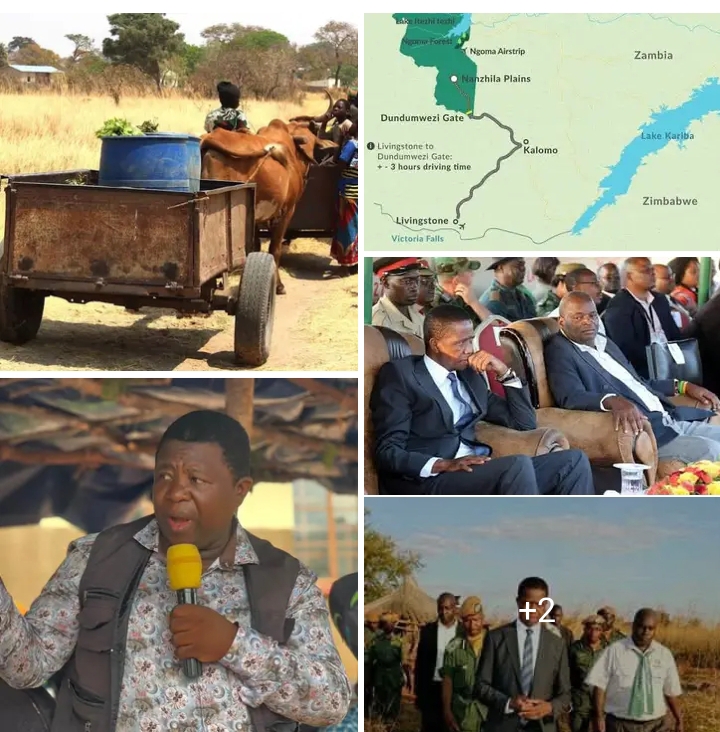
THE TRUTH AND SAD STORY OF DUNDUMWEZI MOST OF ZAMBIANS DON’T KNOW AND KEBBY MBEWE’S ADVICE TO MUNDUBILE NOT TO CAMPAIGN IN SOUTHERN PROVINCE WAS A SERIOUS POLITICAL MISCALCULATION.
By Dr. Larry Mweetwa
Let me put this in clear context, Kebby Mbewe misled Mundubile.
I want to express the truth plainly rather than inviting unwarranted criticism in my inbox all for people to understand we do not vote on tribal lines, but instead focus on delivering the last-mile incremental progress and practical strategy taught by President HH, ensuring that no province or district is ever left behind or deemed irrelevant.
I deeply appreciate the people of Dundumwezi, who, despite sacrificing so much for our victory, ask only for essentials like network towers for communication at mabombo, Muchindu primary, dams at shabulile, bungasha and boreholes for water, and functional feeder roads, these people will never demand for a K5 million Kwacha for marketers donations no! They are remaining steadfast in their support and conviction that a better future is coming; just as I’ve witnessed across other similarly underserved regions supported by organizations like World Vision, this term of office is dedicated to rewarding all communities that have sacrificed for our party’s success.
If it is indeed correct that Kebby Mbewe advised Brian Mundubile not to waste his time campaigning extensively in Southern Province because Tonga voters would never vote for him, then that advice must rank among the most serious strategic miscalculations of Mundubile’s campaign.
Politics is about addition, not subtraction. A presidential candidate cannot aspire to govern Zambia while mentally writing off an entire province before asking for its vote.
There is an old African proverb:
“The child who is not embraced by the village will search elsewhere for warmth.”
You cannot complain that people do not support you when you have made little effort to enter their communities, listen to their problems and ask for their confidence.
The political mistake was to treat Southern Province as a permanently closed political market rather than as a constituency in which even incremental gains mattered.
MUNDUBILE SHOULD HAVE CAMPAIGNED FOR EVERY AVAILABLE VOTE
A presidential election is ultimately arithmetic.
If an opposition candidate moves from 5 per cent to 10 per cent in a difficult province, that is progress. If he moves from 10 per cent to 20 per cent, that is political capital. Even where victory is unlikely, reducing an opponent’s margin can contribute significantly to the national tally that’s Where president HH is beating these Guys on incremental gains.
As the saying goes:
“You do not abandon the field because the harvest may be small; sometimes the small harvest is what fills the last basket.”
Mundubile therefore did not necessarily need to win Southern Province for campaigning there to make strategic sense. He needed to improve his numbers, establish relationships, build structures and demonstrate that he regarded Southern Province as equally deserving of his attention.
The preliminary 2026 election picture should also caution against making definitive numerical comparisons until the Electoral Commission completes and announces the official national results. As of 16 August, counting and verification were still ongoing, and credible reporting noted that official final results were expected on Monday.
But if the eventual official results demonstrate that Mundubile substantially improved the opposition’s performance in parts of Southern Province compared with Edgar Lungu’s previous performance, the strategic question will become even more compelling:
How much better might Mundubile have performed if he had deliberately invested time, organisation and resources there?
EDGAR LUNGU HAD ALREADY SHOWN THE ROAD
The irony is that President Edgar Lungu’s experience provided a useful political template.
After the extraordinarily poor PF performance in Dundumwezi in 2016, Lungu did not simply conclude that the people were politically unreachable. His administration subsequently pursued development interventions there.
Parliamentary records show that Dundumwezi had historically suffered from a serious electricity deficit. In 2016, Parliament was told that the constituency remained without electricity connectivity decades after independence.
Subsequently, the PF Government undertook electrification works in Dundumwezi. By 2021, the then Minister of Energy told Parliament that electrification works had been commissioned there and specifically rejected the proposition that government should neglect opposition strongholds.
Chief Chikanta also publicly acknowledged improvements including mobile communication towers, electricity in parts of the chiefdom and work on the Kalomo–Dundumwezi–Itezhi-Tezhi road, arguing that development could influence how citizens assessed a government politically.
That was the lesson Mundubile’s strategists should have studied.
“Where another man found a footpath, a wise traveller does not return to the forest; he widens the path.”
Instead of telling Mundubile, “Don’t waste your time there,” the strategic advice Kebby Mbewe should have been:
“President Lungu opened a political door here. Let us build upon the development footprint, acknowledge what remains unfinished, and present Mundubile as the man capable of completing the job.”
SELL MUNDUBILE AS A PRO-FARMER PRESIDENT
Southern Province should never have been approached primarily through ethnicity. It should have been approached through economics, agriculture and development.
The political conversation should have been:
Cattle. Maize. Irrigation. Dams. Feeder roads. Electricity. Mobile connectivity. Agricultural finance. Veterinary services. Storage. Markets. Mechanisation.
Dundumwezi itself has historically been recognised as a major agricultural area; parliamentary debate even highlighted its significant contribution to food production.
That would have given Mundubile a natural campaign entry point.
He could have stood before farmers and said, in substance:
“I am not here asking you to abandon your identity. I am asking you to examine my programme for your cattle, your maize, your roads, your dams, your electricity, your communication network and the future of your children.”
That would have been far more powerful than conceding the province before the contest had even begun and want to brand us voting on tribal lines.
“A farmer does not ask which tribe the rain belongs to; he asks whether it will reach his field.”
That should have been the philosophy.
POLITICS CANNOT BE WON FROM VIRTUAL RALLIES ALONE
Another strategic weakness was excessive reliance on virtual political engagement where physical presence was needed.
Digital communication is useful. Social media is useful. Virtual rallies can amplify a message. But they cannot completely substitute for shaking hands with farmers, sitting with traditional leaders, visiting markets, inspecting broken bridges, seeing dry dams and travelling the feeder roads people complain about.
Politics remains intensely human.
“The feet that enter the village understand what the eyes on the mountain cannot see.”
A presidential candidate needs to be physically seen in difficult territory.
Sometimes simply appearing before people who historically reject your party communicates something powerful:
“I know you may not vote for me, but I still respect you enough to come and ask.”
That is how political walls gradually come down.
NEVER CONFUSE A STRONGHOLD WITH PRIVATE PROPERTY
Southern Province may be a UPND stronghold, but no democratic constituency belongs permanently to any political party.
Likewise, Eastern Province does not permanently belong to NRPUP/PF. Northern Province does not belong to one political movement. Western, Luapula, Muchinga, Copperbelt, North-Western, Central and Lusaka are not hereditary political estates.
Voters change. Generations change. Issues change. Candidates change.
“Political strongholds are rented by performance; they are never owned by title deed.”
A serious national party therefore contests everywhere.
Even when the probability of winning is small, you build structures because today’s 10 per cent can become tomorrow’s 25 per cent, and tomorrow’s 25 per cent can eventually become a competitive constituency.
KEBBY SHOULD HAVE ADVISED MUNDUBILE TO GO SOUTH
The superior strategy would therefore have been to send Mundubile repeatedly into Kalomo, Choma, Monze, Mazabuka, Namwala, Pemba, Sinazongwe, Gwembe, Siavonga and surrounding farming communities.
Not merely for rallies.
He should have held farmer meetings, traditional-leadership engagements, youth dialogues, livestock meetings and community development discussions.
The message should have been simple:
“We know President Lungu started some development projects here. We recognise what was achieved. We also recognise what remains unfinished. Give Mundubile an opportunity to complete the roads, expand irrigation, rehabilitate dams, strengthen livestock services, extend electricity and improve digital connectivity.”
That would have converted Lungu’s development footprint into a bridge rather than treating Southern Province as hostile territory.
THE BIGGER LESSON
The greatest mistake in national politics is allowing ethnic voting assumptions to become self-fulfilling prophecies.
If politicians say, “Those people will never vote for us,” they stop campaigning there.
When they stop campaigning there, they stop building structures.
When they stop building structures, they stop understanding local problems.
When they stop understanding local problems, their vote collapses.
Then they point to the collapsed vote as proof that the people would never support them.
That is circular political thinking.
Leadership requires breaking that cycle.
“You cannot harvest where you deliberately refused to plant.”
And perhaps the most important lesson for Mundubile and any future presidential candidate is this:
Never allow anyone to convince you that some Zambians are not worth campaigning for.
A person seeking to become President of Zambia must be prepared to enter the strongest constituency of his opponent and respectfully ask for one vote at a time.
Because elections can ultimately be decided by the votes politicians were told not to bother pursuing.
The wiser strategy is therefore not “They will never vote for us.”
It is:
“What must we do differently so that more of them will consider voting for us?”
That single change of mindset separates a regional political strategy from a national presidential strategy.
Beautiful analysis.
Oh, Oh! what else can I say? Powerful analysis. This analysis must be basis of any future campaign endeavours for whatever opposition parties will exist at that time. In Tonga/Ila we say ” Kanyama kalya uzumanana.”