

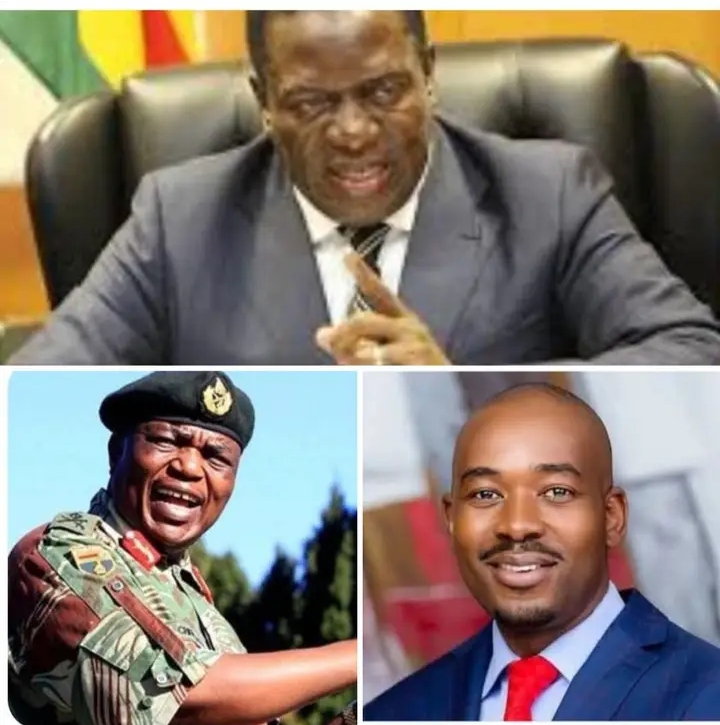
THE UNDERRATED PRESIDENT, THE OVERRATED VICE PRESIDENT AND THE OVERRATED OPPOSITION:
Zimbabwe’s greatest political misunderstanding may be that we keep mistaking popularity, mythology and noise for strategy.
By Reason Wafawarova
Zimbabwean politics has produced a rather fascinating intellectual problem.
We may be dealing with an underrated President, an overrated Vice President and an equally overrated opposition.
And, because we are Zimbabweans, there is a very good chance that all three camps are currently convinced that I am talking about the other two.
That is the beauty of political satire. Everybody laughs until they recognise themselves in the joke.
Let us begin with an uncomfortable proposition.
Emmerson Mnangagwa is probably one of the most politically underestimated politicians in Zimbabwe.
This is not because he is charismatic.
He is not. He is not Nelson Chamisa.
He does not walk into a room with the aura of a Pentecostal crusader who has just discovered the microphone.
He does not have Chamisa’s oratorical dexterity, youthful appeal or ability to turn a political rally into an evangelical service.
He is not another Robert Mugabe.
He does not even appear particularly interested in being impressive.
On a good day, Mnangagwa can look politically unassuming.
On a bad day, he can look clownish.
His jokes occasionally arrive at a funeral wearing a Hawaiian shirt.
His public speeches have produced moments in which one wonders whether the teleprompter has resigned.
His microphone relationship is sometimes reminiscent of a man who has been told that the nation is listening but has not been informed why.
He can say something astonishingly consequential with the facial expression of a man announcing that there are free sandwiches outside.
And yet this apparently unelectable, unassuming and frequently irritating politician has managed to do something that Zimbabwe’s political intellectuals should probably spend more time studying:
He has repeatedly outmanoeuvred people who looked politically stronger than him.
That is not a small thing. In fact, it may be the most important thing.
Because politics is not a beauty contest.
Unfortunately, Zimbabweans have spent a great deal of time behaving as though it is.
We count crowds. We count followers. We count Facebook views. We count titles. We count uniforms.
We count degrees. We count slogans. We count rallies. We count social-media likes. We count who has been photographed with whom.
We count who shook whose hand. We count who was given a car. We count who was called His Excellency before breakfast.
And then, after counting all these things, we make the extraordinary intellectual mistake of assuming we have counted power.
We haven’t.
Myth is not strategy:
This is the central misunderstanding. In politics, myth is not strategy.
Clout is not strategy. Institutional title decorations are not strategy.
Eloquence is not strategy. Multitudes of followers are not, in themselves, strategy.
A military pedigree is not strategy. Being popular is not strategy. Being feared is not necessarily strategy.
Being loved is not strategy. Having a million Facebook followers is certainly not strategy.
It may be evidence of something. It may even be useful.
But it is not the same thing as possessing a political machine capable of converting sentiment into outcomes.
Zimbabwe’s opposition has sometimes behaved as though the election is won when the Facebook comments section becomes sufficiently enthusiastic.
It isn’t. The comments section does not appoint electoral commissioners.
The comments section does not control Parliament.
The comments section does not administer patronage.
The comments section does not distribute state contracts.
The comments section does not appoint provincial administrators.
The comments section does not control the security architecture.
The comments section does not manufacture parliamentary majorities.
And, sadly, the comments section cannot even prevent your own supporters from fighting each other.
This is where Mnangagwa’s political achievement becomes intellectually interesting.
He appears to have understood something that his opponents have repeatedly struggled to understand:
You do not necessarily defeat political popularity by becoming more popular.
Sometimes you simply make popularity less politically useful.
That is a very different strategy.
The Chamisa paradox:
Nelson Chamisa is perhaps the clearest example.
Nobody seriously disputes his extraordinary political mass appeal. He is one of the most recognisable opposition politicians Zimbabwe has produced.
He has charisma. He has communication skills. He understands crowds. He understands political theatre.
He can make people feel that something historic is happening even before anything historic has actually happened.
That is a political gift.
But here comes the uncomfortable question: How does a politician with such obvious mass appeal become so easily contained by a politician who appears to possess considerably less of it?
That is the question intellectuals should be asking.
Not whether Chamisa has followers. We know he does.
Not whether Chamisa can fill a stadium. We know he can.
Not whether his supporters believe in him. They do.
The question is why that mass has not translated into commensurate political power.
Because political mass and political machinery are not the same thing.
This is where the Mnangagwa strategy becomes visible.
The strategy appears to have been constructed almost entirely against the conventional terrain of modern politics.
The conventional politician wants popularity.
Mnangagwa has pursued control.
The conventional politician wants influence.
Mnangagwa has pursued institutional influence.
The conventional politician wants loyal followers.
Mnangagwa has pursued loyal structures.
The conventional politician wants applause.
Mnangagwa has pursued people who can make decisions.
And there is an important distinction.
A person who loves you may disappear when the political weather changes.
A person whose prosperity, position, contract, appointment or access depends upon your political survival has a rather different relationship with you.
This is the genius—and the tragedy—of patronage politics.
It does not require everybody to love you. It requires enough people to need you.
That is a much cheaper political commodity.
The patronage revolution:
Mnangagwa’s political environment has increasingly demonstrated an extraordinary proposition:
You can destroy the political value of morality without formally abolishing morality.
You simply make money more politically important than virtue.
You make access more important than principle. You make proximity more valuable than competence.
You make loyalty more profitable than independence. You make corruption so normal that complaining about it begins to sound quaint.
You elevate people who, under an older moral vocabulary, would have been considered politically radioactive.
Suddenly the question is not:
“What did this person do?”
It becomes: “How close is this person to the President?”
That is a profound transformation of political culture.
The old moralist asks: “Is this person suitable?”
The patronage state asks: “Is this person useful?
And Zimbabwe has become remarkably good at answering the second question.
We have developed a political economy in which criminal allegations, dubious reputations, questionable wealth and moral controversy are increasingly treated as inconvenient details—as long as the individual remains useful to someone sufficiently powerful.
We have effectively democratised the pursuit of money while privatising the consequences.
Everyone is now told: Make money.
Nobody asks: By what means?
That is how morality becomes an ancient relic.
Something your grandmother believed in. Like greeting elders.
Or returning borrowed money. Or not taking what does not belong to you.
Very charming values.
Unfortunately, they do not appear to have survived the political economy.
And then came the dollar:
Zimbabwean politics has also been progressively dollarised—not merely economically, but psychologically.
Money has become political language.
Cars become political language.
Contracts become political language. Business opportunities become political language. Donations become political language.
Luxury becomes political language. Access becomes political language.
A photograph standing next to the President becomes political currency.
The political entrepreneur has emerged. He does not necessarily need ideology. He needs proximity.
He does not need a manifesto. He needs a WhatsApp number.
He does not need a constituency. He needs access to someone who has one.
This answers your question on why everyone and anyone with a hundred thousand followers or fans is driving a Wicknell Chivayo freebie car.
And this is where the Mnangagwa patronage system becomes particularly interesting.
It has created an alternative route to political relevance.
You no longer have to mobilise thousands of citizens to become politically significant.
You may simply need to become useful to the person who controls the machinery.
That is a completely different conception of politics.
And it is extraordinarily difficult for an opposition built around popularity to compete with.
The Chiwenga problem:
Then we arrive at Constantino Chiwenga.
Here again Zimbabweans may have confused institutional pedigree with political strategy.
The military tradition has historically mattered enormously in ZANU PF succession politics.
Chiwenga’s credentials in that tradition are not imaginary.
His political and military history gives him a weight that most politicians simply cannot manufacture.
But weight is not movement. A heavyweight can still be strategically stationary.
And this may be one of the most fascinating aspects of the Mnangagwa era.
How has Mnangagwa managed to neutralise, or at least substantially dilute, the traditional influence of the military establishment in succession politics?
That deserves an academic thesis of its own.
Because conventional thinking would suggest that a politician of Mnangagwa’s apparent political limitations should have struggled against a figure carrying the historical authority of the military establishment.
Yet here we are.
Perhaps the answer lies in the same distinction between power as aura and power as architecture.
The military can confer authority. But political systems can be redesigned.
Networks can be cultivated. Institutions can be staffed.
Loyalty can be purchased.
Competing centres of influence can be fragmented. Potential rivals can be accommodated, isolated, promoted, rewarded or simply rendered politically unnecessary.
You don’t have to defeat every opponent. Sometimes you merely have to make their power irrelevant.
That is a much more sophisticated form of political neutralisation.
The President nobody thinks is clever:
There is a delicious irony here.
Mnangagwa may have benefited from the fact that Zimbabweans do not instinctively regard him as particularly clever.
People tend to underestimate politicians who do not look clever.
We associate intelligence with eloquence. With academic qualifications. With sophisticated vocabulary. With polished speeches. With impressive Twitter threads.
With people who can say “constitutionalism” without looking at their notes.
But political intelligence is not necessarily linguistic intelligence.
Sometimes the cleverest politician in the room is the one who says the least interesting thing while quietly arranging the most consequential thing.
The man giving the brilliant speech may be winning applause.
The man arranging who controls the institution may be winning the country.
Zimbabwe’s opposition has occasionally won the argument while losing the architecture.
That distinction should terrify political strategists.
The opposition’s favourite currency: belief
The opposition has another problem. It has sometimes treated political belief as though belief itself were an instrument of power.
The faithful believe. The faithful wait. The faithful defend. The faithful explain. The faithful reinterpret. The faithful blame everyone except their own political strategy.
This produces what I would call messianic politics.
The leader becomes larger than the organisation. The organisation becomes larger than strategy. The supporters become larger than reality.
And eventually everybody becomes so invested in the mythology that nobody is permitted to ask the embarrassing question: What is the plan?
This is not unique to Chamisa. It is a broader Zimbabwean political disease.
We prefer heroes to systems. We prefer personalities to institutions. We prefer slogans to strategy. We prefer prophecy to planning. We prefer political theatre to organisational discipline.
And then we are surprised when somebody with no discernible charisma defeats somebody with enormous charisma.
The three political religions:
So perhaps Zimbabwe currently has three political religions.
The Chamisa religion says: The people are with us.
The Chiwenga religion says: The establishment is with us.
The Mnangagwa patronage religion says: The people who matter are with us.
And each has a weakness.
The first confuses followers with organisation.
The second confuses pedigree with strategy.
The third confuses patronage with legitimacy.
The first believes crowds automatically become power.
The second believes history automatically becomes succession.
The third believes money automatically becomes loyalty.
None of these propositions is entirely true. But the third has perhaps been the most operationally effective.
And that is the uncomfortable part.
Mnangagwa’s greatest political achievement may not be popularity:
The great irony is that Mnangagwa’s political success may have very little to do with making Zimbabweans like him.
He appears to have understood that he does not need to be adored.
He needs to be difficult to dislodge.
That is a different political objective. And once you understand that, many things begin to make sense.
The cars. The donations. The appointments. The business networks. The institutional changes.
The cultivation of influential personalities. The elevation of controversial figures.
The political rehabilitation of people whose reputations would once have disqualified them from respectable society.
The extraordinary glamour attached to sudden wealth.
The public celebration of proximity.
The constant production of images of access.
It is not necessarily about convincing the whole country that Mnangagwa is wonderful.
It is about constructing a political ecosystem in which enough people have a material interest in Mnangagwa remaining politically relevant.
That is not populism. It is political engineering.
And political engineering is often more durable than popularity.
Which brings us back to 2030:
This is why the current constitutional and succession struggle should not be dismissed merely as a fight between personalities.
The deeper contest is over whether political legitimacy comes from institutions and citizens, or from institutional control and patronage networks.
That is why the debate around 2028 and 2030 matters.
That is why constitutional amendments matter. That is why Parliament matters. That is why appointments matter. That is why patronage matters.
Because once political power becomes institutionalised, it becomes considerably less dependent on the personality of the politician who currently occupies the office.
And that is precisely why the apparently unassuming politician deserves more intellectual attention than he receives.
We have spent years laughing at the jokes.
Perhaps we should have been studying the machinery.
The joke is on all of us:
There is, finally, an uncomfortable conclusion.
Perhaps Zimbabwe has overrated all three camps.
The Chamisa camp has overrated the political power of mass popularity.
The Chiwenga camp has overrated the automatic political power of military pedigree.
The Mnangagwa camp has overrated the political durability of patronage.
The first thinks followers are a strategy.
The second thinks history is a strategy.
The third thinks money is a strategy.
They are all wrong.
Strategy is the capacity to convert resources into political outcomes.
That is the definition we should be using.
Not how many people clap. Not how many people salute. Not how many people post your photograph.
Not how many people call you Doctor, General, President, Commander, Advocate, His Excellency or the people’s choice.
Titles are decorations. Crowds are potential. Money is a resource. Military pedigree is leverage. Eloquence is an instrument.
None of these is strategy by itself.
The question is always: What can you actually make happen?
That is the question Zimbabwean politics has been avoiding.
And perhaps this is why Mnangagwa has been so difficult to read.
We have been looking for the politician we expected him to be.
The charismatic one. The intellectually dazzling one. The mass politician. The great orator. The military strongman.
Instead, we got something much more mundane and, therefore, much more dangerous to underestimate:
a politician who appears to understand the machinery of power better than the people competing with him.
That does not make him a great President.
It does not make his politics legitimate. It does not make patronage virtuous. It does not make corruption respectable. It does not make institutional manipulation democratic.
And it certainly does not make 2030 legitimate merely because machinery can manufacture legality around it.
But it does mean that those who want to defeat his political project need to stop laughing at the man long enough to understand the method.
Because there is a dangerous political lesson here.
The politician who wins the popularity contest is not necessarily the politician who wins the political contest.
Chamisa may have the aura.
Chiwenga may have the pedigree. Mnangagwa may have the machinery.
And Zimbabwe’s tragedy is that we have spent so much time arguing about who looks most powerful that we have barely asked the only question that matters:
Who has actually learned how power works?
That, perhaps, is the joke. And perhaps it is not a very funny one.
Reason Wafawarova
VOICE OF REASON