

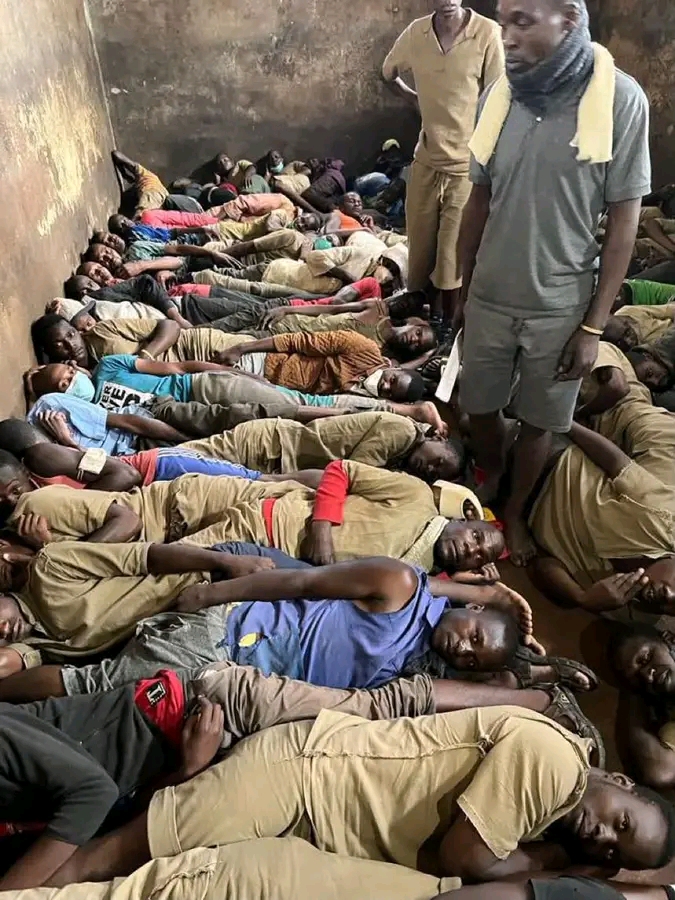
THERE IS NOTHING NEW ABOUT VIP TREATMENT IN ZIMBABWE’S CELLS — CHIN’ONO SAYS ANGEL CASE ONLY EXPOSED WHAT EVERYONE ALREADY KNEW
HARARE — The arrest of four Highlands police officers for allegedly giving Uebert Angel an office to sleep in instead of a cell has shocked many Zimbabweans.
But according to award-winning journalist Hopewell Chin’ono, there is nothing new about it at all.
In fact, he says, it is how Zimbabwe’s police stations and prisons have worked for years — for the powerful, for the connected, and even for the persecuted.
Chin’ono was reacting to the dramatic fall of Angel, born Uebert Mudzanire, the Spirit Embassy founder and President Emmerson Mnangagwa’s ambassador-at-large, who was arrested on Sunday during a church service at the Harare Hippodrome and charged with aggravated indecent assault.
He has spent another night in detention after a Harare court deferred his bail hearing. Prosecutors opposed bail, calling him a flight risk who could interfere with witnesses. The charge carries a possible 15 to 20 years in prison. Angel denies the allegations, which have not been tested in court. His lawyer, Prof Lovemore Madhuku, says the complainant — a 40-year-old mother of six from Bulawayo — signed an affidavit on 19 August withdrawing her complaint. Police are pursuing the case anyway.
But for Chin’ono, the real story is not just the charge. It is the humiliation ritual — and the VIP treatment that followed.
“He was taken out of his church in the middle of preaching. That is total humiliation, and when it happens, the top office is aware of it,” Chin’ono wrote.
He was then put in an open pan truck and driven away, seated in the pan, surrounded by armed police.
“That was another act of humiliation. A man who drives a Rolls-Royce is paraded in an open pan truck where everyone can see him, taken from his own church like an armed robber.”
He was then brought to court in handcuffs, wearing khakis — what Chin’ono called “the final act in a carefully staged fall from grace.”
“It goes back to the analogy I gave when I said it is foolish for any of these youngsters to think they are Emmerson Mnangagwa’s friend. They are functionaries who can be disposed of or punished at any time.”
“As I said in my analysis piece, anyone with proximity to President Emmerson Mnangagwa should not assume that this proximity makes them immune indefinitely, or untouchable. If you are deemed to be disloyal, you will be punished.”
The office, not the cell — and why police were arrested for it
When Angel was detained at Highlands Police Station, the officers who tried to assist him were themselves arrested.
Four officers — Joshua Manyena (42), Nyasha Mandaraza (35), Dennis Kudakwashe Paganga (34) and Alexander Marufu (38) — have now appeared in court on charges of criminal abuse of duty. The State alleges they agreed not to put Angel in the cells, and instead took him to an unknown place for more than two hours.
CID detectives acting on a tip-off arrived at Highlands at around 1am on 23 November and found neither Angel nor Paganga, who held the cell keys. The two allegedly returned about two hours later. Other detainees reportedly said Angel never entered the cells.
The officers allegedly told investigators they allowed Angel to stay in the office so he could access his medication.
“That is when I put my hands up and said that the top politicians are involved in this,” Chin’ono wrote.
“Many of us have not slept in cells”
Here is Chin’ono’s central point — and the one most Zimbabweans missed in the outrage:
Preferential treatment is not new. It is normal.
“Many of us who have been to prison for fighting corruption and repression have not slept in cells. Police officers gave us offices, because they knew in their hearts that we had committed no crime. We were being persecuted.”
In other words, officers have for years quietly bent the rules — giving a bed, an office, a chair, a blanket, a phone call — to detainees they believed did not belong there, or to detainees too powerful to be treated like ordinary suspects.
What is different in Angel’s case, Chin’ono argues, is not the favour. It is that the favour was punished.
“The fact that those who assisted him are being punished tells us that his troubles are huge.”
Former Foreign Minister Walter Mzembi, who has himself spent months in detention, made a similar point this week: “Don’t cheat the process, pain is part of the process.” Former Norton MP Temba Mliswa asked: “What medication requires an office? In cells, everything happens there.”
But Chin’ono’s argument flips that: if giving an office is now a crime, then why was it tolerated for so long for so many others?
Why Angel fell — according to Chin’ono
Chin’ono says Angel’s real problem was not the charge. It was the threats made in his defence.
“He was so desperate to avoid arrest that he got Nigerian preacher Pastor Chris Oyakhilome, a fake prophet, to issue what amounts to a fatwa on anyone who touches him. The Nigerian declared that anyone who goes after Angel will die.”
“That was the beginning of his problems. The Zimbabwean system was furious, and it set out to show him who holds real power. Those threats are at the centre of how he is being punished.”
Then, Chin’ono says, another “fake prophet” threatened that if Angel was not released within three days, all the state secrets he holds would be made public.
“That is the worst thing anyone can do. You do not threaten those who hold the levers of power in the very country where you live and operate.”
“Such a threat does not frighten a state, it irritatingly provokes it. It tells those in power that the man is a risk, and that they must keep him exactly where he is. Sadly, some think they will be assisting him when they are actually making his situation worse than it is.”
For Chin’ono, Angel’s case is a warning to every young pastor, businessman, influencer and politician who thinks proximity to power is protection.
It is not.
Power in Zimbabwe, he argues, is not friendship. It is utility. And when you stop being useful — or start becoming a threat — the same system that gave you a diplomatic passport, a church full of followers and a Rolls-Royce will put you in an open truck, in handcuffs, in khakis, in a cell.
And the officers who once gave you an office will be arrested for doing what officers have always done.
There is nothing new about preferential treatment in Zimbabwe’s police stations.
What is new is that this time, the state decided to punish it — to send a message that no one, not even its own ambassador-at-large, is untouchable.
Angel remains presumed innocent until proven guilty.