

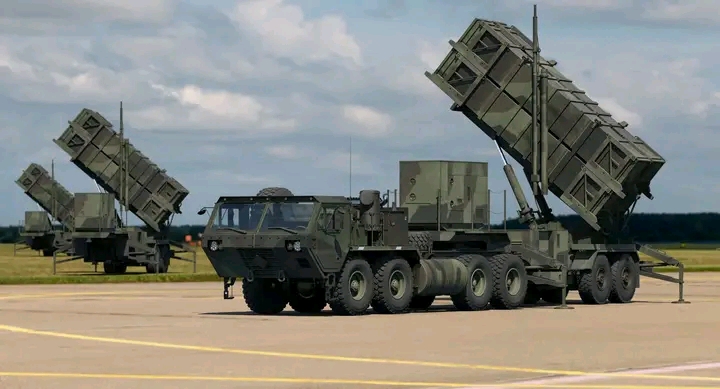
TRUMP BACKS AWAY FROM FULL PATRIOT PRODUCTION LICENSE FOR UKRAINE — SENSITIVE PAC-3 TECHNOLOGY APPEARS TO BE THE STICKING POINT
President Donald Trump has reportedly backed away from his earlier promise to give Ukraine a license to produce Patriot interceptors domestically, with concerns growing inside Washington over transferring some of the system’s most sensitive technology during an active war with Russia.
Trump had publicly floated the idea of allowing Ukraine to manufacture Patriot missiles itself, and the Pentagon confirmed in late July that it was examining several production options involving both U.S. and international manufacturing. Those discussions have not necessarily ended, but a full transfer of the most advanced technology now appears much less likely.
At the center of the concern is one particularly sensitive component inside the PAC-3 interceptor: its active Ka-band radar seeker.
Boeing manufactures and sustains these seekers in Huntsville, Alabama, as a subcontractor to Lockheed Martin. The seeker essentially acts as the missile’s own radar during the final stage of an interception, acquiring the incoming target, selecting the optimal aim point and providing the terminal guidance needed for a direct hit. Boeing describes it as a highly sophisticated millimeter-wave system developed over decades.
That technology is part of what makes the PAC-3 so valuable against ballistic missiles.
Unlike older blast-fragmentation interceptors that explode near a target, the PAC-3 family uses hit-to-kill technology, physically colliding with the incoming missile at enormous speed. Its seeker has to calculate range, velocity and angle with extraordinary precision during the final moments of the engagement.
And Washington clearly considers the technology extremely valuable. Boeing and the U.S. government are currently expanding PAC-3 seeker production dramatically, with plans to triple capacity as global demand for ballistic-missile defense surges. Boeing has already produced thousands of the seekers, while 17 countries now operate PAC-3 interceptors.
According to The Telegraph, one concern behind Washington’s hesitation is the possibility that sensitive Patriot technology manufactured inside Ukraine could eventually be captured, recovered from damaged facilities or otherwise fall into Russian hands.
That concern is understandable from a technology-security perspective.
But for Ukraine, the timing could hardly be worse.
Ukraine is currently facing a severe shortage of ballistic-missile interceptors. Robert “Magyar” Brovdi has warned that Russia is trying to expand its ability to launch much larger ballistic salvos, potentially reaching 100 missiles or more in a single attack in the future. Recent Russian strikes have already demonstrated what happens when Ukraine does not have enough interceptors available: ballistic missiles simply get through.
So this leaves Washington and Kyiv with a difficult problem.
Ukraine desperately needs a much larger and more sustainable supply of Patriot missiles.