

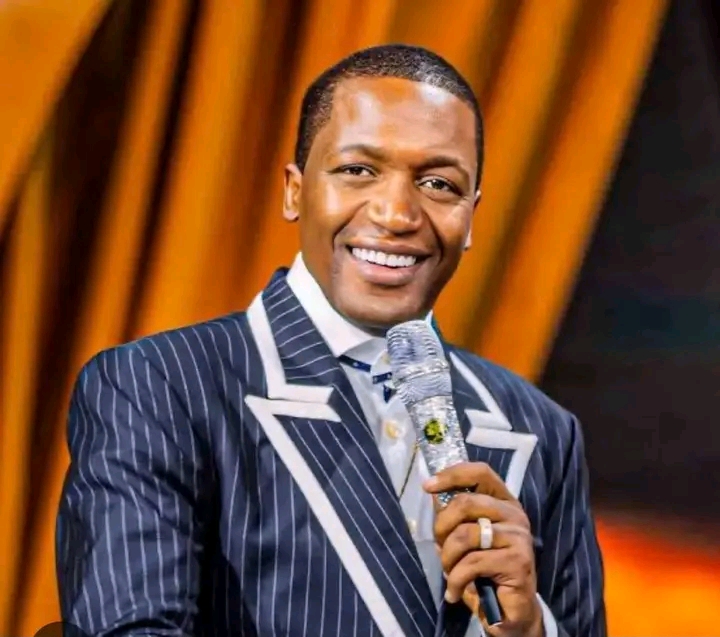
UEBERT ANGEL AND THE THEOLOGY OF VIOLENCE: WHEN SPIRITUAL AUTHORITY TURNS INTO INTIMIDATION
By Gabriel Manyati
There are moments when the boundary separating spiritual leadership from public theatre dissolves entirely, leaving behind a spectacle that demands immediate, unflinching examination. A viral video circulating across social media platforms this week captures one such moment. In the footage, Uebert Angel, a prominent Zimbabwean preacher known for his opulent lifestyle and transnational following, is seen standing at the pulpit and issuing explicit threats of physical violence. The targets of his wrath are individuals who have allegedly prophesied that Scott Sakupwanya – a ZANU PF Member of Parliament and businessman – will soon die.
Rather than offering a measured pastoral correction or turning the matter over to prayer and sober reflection, Angel chooses the path of intimidation. He recounts an earlier incident from three years prior, claiming that he and others took a man who had predicted his wife would die in a plane crash and beat him.
The footage is not a subtle allegory or a rhetorical flourish. It is a direct, unfiltered declaration from a religious stage, raising a profound and unsettling question for anyone concerned with the health of public discourse and spiritual life: What happens to Christian authority when a preacher responds to allegedly false prophecy with threats of physical violence?
This controversy is not merely a theological disagreement over the validity of modern prophetic claims. It strikes at the heart of public ethics, the responsibilities that accompany religious influence, the limits of spiritual authority and the behavioral standard being set for thousands of impressionable believers. When a minister of the Gospel exchanges the tools of persuasion and pastoral care for the language of the street corner and the enforcer, the foundational integrity of the ministry is severely compromised.
The Rhetoric of Retaliation and the Logic of Intimidation
To understand the gravity of the video, one must examine the language used by Angel from the pulpit. The statements are startling in their clarity and concerning in their implications. Angel declares, “We will find you and beat you thoroughly until you speak the real death.” He adds, “I did not say we will pray for you. No. We will hit you.”
The specificity of these remarks reveals a calculated rejection of traditional pastoral responses. Instead of turning the other cheek, Angel embraces physical confrontation as an instrument of truth. He moves from threats of violence to procedural cynicism, outlining how he believes such conflicts should be handled.
“We have to take you to court after beating you up,” he notes, before adding, “After we beat you up, we will go to the police and say you beat us. We will report you first.”
This particular formulation deserves rigorous scrutiny. It suggests a calculated manipulation of legal channels where the aggressor pre-emptively positions himself as the victim. While these words do not constitute a legally established crime or a court judgment against Angel, they raise profound ethical concerns. They normalise intimidation, blur the lines of accountability, and suggest an alarming contempt for the rule of law.
When a religious leader publicly jokes or boasts about beating someone first and reporting them to the police to gain an institutional advantage, he is modeling a dangerous form of lawlessness.
Yet, this bravado is paired with an apparent challenge to authority. “You can report me to the police,” Angel proclaims. “I am here.” Whether this posture stems from supreme confidence in his own untouchability, theatrical posturing designed to thrill a partisan audience, or sheer arrogance, it communicates a troubling message to his followers. It tells them that proximity to power and celebrity status place a leader above the ordinary expectations of civic responsibility and ethical restraint.
Funerals, Prophecies and the Burden of Public Speculation
This latest pulpit outburst did not emerge in a vacuum. It must be situated within the intense public discussions that followed the funeral proceedings for Wicknell Chivayo on 8 October 2026. Chivayo’s sudden death in a helicopter crash sent shockwaves through the nation, sparking widespread public grief, speculation, and rumour. In the anxious days following his passing, social media chatter suggested that Scott Sakupwanya, a prominent businessman closely associated with Chivayo, would be the next person to die.
The proliferation of death predictions around wealthy and influential figures is a recurring pathology of modern celebrity culture. When tragedy strikes someone of note, opportunists and prophets of doom rush to fill the vacuum with sensational claims, generating clicks, controversy, and public anxiety. At Chivayo’s funeral proceedings, Sakupwanya confronted this macabre speculation directly. Challenging those who whispered about his impending demise, he asked, “Vanhu munoti next ndiScott, uri Mwari here iwewe?” Translated into English, the question cuts deep: “The people who are saying Scott is next, are you God?”
Sakupwanya’s intervention was a legitimate pushback against human presumption. He challenged those who arrogated to themselves divine knowledge of life and death.
However, it is essential to distinguish between Sakupwanya’s measured frustration and Angel’s subsequent threats of violence. A public figure is entirely justified in calling out irresponsible and frightening predictions about their mortality. But that rightful indignation does not license anyone to take the law into their own hands or promise physical retribution against the prognosticators. Sakupwanya exposed the absurdity of playing God; Angel responded by playing enforcer.
The Antithesis of the Gospel
The central moral and theological failure of this episode lies in the profound contradiction between Angel’s threats and the core teachings of Jesus Christ. A preacher does not defend the Gospel by threatening to beat people into submission. Christianity has never claimed that its truths are preserved through physical force or intimidation. On the contrary, the New Testament explicitly warns against the use of violence and strife in the propagation or defense of the faith.
Consider the ethical framework laid out in the Bible. In the Sermon on the Mount, Jesus teaches a radical ethic of peace and restraint: “Blessed are the peacemakers: for they shall be called the children of God.” He continues with instructions that directly challenge the instinct for retaliation: “But I say unto you, That ye resist not evil: but whosoever shall smite thee on thy right cheek, turn to him the other also.”
Furthermore, when addressing the conduct required of those who lead God’s people, the Apostle Paul writes to Timothy with absolute clarity: “And the servant of the Lord must not strive; but be gentle unto all men, apt to teach, patient.” These passages are not decorative ornaments to be ignored when convenience dictates. They are foundational markers for Christian leadership. They demand self-restraint, patience in correction, and a complete rejection of physical coercion.
This is not to argue that Christian ministers must remain passive in the face of deception. Scripture and reason alike permit a leader to expose false prophecies, challenge self-proclaimed prophets, demand evidence for wild claims, and warn congregations against spiritual exploitation. There is a vast difference between theological critique and physical assault, between defending a flock from wolves and acting like a bully in the pulpit.
The irony of a man claiming to represent a crucified Saviour while boasting about administering slaps to his critics is as tragic as it is glaring. Such conduct does not strengthen the credibility of Christian ministry; it eviscerates it from within.
The Economics of Prophetic Spectacle
Angel’s own rhetorical questions during his sermon invite a broader investigation into the culture of modern prophecy. “Why is it that the prophecy for death only happens to multimillionaires?” he asks, following up with the sharp observation, “Not one prophecy about where your money went.”
These questions expose the underlying mechanics of prophetic celebrity culture. Predictions concerning the deaths or downfalls of wealthy businessmen, politicians, and celebrities are rarely born of genuine spiritual burden. They are designed to capture headlines. In an era dominated by social media algorithms, dramatic predictions about prominent figures generate immense engagement. They bring visibility to the person making the claim, transforming the pulpit into a stage where influence is measured in viral impressions rather than spiritual fruit.
When prophecy becomes a commercial or theatrical performance, it invites scepticism. Claims about the future ought to be judged by their evidence, consistency, and alignment with scriptural truth, rather than by the charisma, wealth, or intimidation tactics of the speaker. Yet, by responding with threats of physical beatings, Angel merely substitutes one form of spectacle for another. A public brawl or a threatened assault attracts just as much digital traffic as a false prophecy. Neither approach helps the public discern truth from manipulation. Both degrade the sacred space of the church into an arena of ego and retaliation.
Accountability, the Rule of Law and Moral Consistency
The debate over false prophecy naturally intersects with questions of legality and public order. Angel speaks about cyberbullying in his video and argues that those who spread malicious falsehoods should face arrest. On this point, a distinction must be drawn between legitimate accountability and the suppression of speech.
Individuals who engage in targeted harassment, defamation, or fraudulent exploitation should certainly face legal consequences under the established laws of the land. However, the mere utterance of a foolish or reckless prediction does not automatically constitute a criminal offense, nor does it grant any citizen the right to dispense summary justice. If a religious leader insists that those who make false predictions must face scrutiny and legal penalties, he must hold his own public statements to that exact same standard.
No individual – regardless of how wealthy, influential, or spiritually prominent they may be – stands above the law. The suggestion that one can administer beatings and then manipulate police reports to evade consequences reveals a profound contempt for civic order. Justice requires that both the prognosticator who spreads fear and the preacher who threatens violence are held accountable by lawful, transparent processes, rather than by vigilante intimidation.
Discernment Without Cynicism
To critique these alarming developments is not to launch a blanket condemnation of Pentecostal, Apostolic, or prophetic Christianity. At Wicknell Chivayo’s funeral, Scott Sakupwanya rightly defended the Apostolic and prophetic traditions that formed part of Chivayo’s spiritual life, noting that such traditions often operate on the premise that spiritual people may perceive things without necessarily having the power to alter divine decrees.
There is theological space within various Christian traditions for diverse understandings of prophecy. Believers frequently distinguish between receiving a revelation and having the capacity to stop an event. However, this doctrinal nuance cannot be weaponised to shield reckless predictions from rational critique. Nor should the tragedy of human mortality be exploited by religious figures seeking to project retrospective omniscience or silence their critics through fear.
What is required is a return to spiritual discernment, intellectual humility, and institutional accountability. Responsible Christian leaders must be willing to acknowledge their own limitations, admit that sincere belief does not automatically validate every prophetic claim, and reject the temptation to use spiritual authority as a shield for erratic behaviour.
A Call to Responsible Leadership
When influential ministers threaten violence from the pulpit, church organisations and Christian communities cannot afford the luxury of silence. Silence in the face of intimidation is too easily interpreted as tacit approval. Responsible Christian leadership demands a different path.
Ministers who encounter harmful or false prophecies should publicly correct them using truth, evidence, and persuasion, rather than threats. They must guide vulnerable congregants away from fear and encourage them to use lawful channels when harassed. Above all, they must model Christlike restraint, rejecting retaliation and submitting themselves to the same ethical accountability they demand of others.
The controversy surrounding Uebert Angel’s recent pulpit threats brings us back to an inescapable moral crossroads. We are forced to confront the deep dissonance between the immense power claimed by modern religious leaders and the rigorous responsibility demanded by the Gospel.
To proclaim divine authority while threatening to beat people is a profound contradiction. To demand public accountability while boasting of physical assaults, or to denounce false prophecy while speaking as though personal anger grants the right to punish, is to abandon the core tenets of the Christian faith. This critique does not presume to judge the state of any individual soul. It evaluates the words spoken, the conduct described, and the public message broadcasted to the faithful.
A preacher should know very well that the authority to proclaim the Gospel is never a licence to threaten violence.