

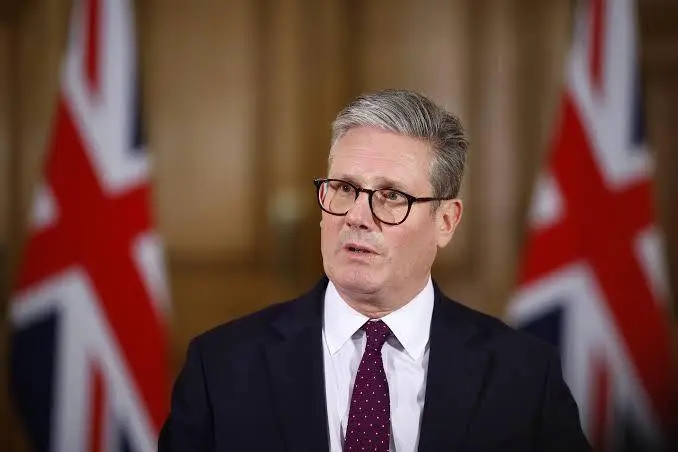
UK’ Prime Minister Sir Keir Starmer resigns as prime minister and leader of the Labour Party, in a statement outside 10 Downing Street.
Keir Starmer has announced he will stand down as prime minister after days of intense pressure from Labour MPs, including cabinet ministers, following the return of Andy Burnham to Westminster.
Less than two years after a historic election victory, Starmer had faced calls from his MPs to set out a timeline for his departure, with many of them spooked by the threat from Nigel Farage’s party ahead of the next general election.
While Starmer insisted on Friday that he would fight any leadership contest, conversations with ministers and time with his wife Victoria at Chequers over the weekend appear to have shifted his thinking decisively.
More than half a dozen cabinet ministers are understoo to have privately told him his time is up, while Starmer and his inner circle began work on drafts of a resignation speech on Saturday.
Starmer’s decision to announce his own departure could kickstart a race among Labour MPs to become the UK’s seventh prime minister in 10 years, which Burnham – who saw off a Reform challenge to win the Makerfield byelection – is in pole position to win.
But it could also result in a coronation if no other candidates – who could include the health secretary Wes Streeting – get the 81 nominations required, or if they strike a deal with the former mayor of Greater Manchester.
Starmer will stay in post in Downing Street until any leadership contest – or handover of power – is complete, leaving his successor to take on the serious challenges of the UK economy and a precarious international backdrop.
Some Labour MPs are concerned that Burnham may be unprepared for the role, and want him to face the scrutiny of a full contest, while others fear it would further damage Labour’s ratings with the public, and they should make as swift transition as possible.
Starmer steps down after months of pressure over his leadership, which was first almost derailed in February when Anas Sarwar, the party’s leader in Scotland, called for him to quit. At that point, the cabinet rallied round.
Despite his poor personal approval ratings, he had seemed on firmer ground in recent months with his handling of the Middle East crisis and refusal to do Donald Trump’s bidding by taking the UK into war with Iran.
However, any respite was blown apart when the Guardian revealed in April that Peter Mandelson, his controversial pick for UK ambassador to Washington, had been appointed despite failing his security vetting.
Mandelson’s appointment was the latest in what many inside Labour regard as a long line of political misjudgments by Starmer, including restricting winter fuel payments and welfare cuts, which caused the party to sink in the polls.
His willingness to reverse those decisions only added to his unpopularity among the parliamentary Labour party, large parts of which increasingly came to view him as weak and ineffectual. Some MPs were also concerned about his poor communication skills.
Multiple MPs were shocked by the scale of Starmer’s unpopularity on the doorstep as they campaigned during the May elections, which many believed became a lightning rod for wider frustrations with the political system itself.
As the results rolled in, with significant losses across the country, the scale of the electoral challenge facing Labour became clear, and the trickle of voices from MPs calling for Starmer to name an exit date turned into a steady stream.
The increasingly precarious nature of Starmer’s premiership was underlined by the resignation of Streeting days later – after seemingly failing to get the numbers to launch a challenge – and then a vacancy in the seat of Makerfield which gave Burnham a route back to parliament.
Since then, he has also lost his defence secretary John Healey over military spending plans, and a view settled among Labour MPs that Starmer’s leadership was so fragile that – despite his insistence that he would fight on – his days in Downing Street were numbered.
Starmer’s exit caps a calamitous fall from grace since becoming only the fourth Labour leader to win an election, taking more seats in 2024 than anyone since Tony Blair’s 1997 landslide.
©️The Guardian