

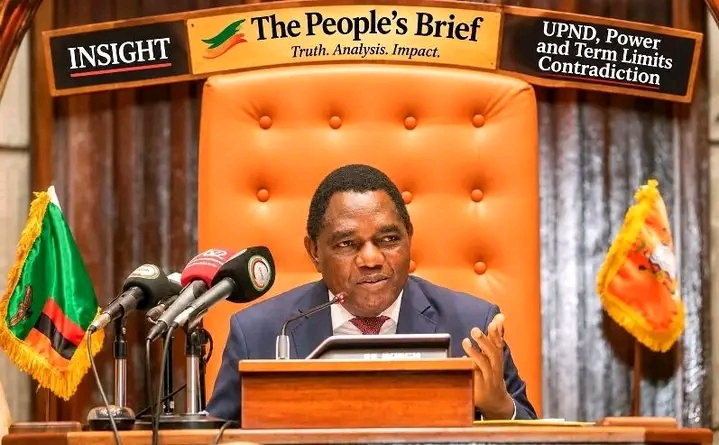
INSIGHT | UPND, Power and Term Limits Contradiction
President Hakainde Hichilema has secured a second term, but an increasingly contentious campaign to remove presidential term limits is exposing uncomfortable contradictions within the ruling UPND. The proposal has reached Parliament, attracted support from influential party figures and provoked resistance among civil society organisations. Information gathered by The People’s Brief also points to growing opposition among people who support Hichilema, including individuals within UPND and Government circles. Their disagreement raises a fundamental question: must supporting a President mean supporting constitutional changes that could extend his time in office?
On 6 October 2026, UPND Media Director Mark Simuuwe publicly defended removing presidential term limits, arguing that voters should be free to retain a leader for as many elections as they wish.
“You flush out the best leader because of two terms. You end up with a very useless leader,” he argued.
His distinction between seeking a third term and abolishing term limits is legally relevant. Politically, however, it leaves important questions unanswered. Simuuwe is not an ordinary commentator. He occupies a senior communication position in the ruling party. When its media director repeatedly promotes a constitutional proposal, should citizens simply accept that he is expressing an isolated personal opinion? Is UPND testing public reaction before committing itself openly?
The debate gained further attention on 3 November when Mwanto Kabaso, a UPND proportional-representation MP and former University of Zambia Students’ Union president, raised presidential term limits during his maiden parliamentary speech.
“Do we need elections for the sake of being called a democratic nation or do we need elections for the sake of bringing development to the homes of poor Zambians?” he asked.
His intervention attracted criticism online, particularly over his reasoning about the necessity and cost of elections. But removing presidential term limits would not abolish elections. It would permit the same individual to contest them repeatedly.
For a young parliamentarian entering the National Assembly through a system intended to broaden representation, the public is entitled to ask why presidential tenure featured so prominently in his first contribution. Zambia’s young people face unemployment, educational challenges and economic uncertainty. How does removing presidential term limits address those concerns
History makes the present argument particularly difficult for UPND. In 2001, Frederick Chiluba’s third-term ambitions encountered resistance from civil society, churches and members of his own MMD. Following the 2016 general election, the PF began advancing Edgar Lungu’s eligibility to contest again in 2021. Its argument was that Lungu’s first period in office, from January 2015 to September 2016, did not constitute a full presidential term. UPND rejected that interpretation, maintaining that another election victory would effectively give Lungu a third term.
The dispute reached the Constitutional Court, which ruled in Lungu’s favour in December 2018. In May 2021, the court dismissed another eligibility challenge brought by UPND MP Bampi Kapalasa and Joseph Busenga, citing its earlier decision.
But the controversy did not end with UPND’s victory in August 2021. A subsequent constitutional petition, filed by Michelo Chizombe, reopened the eligibility question. On 10 December 2024, the Constitutional Court departed from its earlier interpretation and ruled that Lungu had twice been elected and had twice held presidential office, making him ineligible for future presidential elections
The distinction is striking. Lungu had not sought to abolish presidential term limits. His argument concerned how his first period in office should be counted. Yet UPND consistently opposed his eligibility, while the Government later welcomed the ruling that barred his return
Today, influential figures within the same party are advocating the removal of the two-term restriction altogether. Would they advance that argument if Lungu were still President? If Brian Mundubile had defeated Hichilema in August 2026, would they be campaigning for unlimited presidential re-election? What constitutional principle explains the difference?
The contradiction extends to constitutional reform itself. UPND opposed the PF administration’s Bill 10, which failed in Parliament in 2020. The 2016 constitutional referendum also failed to meet the required threshold, amid political disagreement over the proposed changes. Once in Government, UPND pursued its own reforms through Bill 7, securing parliamentary support, including from opposition legislators.
The 2025 legislation expanded parliamentary representation for women, young people and persons with disabilities. This was an institutional change with a clear representational purpose and a development narrative. But representation and development are not interchangeable. More seats do not automatically produce better laws, stronger accountability or improved living standards. The performance and independence of those occupying them remain decisive.
Bill 7 also removed term limits for mayors and council chairpersons. Presidential tenure was left untouched. The present campaign therefore raises another question: why should the constitutional restriction on the presidency now be reconsidered so soon after a major reform process?
Supporters argue that retaining a successful President could promote development and policy continuity. But Zambia’s development cannot reasonably depend on the indefinite availability of one political leader. Uganda’s experience under President Yoweri Museveni demonstrates that repeated presidential re-election can coexist with elections and continuing development challenges. The existence of elections alone cannot establish whether a political system provides sufficient accountability or competitive opportunity.
The 2026 election should also temper assumptions about permanent political dominance. Hichilema received 2,965,326 votes, or 60.49 percent, while Brian Mundubile obtained 1,856,217 votes, representing 37.87 percent. Mundubile emerged as the principal opposition challenger within a relatively short political period, drawing support from an opposition coalition that included PF networks.
His result does not diminish Hichilema’s electoral mandate. It demonstrates that a substantial section of the electorate supported an alternative. Political competition can reorganise quickly, and constitutional rules written around the interests of today’s governing party will also apply when another party eventually assumes power.
Resistance to the proposal is meanwhile becoming organised. In a statement issued on 4 November, civil society organisations, including Caritas Zambia, Chapter One Foundation, Transparency International Zambia and the Council of Churches in Zambia, confirmed plans to demonstrate on 25 November.
“Presidential term limits remain an important safeguard against the excessive concentration and perpetuation of executive power,” the organisations stated.
Sources within Catholic Church leadership have also informed The People’s Brief of mobilisation against the proposed removal. One source warned: “Zambia isn’t for a political party, UPND won’t have it easy.”
The political significance is that constitutional opposition is emerging beyond the established opposition parties, including among people who do not necessarily reject Hichilema’s presidency.
UPND must therefore confront the substance of the debate rather than rely on distinctions between formal party policy and statements by influential members. Those distinctions matter for establishing responsibility, but they do not make the public advocacy disappear.
Nor should criticism of the proposal be confused with opposition to Hichilema himself. A constitutional provision is intended to outlive the political circumstances in which it operates. Its value cannot be measured solely by whether it benefits a leader whom citizens presently support.
The question for UPND is ultimately one of political consistency. If presidential term limits were important when Lungu governed, what has changed about their constitutional purpose now that Hichilema occupies State House? If removing them is democratic today, would it remain democratic under Mundubile or another future President?
And if the proposal is intended to accelerate development, where is the evidence that indefinite presidential eligibility would achieve what stronger institutions and effective public administration cannot?
Zambia’s political history offers repeated examples of parties changing their constitutional arguments after acquiring power. The challenge is to explain why this proposal serves the country beyond the immediate interests of those advocating it.
The People’s Brief | Ollus R. Ndomu
6 November 2026