

VOTE ANALYSIS | Hichilema Leads, But 121 Remaining Constituencies Hold the Answer
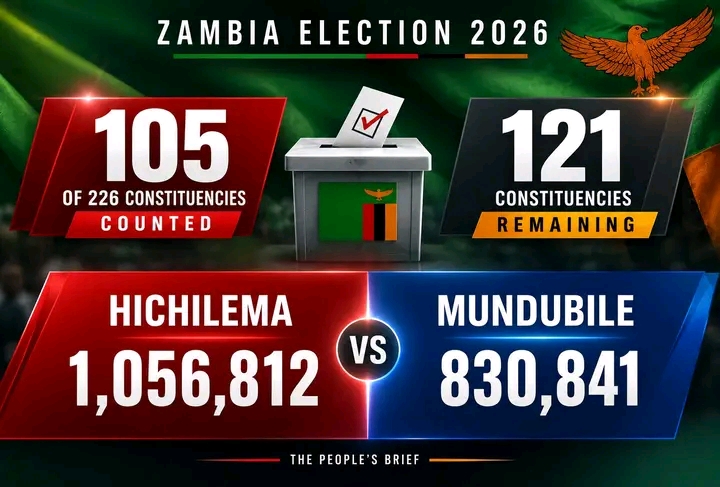
President Hakainde Hichilema has moved into a 225,971-vote lead as Zambia’s presidential count reaches 105 of 226 constituencies. The consolidated figures put Hichilema at 1,056,812 votes against Brian Mundubile’s 830,841. Across all 14 candidates, 1,928,013 valid presidential votes have so far been recorded, with another 63,280 ballots rejected. The declared constituencies contain 3,588,987 registered voters, producing turnout of approximately 55.5 percent when valid and rejected ballots are combined.
Zambia has 8,786,300 registered voters nationally, meaning a large part of the electorate remains outside the current tally.
This distinction matters because 105 constituencies represent 46.5 percent of Zambia’s 226 constituencies, but only about 40.9 percent of registered voters are contained in the constituencies presently declared. Constituencies are not equal in electoral size. The remaining 121 therefore cannot be treated as simply another 53.5 percent of the vote. Some of Zambia’s largest urban constituencies remain outstanding, alongside significant blocks of territory where both Hichilema and Mundubile have been recording very different margins.
Among all valid votes declared so far, Hichilema stands at about 54.8 percent while Mundubile has approximately 43.1 percent. The remaining 12 presidential candidates collectively account for roughly 2.1 percent. This places Hichilema above the constitutional 50 percent threshold inside the current declared sample, but the threshold which ultimately matters will be calculated from all valid votes cast nationally once the count is complete. Zambia requires a presidential candidate to obtain more than 50 percent of valid votes to win outright.
The geography behind Hichilema’s lead remains more important than the headline percentage. Mundubile is winning substantial territory across the old PF belt. Petauke gave him 33,587 votes against Hichilema’s 5,155. Lundazi produced 27,531 against 9,551. Kabushi returned 25,668 against 10,739. Chinsali Central gave Mundubile 15,606 against 3,986, while Kasama North produced 13,336 against 4,058. The opposition challenger has therefore demonstrated beyond reasonable doubt that much of the former PF presidential constituency has transferred to him.
But Hichilema is winning fewer constituencies in some of these regions while extracting meaningful minority votes from them. Luangeni, for example, was relatively close at 13,837 for Mundubile against Hichilema’s 12,386. Sinda actually gave Hichilema 9,994 against Mundubile’s 9,577. Nakonde produced 8,150 for Mundubile and 7,463 for Hichilema. Mafinga North was almost even at 7,489 against 7,180. These results reduce the value of Mundubile’s regional victories because every additional Hichilema vote inside opposition territory enters the same national column as his overwhelming stronghold numbers.
Those stronghold numbers remain extraordinary. Kalomo Central returned 40,544 for Hichilema against 638 for Mundubile. Pemba produced 31,831 against 159, Mbabala 29,850 against 108, Gwembe about 24,800 against 204, Namwala West 23,944 against 315 and Namwala East 20,822 against 143. North-Western is producing similar disparities. Lumwana gave Hichilema 22,224 against 1,006, Kalumbila 18,074 against 912, Zambezi Central 15,482 against 394 and Zambezi East 10,382 against 120. Western has so far followed the same pattern, with Liuwa returning 14,246 against 159 and Kalabo South 9,642 against 67.
That is why Mundubile can win more constituencies and still trail nationally. His Petauke victory produced a net advantage of 28,432 votes. Hichilema’s Kalomo Central victory produced a net advantage of 39,906. Mundubile’s Lundazi margin was 17,980. Hichilema’s Pemba margin was 31,672.
The 121 constituencies still outside the consolidated national count now become the central story. An independent declaration log following ECZ announcements currently places 21 of Eastern Province’s 29 constituencies in the declared column, leaving about eight; Muchinga has 12 of 14 reported, leaving two; Luapula 12 of 20, leaving eight; Northern nine of 19, leaving 10; Southern 14 of 29, leaving 15; North-Western seven of 19, leaving 12; Lusaka eight of 18, leaving 10; Copperbelt seven of 29, leaving 22; Western only three of 26, leaving 23; and Central about 11 of 23, leaving roughly 12. One declaration remains affected by the read-out and constituency-label reconciliation, so these provincial remainder figures presently total one more than the confirmed national outstanding figure of 121. The national number, 121, is the controlling figure.
The imbalance in what remains is striking. Muchinga is almost exhausted, with only about two constituencies left. Eastern, where Mundubile is currently polling around 65 percent across the declared sample, has roughly eight remaining. Luapula, another strong Mundubile province, also has around eight outstanding. Northern has about 10. These provinces remain important, but large parts of Mundubile’s strongest geographical territory have already entered the count. The independent tracker currently shows Mundubile on about 65 percent in Eastern, 66.8 percent in Luapula, 65.2 percent in Muchinga and 62.7 percent in Northern among declared results.
Hichilema’s side of the map is less exhausted. Western has only three of 26 constituencies reflected in the province-level tracker, leaving roughly 23. North-Western has about 12 of 19 outstanding. Southern has approximately 15 of 29 remaining. Those three provinces have so far produced some of the largest Hichilema margins anywhere in Zambia. The tracker currently places his share around 97.6 percent in the small Western sample, 95.8 percent in North-Western and 98.4 percent in Southern. Those percentages will change as more constituencies arrive, but the direction and scale of the margins are already clear.
Then come the two urban giants. Copperbelt still has roughly 22 of its 29 constituencies outside the provincial tally presently tracked, while Lusaka has about 10 of 18 remaining. These are potentially the biggest opportunities for Mundubile to reduce Hichilema’s lead. The declared Copperbelt sample currently favours Mundubile by approximately 61.3 percent to Hichilema’s 37.6 percent. Lusaka, however, is considerably tighter, with the tracker showing Hichilema around 57.3 percent against Mundubile’s 41.8 percent in the eight declared constituencies.
This makes Copperbelt perhaps the most important remaining battleground for Mundubile. Twenty-two constituencies is a substantial reserve, and several large urban centres have the capacity to move the national tally quickly. If Mundubile continues winning the province by wide margins, Hichilema’s 225,971-vote advantage can contract. If the remaining Copperbelt vote becomes closer, particularly once rural and peripheral constituencies enter, the opposition path becomes considerably more difficult.
Western Province presents the opposite problem for Mundubile. With only a small fraction of its 26 constituencies reflected in the current provincial breakdown, a large block remains available to Hichilema. If returns continue resembling Liuwa and Kalabo South, Mundubile would need very strong Copperbelt and Lusaka numbers simply to neutralise those new Hichilema surpluses before addressing Southern and North-Western.
Turnout could decide how powerful these remaining strongholds become. The 105 declared constituencies have produced roughly 55.5 percent turnout based on the available registered-voter and ballot figures. Turnout has not been uniform. If participation remains stronger in Hichilema’s high-margin rural constituencies than in parts of Mundubile’s base, winning a province will not necessarily deliver the volume of votes its registration numbers suggest. The reverse applies if the outstanding Copperbelt and Lusaka constituencies produce heavy turnout for Mundubile.
The 50-percent-plus-one math also needs to be understood correctly. Hichilema has already crossed 50 percent of the valid votes currently declared, but he has not crossed 50 percent of the final national vote because nobody knows the final denominator. Every new constituency changes both the candidate totals and the number required for victory.
The question is therefore not whether Hichilema currently has more than half. He does. The question is whether he can maintain more than half once the remaining 121 constituencies are incorporated.
At this stage, both candidates retain a mathematical path. Mundubile needs a larger share of the outstanding vote than he has received so far, with the strongest opportunity coming from the large number of Copperbelt constituencies still outside the tally, alongside the remainder of Northern, Luapula and Eastern.
Hichilema can surrender some of those areas if he continues losing competitively while maintaining his extraordinary margins across Western, Southern and North-Western and remaining strong enough in Central and Lusaka.
The count is now far enough advanced to see the structure, but not far enough to call the winner. Hichilema has the votes and the lead. Mundubile still has substantial territory outstanding, particularly on the Copperbelt. At the same time, some of Hichilema’s most productive electoral territory, especially Western, Southern and North-Western, still has many constituencies to enter the tally.
This is why the remaining 121 matter more than the first 105.
– The People’s Brief | Ollus R. Ndomu
Excellent analysis.
Very objective analysis. I can already see good triumphing over evil! Keep it up Sir.
Well balanced analysis.
Thank you
Wonderful analysis. Thank you.
Very objective and informative analysis compared to Sishuwa and Mwamba garbage.