

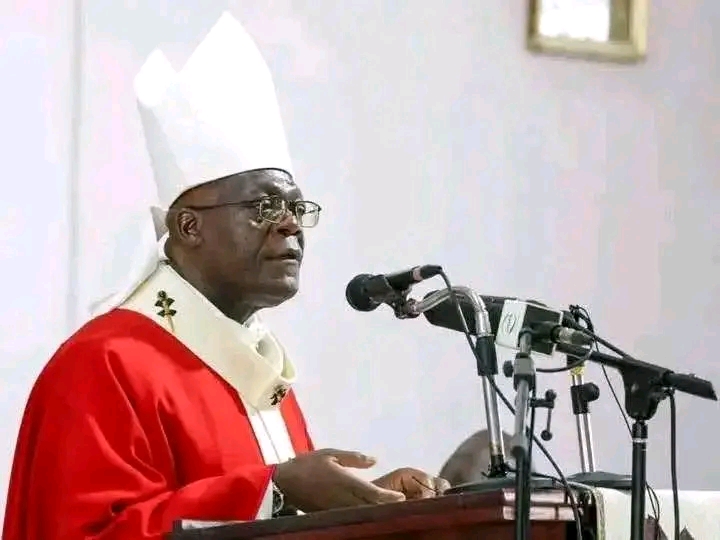
WHO IS ALICK BANDA? UNDERSTANDING THE MAN, THE OFFICE AND THE LAW
By Bwembya Mwaume | Political Commentary & Research
Before anyone demands that Archbishop Alick Banda should vacate his office, one fundamental question must be answered: Who is Alick Banda, and what authority does the law give to those demanding his departure?
This is not merely a question about an individual. It is a question about religious independence, constitutional rights, accountability and the relationship between the Church and the State in a democratic society.
1. WHO IS ARCHBISHOP ALICK BANDA?
His Grace, the Most Reverend Dr Alick Banda, is a Zambian Catholic prelate born on 15 November 1963 in Mufulira, Copperbelt Province.
He was ordained a Catholic priest on 7 August 1994 and consecrated a bishop on 29 July 2007.
His ecclesiastical journey took him through the Diocese of Solwezi and the Diocese of Ndola before Pope Francis appointed him Metropolitan Archbishop of Lusaka on 30 January 2018. He was installed on 14 April 2018.
Archbishop Banda’s episcopal motto is Instaurare Omnia in Christo — “To restore all things in Christ.”
His office is not an ordinary political appointment. It is a position within the institutional and spiritual structure of the Catholic Church.
His appointment and ecclesiastical responsibilities are matters governed by the Church’s own laws and procedures.
2. HOW DOES ALICК BANDA DERIVE HIS AUTHORITY?
Archbishop Banda’s authority as Archbishop of Lusaka comes through his appointment within the Catholic Church.
Canon 377 §1 of the Catholic Church’s Code of Canon Law provides that the Supreme Pontiff freely appoints bishops or confirms those legitimately elected.
Canon 375 describes bishops as successors to the Apostles, entrusted with teaching doctrine, celebrating sacred worship and governing the Church.
These provisions establish an important principle: the appointment and governance of Catholic bishops belong to the Church’s ecclesiastical authority, not to political parties, civil society organisations or individual politicians.
An organisation outside the Church may criticise an archbishop, question his public statements or express concerns about his conduct. Such criticism, however, does not itself confer the power to terminate his ecclesiastical appointment.
3. CAN A NON-CATHOLIC ORGANISATION REMOVE ARCHBISHOP BANDA?
The distinction between demanding someone’s resignation and possessing the legal authority to remove that person is crucial.
An organisation may publicly call upon Archbishop Banda to resign, take leave or temporarily withdraw from pastoral responsibilities. Members of the public are entitled to express their opinions within the law.
However, making a demand is not the same as having the authority to enforce it.
The Catholic Church has its own canonical procedures governing the appointment, resignation, transfer and removal of bishops.
Canon 416 identifies circumstances in which an episcopal see becomes vacant, including the bishop’s death, resignation accepted by the Pope, transfer and deprivation of office made known to the bishop.
Consequently, an external organisation cannot simply declare an archbishop removed from his spiritual office and expect that declaration to have canonical effect.
The appropriate ecclesiastical authorities must deal with questions concerning his continued service in accordance with Church law.
4. DOES THIS MEAN THAT AN ARCHBISHOP IS ABOVE THE LAW?
Absolutely not.
This is where a balanced and constitutionally informed discussion becomes necessary.
Archbishop Banda, like every other Zambian citizen, remains subject to the country’s applicable laws.
His religious office does not automatically exempt him from criminal investigations, court proceedings or lawful orders issued by competent authorities.
Equally, the existence of an investigation or criminal charge does not, by itself, amount to proof of guilt.
Where allegations have been made, the principles of due process, the presumption of innocence and the right to a fair hearing must be respected.
The State has authority over civil and criminal matters within its lawful jurisdiction. The Church, meanwhile, has its own authority over ecclesiastical office.
These responsibilities may intersect, but they are not identical.
Religious independence is not immunity from the law. Equally, the application of civil law does not automatically transfer control of a bishop’s ecclesiastical office to politicians or outside organisations.
5. WHAT DOES THIS MEAN FOR ZAMBIA’S DEMOCRACY?
Zambia is a constitutional republic in which freedom of religion and freedom of expression are important principles.
A democratic society must allow citizens to question religious leaders, just as it allows them to question politicians and public institutions.
Religious leaders must also be prepared to face legitimate scrutiny when their conduct touches on matters of public interest.
But democratic accountability requires more than public pressure. It requires respect for institutional boundaries, the law and established procedures.
If people believe Archbishop Banda has acted improperly, they should identify the alleged misconduct and pursue the appropriate legal or ecclesiastical channels.
If they believe he should step aside while a case proceeds, they are entitled to argue for that position.
However, they should distinguish between a political demand, a moral argument, a legal obligation and a decision made by the competent Church authority.
Those are four different things.
6. THE FUNDAMENTAL QUESTION
The debate surrounding Archbishop Alick Banda should not be reduced to whether somebody supports or opposes him.
The more important questions are these:
What exactly is he accused of doing?
What evidence supports the allegations?
What do the applicable laws require?
What authority does the Church retain over his pastoral responsibilities?
What process must be followed before any decision concerning his ecclesiastical office is made?
These questions deserve answers grounded in facts, not emotion, political expediency or public pressure.
CONCLUSION: RESPECT THE LAW, RESPECT THE CHURCH, RESPECT THE CONSTITUTION
Archbishop Alick Banda is a religious leader whose appointment as Metropolitan Archbishop of Lusaka was made by Pope Francis in accordance with the Catholic Church’s established procedures.
His office is not a political seat that any external organisation can simply withdraw.
At the same time, his position does not place him above Zambia’s laws or exempt him from lawful accountability.
The correct approach is therefore straightforward: let the law take its course, respect the Church’s canonical procedures, protect the right to legitimate public criticism and uphold the presumption of innocence.
Nobody should be above the law. But nobody should be presumed guilty merely because allegations have been made, and no organisation should claim powers it does not legally possess.
That is the standard expected in a constitutional democracy.
Bwembya Mwaume | Political Commentary & Research