


WHO IS THE LEADER OF THE OPPOSITION IN PARLIAMENT, AND WHO CHOOSES HIM or HER?
Picture this:
Ba Mudala is seated around a village campfire, sipping Maheu, when someone asks a question that nearly sends the poor man’s drink through his nose.
“Mudala, who exactly chooses the Leader of the Opposition in Parliament? Is it the Speaker, the President, or opposition MPs gathering like people who have heard that free mealie meal is being distributed at the council?”
Ba Mudala adjusts his sitting position, clears his throat and declares, “My friend, before you embarrass yourself on Facebook, let us consult the Constitution!”
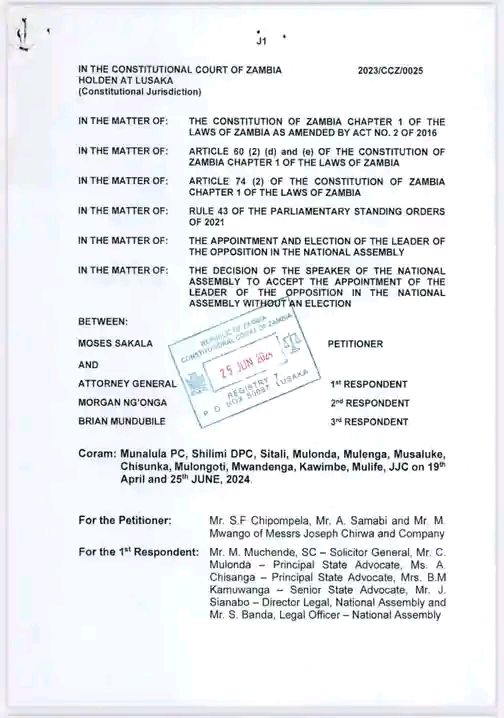
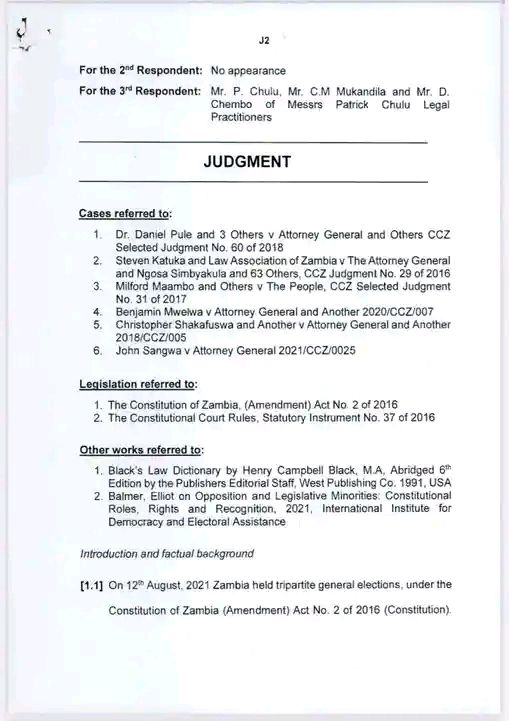
In Moses Sakala v Attorney General and Others, 2023/CCZ/0025, the Constitutional Court explained the rules of this political game.
First, WHO IS THE LEADER OF THE OPPOSITION?
Under Article 74(2), the opposition political party with the largest number of seats in the National Assembly elects the Leader of the Opposition. The candidate must be a Member of Parliament belonging to an opposition political party. An independent MP need not apply. The Constitution has already shown him the exit, no need to argue at the gate!
Second, HOW IS THIS LEADER ELECTED?
Now, pay attention, ba mudala!
The Constitution does not prescribe one particular method of election. The party may use a caucus meeting, party polls or another process recognised within its structures.
In simple terms, the Constitution tells us WHO chooses the leader, but leaves the party to decide HOW it makes that choice. The Court also clarified that participation need not be restricted to opposition MPs alone. The party’s wider membership and structures may be involved.
Third, WHAT DOES THE SPEAKER DO?
Ba Mudala nearly chokes on his Maheu.
“So, you mean the Speaker must not abandon Parliament, grab a notebook and start asking who voted for whom?”
Precisely!
Under Rule 43 of the National Assembly Standing Orders, 2021, the Speaker receives written communication notifying her of the person elected. She is not required to demand meeting minutes, count votes or investigate the party’s internal selection process.
That is why, in this case, the Constitutional Court dismissed Moses Sakala’s petition challenging the selection of the then leader of the house. The petitioner had not proved his allegation that other party members were excluded.
What Does This Mean for The Ordinary Citizen?
It means political parties are not above the Constitution. Citizens can challenge alleged constitutional violations, but allegations alone are not evidence. You cannot walk into court carrying rumours from the market and expect the judges to turn them into facts!
The Moral of The Story?
When the Constitution gives a party the power to choose its leader, do not blame the Speaker for failing to conduct an election she was never assigned to conduct. But remember, freedom to choose the procedure is not freedom to disregard the Constitution.
Ba Mudala takes his final sip of Maheu and delivers the verdict of the campfire:
“My friends, the Constitution is like the rules of a village football match. It tells you who is allowed to play, who chooses the captain, and who keeps score. But it does not require the village headman to referee every training session!
The lesson is simple: know who has the power, understand the limits of that power, and do not accuse someone of breaking rules they were never responsible for enforcing. In the eyes of the law, suspicion may start a conversation, but evidence must finish it.”
Disclaimer:
My commentary on this decision is no more a legal critique than a campfire tale is a treatise on thermodynamics. It is, rather, a dramatized retelling, a lively reenactment if you will, of the judicial clash, unburdened by the solemn drudgery of analysis and delivered with the unapologetic zest of a storyteller who knows a good duel when he sees one.
-Deeslie Mondoka
You haven’t given your opinion but you have only given us a good story. Thanks.