

By Deeleslie Mondoka
WHY PRESIDENT HICHILEMA’S DECISION NOT TO SIGN THE PUBLIC GATHERING BILL MATTERS TO EVERY ZAMBIAN
Picture this:
A group of marketeers at Soweto Market decide they have had enough of the rising cost of doing business. Bus drivers want to complain about road levies. University students want to hold a peaceful march. A political party wants to launch its candidate in Mazabuka. Church youth want to organise a prayer procession through town.
In a democracy, one would think the answer is simple: inform the authorities, maintain peace, and proceed with the gathering.
But then comes the familiar Zambian question:
“Ba police batila shani?” (What have the police said?)
And there lies the heart of the Public Gathering Bill No. 71 of 2026.
The Bill was introduced to replace the old Public Order Act, a law many Zambians came to associate with cancelled rallies, blocked processions, and the curious phenomenon where some gatherings appeared to proceed effortlessly while others mysteriously developed “security concerns.”
Supporters of the Bill insist it is a step forward. They point out that it recognizes freedom of assembly, requires police officers to be impartial, demands written reasons when restrictions are imposed, and allows citizens to challenge those decisions.
Critics, however, have responded with the skepticism of a Lusaka commuter inspecting a “shortcut” suggested by a minibus conductor. They argue that although the Bill abandoned the language of “permission,” it introduced the language of “approval.” To them, that sounds suspiciously like the. label on the same bottle.
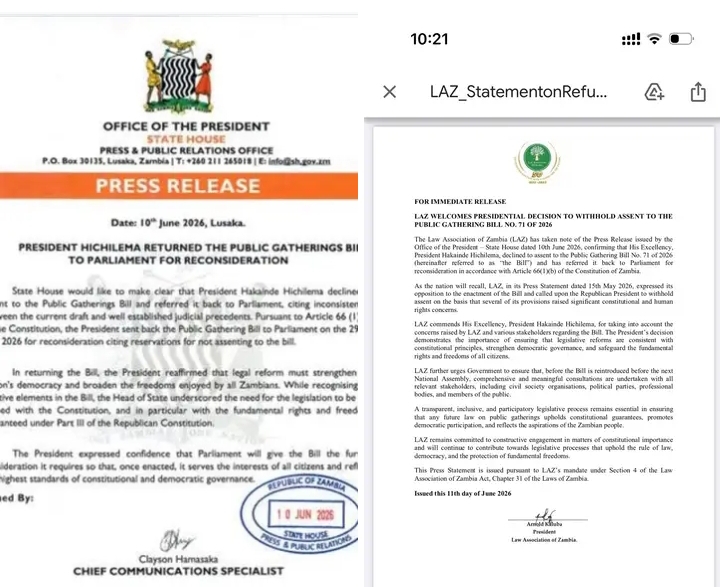
Then came the surprise. On 10 June 2026, President Hakainde Hichilema refused to sign the Bill into law and sent it back to Parliament, saying that some parts of it did not comply with the Constitution and went against decisions already made by the courts.
Naturally, politics entered the chat.
Supporters praised the President for putting the Constitution first. Critics asked, quite reasonably, “But wasn’t this the same Bill approved by a Cabinet that he chaired? If the fish had bones, surely someone should have noticed before serving the meal?”
Meanwhile, the Law Association of Zambia through its president Arnold Kaluba welcomed the President’s decision, arguing that any law affecting fundamental freedoms must undergo rigorous constitutional scrutiny and broader public consultation.
WHAT DOES ALL THIS MEAN FOR THE ORDINARY ZAMBIAN?
Quite a lot, actually.
This issue is not just for lawyers in expensive wigs speaking Latin to one another, or politicians holding press conferences where everyone says they are “consulting stakeholders.” It concerns the tomato seller at Soweto Market who wishes to petition the council about trading spaces. It concerns the church planning an overnight prayer meeting. It concerns the miners demanding better conditions, the students protesting meal allowances, and the political party launching a candidate somewhere between Choma and Chipata.
Because the true test of democracy is not whether people can gather when those in authority are clapping enthusiastically in the front row. The real test is whether people can gather peacefully when those in authority suddenly develop an allergy to crowds.
That is why this decision matters.
For if constitutional rights depend entirely upon official approval, they cease to be rights and begin to resemble favors. And favors, unlike rights, can be withdrawn the moment they become inconvenient.
Rights are not supposed to operate like invitations to a wedding at State House, where attendance depends on whether your name appears on the guest list. Nor should they function like VIP passes to the Mosi Day of Thunder concert, reserved only for those fortunate enough to obtain official clearance.
The very purpose of constitutional rights is that they belong to citizens by virtue of their citizenship, not by grace and favour of those who tempor arily occupy positions of authority. Governments may regulate the exercise of those rights to maintain public order, but they must not transform themselves into gatekeepers deciding who may enjoy them and who may not.
5WHY PRESIDENT HICHILEMA’S DECISION NOT TO SIGN THE PUBLIC GATHERING BILL MATTERS TO EVERY ZAMBIAN
Of course, public gatherings must be regulated. Nobody is suggesting that five thousand people should decide to hold a rally in the middle of Cairo Road during rush hour while insisting that the Constitution protects their right to create the mother of all traffic jams.
But regulation should be like a referee at a football match; ensuring that the game is played fairly. It should not become the striker, goalkeeper, linesman, and owner of the stadium all at once.
For generations, Zambia’s democracy has been built through debate, participation, and the occasional passionate argument over a plate of nshima. The question before Parliament is therefore not whether citizens should assemble. It is whether the rules preserve liberty or quietly place it on a leash.
And that, fellow citizens, is a conversation worth having… preferably before someone suggests that even discussing the right to gather requires prior approval from the nearest police station