

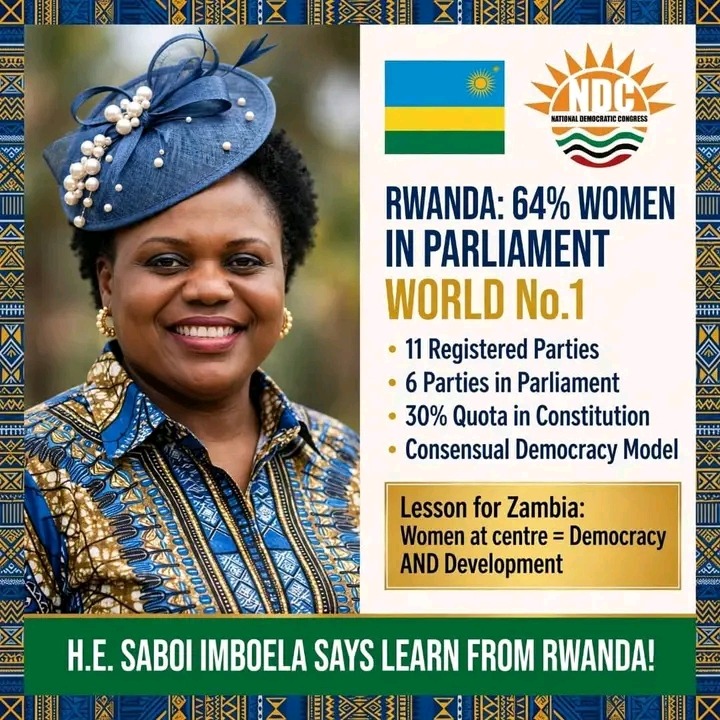
WHY RWANDA HAS THE BEST GOVERNANCE MODEL IN AFRICA FOR WOMEN LEADERSHIP
24/09/2026
Rwanda is today the only country in the world with a female-majority parliament that exceeds 60%, and it is not by accident. It is by design.
According to the latest Inter-Parliamentary Union (IPU) data released in March 2026, women now occupy *63.8% of seats in Rwanda’s Chamber of Deputies*, keeping Rwanda firmly number one in the world. Globally, women hold just 27.5% of seats. Rwanda also has about 53-54% women in the Senate and 52% of Cabinet positions.
How did they do it? We must learn as Zambia.
1. A Constitution Born From Tragedy
After the 1994 Genocide against the Tutsi, 70% of survivors were women. Women had to rebuild the nation. Rwanda’s 2003 Constitution made a deliberate choice: *a mandatory 30% quota for women in all decision-making positions*. That quota was a floor, not a ceiling. Rwanda quickly surpassed it. Today the 30% rule still guarantees 24 seats reserved for women, plus 2 for youth and 1 for persons with disabilities out of 80 seats
2. Consensual Democracy, Not Adversarial Democracy
Instead of copying Western adversarial politics that had led to conflict, Rwanda invented *Consensual Democracy* after national dialogues in the late 1990s.
Its principles are:
– *Power-sharing:* No single party may hold more than 50% of Cabinet positions. The President and Speaker of Parliament must come from different parties.
– *National Consultative Forum (NFPO):* All legally recognized parties meet regularly to adopt shared agendas focused on unity and development.
– *Inclusion:* Mechanisms like Umushyikirano allow citizens to question leaders directly.
– *No divisionism:* Parties cannot organize along ethnic, regional or religious lines.
– *Gender equality:* The 30% minimum that produced the world record.
3. How Many Parties?
Rwanda has *11 legally recognised political parties* operating under the NFPO.
In the July 2024 parliamentary elections, *7 parties/lists contested* the 53 directly elected seats. After results, *6 party blocs entered Parliament*:
– RPF-Inkotanyi coalition (RPF plus its 5 allies: PDC, PPC, PSR, PSP, UDPR)
– Liberal Party (PL)
– Social Democratic Party (PSD)
– Democratic Green Party (DGPR)
– Ideal Democratic Party (PDI)
– Social Party Imberakuri (PS-Imberakuri)
The other 27 seats are for special interest groups.
This power-sharing model means opposition parties are not enemies to be crushed, but partners in the National Consultative Forum- all 11 parties even issued a joint endorsement of government policy in 2025.
LESSON FOR ZAMBIA
While other African nations debate how to exclude women, Rwanda debated how to include them. While we in Zambia debate term limit extensions, Rwanda debates bullet trains, AI, and how to keep corruption among the lowest in Africa.
Rwanda proves that democracy is not just about voting. It is about *WHO is allowed to sit at the table after voting.*
Zambia needs both democracy AND development- and Rwanda shows that when you put women at the centre of governance, you get both.
Writen by
Her Excellency
Ms. Saboi Imboela
President- National Democratic Congress- NDC Zambia
Crying to be appointed on silver plate