

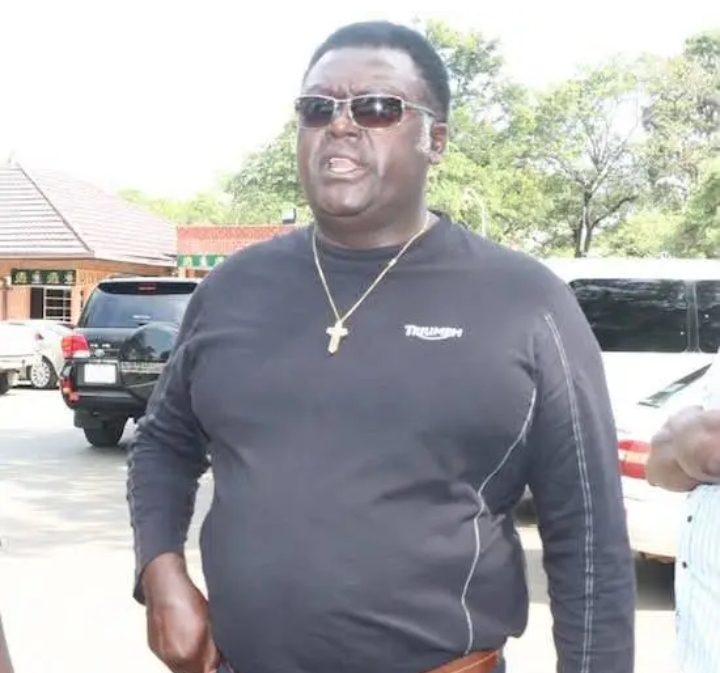
WILLIE NSANDA — BIG WILLIE, BIG POLITICS, BIG DRAMA
If Zambian politics had a Hall of Fame for characters who could turn an ordinary political career into a full-length comedy series, Willie Nsanda would have had a reserved seat in the front row.
Born on 29 May 1952, Nsanda rose from humble beginnings to become a successful businessman, politician, parliamentarian, government minister, political strategist and one of the PF’s most feared mobilisers.
He trained as an agricultural mechanic before venturing into transportation and construction, eventually building a sizeable business empire and a fleet of buses in Kitwe.
It was during this period that Nsanda served as national chairman and president of the United Transport and Taxis Association (UTTA) in Zambia, which represented bus and taxi drivers and operators.
As head of the transport association, he frequently addressed issues involving bus station levies, loading fees and disputes with rival groups such as the Bus Drivers and Motor Taxis Association (BDMTA).
Among bus drivers and ordinary folks on the Copperbelt, he was affectionately known as “Big Willie” a befitting nickname based on his towering figure.
And judging by the size of his political footprint, the nickname was not entirely metaphorical.
Nsanda first entered Parliament through the MMD, winning the Chimwemwe seat in the 2001 general election with 6,265 votes against Heritage Party candidate Ackson Mungabala, who polled 3,413.
President Levy Mwanawasa subsequently appointed him Deputy Minister of Communications. He also served in other deputy ministerial roles under the Mwanawasa administration.
In 2001, Nsanda reportedly made claims concerning Michael Sata’s alleged Tanzanian origins.
The matter became part of a high-profile libel battle.
In October 2002, Sata sued Times Printpak, proprietor of the Times of Zambia, for K80 million over a story alleging that his father came from Tanzania.
Fast-forward a few years.
Nsanda was no longer on the opposite side of Sata.
He had become one of his closest political allies.
Nsanda eventually discovered perhaps the most important rule of Zambian politics:
The party you belong to today may simply be the party you are leaving tomorrow.
In 2006, Nsanda abandoned the MMD and joined Sata’s Patriotic Front.
In Zambia, reconciliation sometimes means discovering that yesterday’s political insult was actually tomorrow’s campaign strategy.
In the 2006 general elections, Nsanda promptly won Chimwemwe again this time on the PF ticket with 8,852 votes, defeating MMD candidate George Lungu, who received 7,397.
Nsanda was not exactly known for treating Parliament like a monastery.
In January 2007, he was accused of referring to unmarried MMD Deputy Ministers Patricia Mulasikwanda and Grace Njapau as “amahule,” meaning prostitutes.
That foul language was very normal at bus stations where Nsanda used to operate from but not in Parliament.
The matter reached the Speaker.
In July 2007, Speaker Amusa Mwanamwambwa formally reprimanded Nsanda and ordered him to apologise to the two ministers, the House and the nation.
Nsanda apologised.
The MPs reportedly responded:
“Hear! Hear! Hear!”
Because apparently Parliament had just witnessed one of those rare occasions when an MP’s mouth needed a parliamentary disciplinary hearing.
Away from Parliament, Nsanda’s private life occasionally found itself standing under the unforgiving spotlight of the Zambian media.
In 2010, he sued Ernest Mwuamba over alleged adultery involving Nsanda’s former wife, Phebby Mumba.
The court dismissed the case after Nsanda failed to provide sufficient physical evidence or witnesses.
In another 2010 incident, he was summoned to Woodlands Police Station following a dispute involving Dorothy Kachusha, a friend of his wife.
There was also a maintenance case involving Ingrid Strutman, who alleged Nsanda was the father of her child.
Nsanda denied paternity.
Big Willie had discovered that political campaigns were easier to organise than domestic ones.
In 2011, Nsanda became Sata’s chief campaign manager, having already performed that role in the 2006 general elections and the 2008 presidential by-election.
Three attempts.
Three campaigns.
And finally, victory.
The man who had once been associated with the Sata controversy eventually helped the same man reach State House.
That is not political irony.
That is Zambian politics doing what Zambian politics does best.
After the PF won the 2011 election, President Sata nominated 10 MPs instead of the constitutionally permitted eight.
Among those caught in the nomination drama were Nsanda and Samuel Mukupa.
The decision was eventually rescinded.
It was an early indication that the new administration had arrived with plenty of political enthusiasm and perhaps a slightly unreliable calculator.
The PF had barely unpacked its boxes at State House before constitutional arithmetic entered the chat.
And that was merely the appetiser.
The years that followed would feature cabinet reshuffles, dismissals, ministry realignments and enough political musical chairs to make people wonder whether government departments had become contestants on a game show.
After the nomination miscalculation, President Sata appointed Nsanda as Road Development Agency (RDA) chairman.
The timing for this appointment was perfect, following President Sata’s launch of the Link Zambia 8000 project, a major infrastructure initiative launched in 2012 to construct and upgrade about 8,200 kilometres of roads across the country.
Critics alleged corruption regarding the infrastructure and road projects during this period, with Nsanda at the helm of the RDA.
The infrastructure programme became associated with massive borrowing, including Eurobonds and Chinese-financed loans, amid claims of heavily inflated contract costs, single-sourced tenders and kickbacks.
With corruption allegations looming over his head, Nsanda somehow found time to cool off by getting involved in an affair with boxer Esther Phiri.
The affair was made public by the duo following Esther’s victory against Zimbabwean boxer Monalisa Sibanda in February 2012.
While celebrating that victory, Nsanda and Esther shared an intimate kiss in the ring.
Nsanda was one man who never appeared particularly shy around the other gender to the extent that some unverified reports over the years suggested that he had allegedly gone after his own son’s girlfriend.
Apparently, Nsanda believed political mobilisation should extend to all constituencies.
But beneath all the drama was a serious political operator.
Nsanda understood the machinery of political mobilisation.
He knew how to organise people, move crowds and build campaign structures.
He became one of Sata’s most trusted political organisers and played a significant role in the PF’s eventual rise to power.
He later managed Edgar Lungu’s campaign in the 2015 presidential election.
Nsanda was instrumental in getting Lungu adopted as the PF candidate in the presidential by-election that followed Sata’s death.
And then, tragically, the political machine lost one of its biggest engines.
Nsanda died on 24 March 2015 at Milpark Hospital in Johannesburg, aged 62, following a battle with prostate cancer.
After Nsanda’s death, his estate became the setting for yet another legal battle.
A girl described in court documents as his daughter sued the administrators of his estate after support for her school fees and upkeep was stopped amid a dispute over whether Nsanda was her biological father.
Her mother maintained that DNA testing had produced a 99.999 percent probability of paternity.
The family dispute eventually found its way into the High Court.
At that point, Nsanda’s legacy had officially acquired everything:
Politics, Parliament, business, romance, accusations, police, DNA and inheritance.
Hollywood would have called it a franchise.
The PF mourned him as a loyal soldier, strategist and powerful mobiliser.
And whatever one’s opinion of Nsanda, one thing is difficult to dispute:
The man never had a boring political career.
He went from mechanic to businessman.
From businessman to MP.
From MMD loyalist to PF heavyweight.
From political opponent of Sata to one of Sata’s most trusted campaigners.
From parliamentary reprimands to presidential campaigns.
From being part of political controversies to helping create political victories.
And somehow, through all of it, Nsanda remained Nsanda.
His career also demonstrated an enduring truth about Zambian politics:
Today you can accuse a man of being foreign.
Tomorrow you can campaign for him.
Today you can cross the political floor.
Tomorrow you can be sitting in the front row at the victory party.
In Zambian politics, yesterday’s enemy can become tomorrow’s campaign manager and nobody even bothers to ask for the minutes of the meeting.
Zambian politics rarely produces characters who fit neatly into one paragraph.
Willie Nsanda was certainly not one of them.
Big Willie was big business, big politics, big controversy and, above all, big drama.