

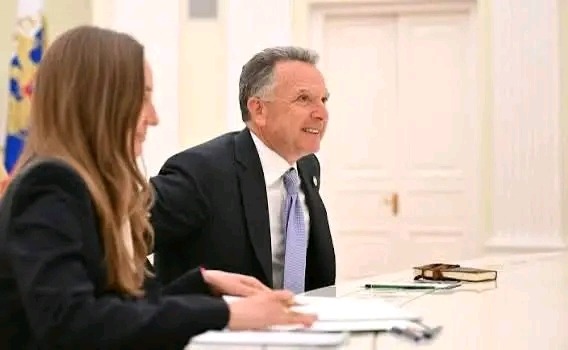
WITKOFF DID NOT KNOW WHO WAS TRANSLATING PUTIN’S WORDS
New attention is being drawn to Steve Witkoff’s April meeting with Vladimir Putin—and the extraordinary failure to verify the interpreter sitting beside him.
Footage shows Witkoff pointing toward the woman and asking:
“Interpreter? From the embassy? OK.”
Reports identify her as Yulia and claim she has previously been seen alongside Sergei Naryshkin, the director of Russia’s Foreign Intelligence Service. Images circulating online appear to support that connection, although her identity and precise role have not been independently confirmed.
What is confirmed is troubling enough: Witkoff appeared not to know who the interpreter was or whom she represented.
That is unthinkable during negotiations carrying enormous consequences for Ukraine, Europe and the United States. An interpreter does not merely repeat words. The interpreter carries each leader’s meaning to the other side and therefore has the power—deliberately or unintentionally—to influence how proposals, threats and concessions are understood.
Every phrase, qualification and change in tone can affect the outcome. That is why governments normally bring trusted interpreters who have been identified, vetted and briefed in advance.
Witkoff should have known exactly who was sitting beside him before a single sensitive word was spoken. If the Kremlin controlled the only translation in the room, it also controlled the channel through which Putin’s message reached the American envoy.