

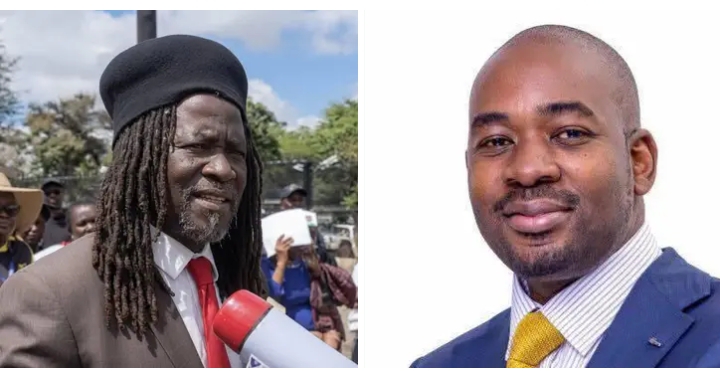
YUP, THE TWO MILLION VOTES WERE NEVER CHAMISA’S TO KEEP
By Gabriel Manyati
The courtyard at Morgan Richard Tsvangirai House in Belvedere is almost empty these days. A single security guard dozes on a plastic chair. Faded orange and black posters peel from the walls like old skin. Somewhere inside, a telephone rings unanswered. This was once the beating heart of Zimbabwe’s democratic challenge. Now it feels more like a museum of unfinished business, a place where the accumulated labour of a generation has been left to gather dust while its temporary stewards quarrel over the inventory.
It is precisely this inheritance that Munyaradzi Gwisai, the former Highfield MP and veteran of the labour trenches, recently refused to allow Nelson Chamisa to claim as personal property. Speaking on the CVN podcast, Gwisai was blunt: “Those two million votes he got in 2018 and 2023 are not so much about Chamisa or CCC. They are a legacy of a movement that arose from the general strikes and stay-aways by students and workers in 1997 and 1998 which led to MDC. He was seen and is seen as a logical successor to that.”
The sentence is an act of historical repossession. The votes were never a private endowment. They were the political capital of a collective that long predates the man who currently holds the microphone.
That collective began in the late 1990s when the Zimbabwe Congress of Trade Unions, under Morgan Tsvangirai, turned workplace anger into national mobilisation. Parallel to the strikes and stay-aways of 1997 and 1998, the National Constitutional Assembly drew in students, churches, lawyers and civic activists. In February 1999 the Working People’s Convention at the Women’s Bureau in Hillside resolved that the only remaining option was a political party.
The Movement for Democratic Change (MDC) was launched at Rufaro Stadium on 11 September 1999. Its early strength was deliberately federated. Labour organisers, constitutional reformers, business figures and ordinary urban workers all claimed ownership. The 2000 constitutional referendum, in which the government’s draft was defeated, and the 57 parliamentary seats won months later, proved the coalition could convert discontent into electoral force.
The price of that force was paid in instalments. Operation Murambatsvina in 2005 drove an estimated 700 000 people from their homes, many of them in opposition urban strongholds. The 2005 split over the Senate election produced two MDCs and years of mutual recrimination. The violence of 2008, when Tsvangirai won the first presidential round only to be forced out of the runoff by systematic assaults on his supporters, remains the movement’s bloodiest chapter.
The Global Political Agreement and the Government of National Unity that followed required compromises still bitterly remembered. Through those years figures such as Tendai Biti, Welshman Ncube, Elton Mangoma, Douglas Mwonzora, Job Sikhala, Lovemore Madhuku, Arthur Mutambara and David Coltart carried portions of the load. Each arrest, each displacement, each internal fracture added another layer to the political capital that would later appear under Chamisa’s name.
Chamisa entered this tradition as a student activist at Harare Polytechnic, rose through the MDC youth structures, became national spokesperson and, in 2016, one of three vice-presidents. When Tsvangirai died in February 2018 the succession was contested by Thokozani Khupe and Elias Mudzuri on constitutional grounds.
Chamisa’s ability to consolidate the youth and urban base was genuine. Yet the 2 150 343 votes he received in 2018 and the 1 967 343 in 2023 were concentrated in precisely the same urban and Matabeleland constituencies that had previously backed Tsvangirai. Continuity of geography is not evidence of personal ownership. It is evidence of an inherited structure that long outlasted any single leader.
There is a certain black humour in what followed. In 2022 Chamisa formed the Citizens Coalition for Change and deliberately refused to create formal structures, party lists or a clear constitution. The strategy was christened “strategic ambiguity.” The idea was to confuse ZANU PF’s legal machinery. Instead it confused almost everyone else. Party officials themselves often could not say who held which office.
When Sengezo Tshabangu later claimed the title of interim secretary-general and began recalling elected MPs and councillors, the absence of institutional paperwork made legal defence nearly impossible. The movement that had once defeated a constitutional draft in 2000 found itself unable to produce a membership register capable of stopping a single man with a letterhead. The irony is almost elegant. A strategy designed to outwit the state succeeded mainly in disarming its own side.
Chamisa’s defenders will insist that his communication skills, energy among younger voters and capacity to project hope across urban Zimbabwe justify treating the votes as personal. Those qualities are real and politically valuable. They helped him inherit and, for a time, expand the democratic vote. Yet recognising talent does not require accepting the fiction that Zimbabwe’s democratic movement begins and ends with him.
The activists arrested and tortured in the early 2000s, the labour organisers who built the ZCTU’s capacity, the journalists who recorded the violence of 2008, the lawyers who challenged electoral irregularities, the church leaders who mediated during the GNU years, and the ordinary supporters who lost employment and housing for displaying an opposition poster all contributed to the capital later counted under his name.
To treat those votes as private assets is to erase their labour and to invite the fragmentation now visible in Belvedere.
The long-term consequence is already visible. A movement that once possessed institutional memory and organisational continuity has been reduced to competing claims of personal legitimacy. Each successive fracture weakens the collective capacity to confront the ruling party. The alternative was always available: to treat leadership as stewardship rather than ownership, to rebuild structures capable of surviving any individual, and to remember that democratic capital is accumulated by thousands and cannot be bequeathed by a single will.
Zimbabwe’s opposition will recover only when it abandons the comforting illusion that any one figure owns the struggle. Leaders come and go. Democratic movements endure only when they are rooted in institutions, collective memory, shared sacrifice and organisational continuity rather than the cult of personality.