

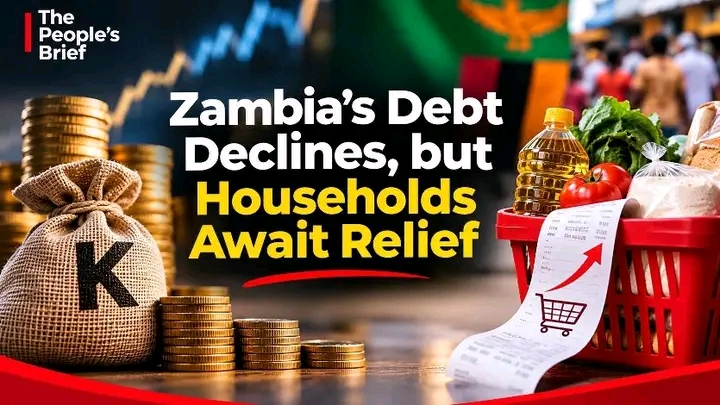
🇿🇲 INSIGHT | Zambia’s Debt Declines, but Households Await Relief
Zambia’s economic recovery presents two contrasting pictures. Finance Minister Situmbeko Musokotwane told Parliament this week that external debt declined from US$16.15 billion in December 2025 to US$15.35 billion in June 2026, a reduction of approximately five per cent. Total central government debt, however, stood at US$30.89 billion, comprising US$15.54 billion in domestic obligations and US$15.35 billion in external debt. The distinction matters: Zambia has reduced part of its debt burden, but substantial obligations remain.
Government attributes the improvement partly to debt restructuring, a Eurobond buyback and reduced external borrowing. These developments deserve recognition because debt sustainability strengthens investor confidence, reduces fiscal vulnerabilities and creates opportunities for development financing. However, economic recovery operates at two levels: the national economy measured through fiscal and monetary indicators, and the household economy experienced through the cost of food, housing, electricity, transport and other basic necessities.
For many Zambians, economic performance is understood less through debt ratios, inflation statistics or international financial assessments than through what their income can purchase. On 10 November, the Jesuit Centre for Theological Reflection (JCTR) reported that the monthly cost of basic necessities for a family of five in Lusaka had increased from K11,399.64 in September to K12,253.72 in October, representing a rise of K854.08, or approximately 7.5 per cent. Essential food costs alone increased from K4,574.79 to K5,339.52, with vegetables and bananas among the major contributors.
Zambia’s annual inflation rate declined from 11.2 per cent in December 2025 to 6.3 per cent in October 2026, an important achievement in restoring price stability. Nevertheless, lower inflation does not necessarily mean cheaper goods. It means prices are generally increasing more slowly. As JCTR director Fr Daniel Mutale observed, “Inflation tells us how fast prices are rising. It does not tell us whether a family could afford them in the first place.”
This distinction also helps explain the political significance of household economic conditions. During the August 2026 presidential election campaign, opposition candidate Brian Mundubile repeatedly challenged the Government’s reliance on macroeconomic achievements, arguing that ordinary citizens were more concerned about the cost of living.
Economically, dismissing macroeconomic indicators altogether would be misleading because inflation, exchange rates, public debt and investment ultimately influence household welfare. Politically, however, his message resonated with sections of the electorate because it spoke directly to their daily financial experiences. That appeal should not be confused with proof that economic recovery has failed.
Indeed, Zambia’s political history demonstrates the electoral importance of household welfare. In 2021, widespread frustration over economic hardship, unemployment and the cost of living contributed to the defeat of the Patriotic Front. Five years later, the same underlying question remains relevant: how quickly can improvements in national economic management translate into tangible benefits for households? Citizens may recognise progress in debt restructuring and fiscal stability while continuing to struggle with rent, electricity, transport and food prices.
The 2027 National Budget illustrates the challenge facing policymakers. Of the proposed K284.8 billion expenditure, K67.6 billion is allocated to debt servicing, approximately 23.7 per cent. Government expects to raise K233.7 billion domestically, representing 82.1 per cent of the budget. Meanwhile, proposed adjustments to Value Added Tax and mobile money levies raise questions about household purchasing power. Government has also proposed increasing monthly Social Cash Transfers from K400 to K450 and expanding school feeding support.
These interventions demonstrate efforts to protect vulnerable citizens, although K450 represents only 3.7 per cent of JCTR’s October basic-needs basket for Lusaka.
The central policy question, therefore, is not whether the Government has achieved anything economically. It has recorded measurable progress in debt management, inflation control and fiscal reforms. The challenge is ensuring that these gains support employment, agricultural productivity, reliable energy, affordable housing and stronger household incomes.
Equally, rising food prices cannot automatically be attributed to Government policy because seasonal shortages, production costs and supply disruptions also influence markets. A credible assessment must recognise both achievements and continuing structural challenges.
Zambia’s economic recovery should ultimately be judged through both national accounts and household realities. Macroeconomic stability is necessary for sustainable development, but its political and social value becomes more visible when citizens experience improved purchasing power and financial security.
For economists, declining debt and inflation may signal progress. For a marketeer, teacher, miner or unemployed graduate, progress may mean affording three meals, paying rent, keeping electricity connected and meeting transport costs without borrowing
The Government’s task is not merely to convince Zambians that the economy is recovering, but to ensure that more households can experience that recovery. An economy can improve on paper long before its people feel the difference in their pockets.
The People’s Brief | Ollus R. Ndomu
13 November 2026