

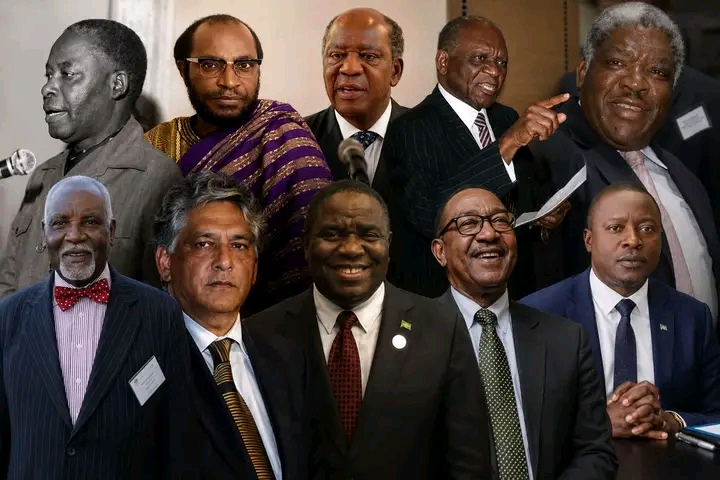
ZAMBIA’S GREAT MINISTERIAL RESIGNATION TRADITION: FROM PRINCIPLE TO POLITICAL SURVIVAL
If there is one thing Zambia’s political history has consistently demonstrated, it is that a ministerial seat is not necessarily a lifetime contract.
From the First Republic to the present, ministers have occasionally discovered that there are things more important than Cabinet and sometimes, apparently, there are things more important than staying in Cabinet.
The tradition of ministers walking away over political disagreements, corruption, constitutional manipulation and outright frustration is almost as old as the Republic itself.
Nalumino Mundia — 1967
One of the early casualties of political disagreement was Nalumino Mundia, who resigned as Minister of Commerce and Industry over policy differences with President Kenneth Kaunda. He subsequently formed the opposition United Party.
Apparently, Cabinet disagreements were already a thing long before the invention of WhatsApp.
Simon Mwansa Kapwepwe — 1971
Kapwepwe resigned as Vice-President and Minister after irreconcilable differences with Kaunda, amid growing political and factional tensions. He later formed the United Progressive Party
It was one of those political divorces where both sides knew the marriage was over, but the country was expected to pretend everything was fine.
Alexander Chikwanda — 1980
Chikwanda resigned as Minister of Agriculture following a fiery Cabinet confrontation in which he openly criticised Kaunda’s leadership style.
A reminder that Cabinet meetings have not always been places where everyone politely says, “Mr President, I completely agree.”
Akashambatwa Mbikusita-Lewanika—1992
Aka resigned his position as Minister of Science and Technology in 1992 over alleged corruption.
Baldwin Nkumbula—1992
Nkumbula resigned from his position as Zambia’s Minister of Sports in August 1992.
He resigned from President Frederick Chiluba’s Movement for Multi-Party Democracy (MMD) government citing rampant corruption.
Following his resignation, he co-founded the opposition National Party and served as its president.
Ludwig Sondashi — 1994
Sondashi walked away from President Frederick Chiluba’s government after disagreements over how the administration was being run and concerns about corruption.
He later made it clear that leaving government did not particularly frighten him.
A rare political commodity: a man apparently willing to discover life after Cabinet.
Levy Mwanawasa — 1994
Mwanawasa resigned as Vice-President in July 1994, citing concerns about corruption, drug trafficking and what he regarded as the degradation of the office of Vice-President.
His relationship with Chiluba had already deteriorated after Mwanawasa, while acting president, attempted to discipline Health Minister Michael Sata only for Chiluba to reverse the decision.
And just like that, the Vice-President discovered that being Acting President and being actually in charge were two very different constitutional experiences.
Mwanawasa would later return to politics and win the presidency in 2001 on an anti-corruption platform.
Vernon Mwaanga—1994
Mwaanga as Foreign Affairs Minister; resigned/was forced out of Cabinet in 1994 amid a drug-trafficking controversy.
In April 2007 Mwaanga resigned as minister of information over a video footage showing him supporting breach-of-contract claims being made by a Congolese governor against the Zambian government.
Rodger Chongwe — 1995
Chongwe, who had served as Zambia’s first Minister for Legal Affairs under Chiluba, resigned after falling out with the administration over justice, human rights, corruption and what he considered growing undemocratic tendencies.
He subsequently formed the Liberal Progressive Front and became one of Chiluba’s most outspoken opponents.
In other words, he left Cabinet and took the argument with him.
Dipak Patel — 1996
Patel resigned from Chiluba’s government over proposed constitutional amendments that sought to bar people of “foreign parentage” from contesting the presidency an amendment widely viewed as an attempt to prevent Kenneth Kaunda from returning to State House.
Patel apparently decided that Cabinet loyalty had limits.
And constitutional engineering was where he drew his line.
Simon Zukas—1996
Zukas resigned from the Zambian cabinet in 1996.
He quit his government position in protest against constitutional changes made by President Frederick Chiluba’s administration.
The new constitution barred former President Kenneth Kaunda and others from running in the 1996 general elections by defining a Zambian citizen as someone born to two Zambian parents. Zukas viewed this as an undemocratic attack on political rights
The 2001 Third-Term Revolt
Then came Chiluba’s attempt to secure a third term, and suddenly Cabinet developed an impressive number of constitutional experts.
Vice-President Christon Tembo and ministers including Edith Nawakwi, Godfrey Miyanda, Vincent Malambo, William Harrington, Ben Mwila, Ackson Sejani, Suresh Desai, Dawson Lupunga and Syamukayumbu Syamujaye opposed the attempt.
Some were fired. Others were stripped of positions. The revolt eventually helped force Chiluba to abandon the third-term bid.
It was perhaps Zambia’s most memorable reminder that ministers can discover their backbone remarkably quickly when the constitutional amendment in question involves extending someone else’s stay in State House.
Michael Sata — 2001
Sata eventually left Chiluba’s administration after his political relationship with the MMD leadership broke down.
He went on to form the Patriotic Front and spent years criticising the very political establishment he had once served.
The rest, as they say, is history.
Or, in Sata’s case, history with a microphone.
Geoffrey Mwamba — 2013
Mwamba resigned as Defence Minister under President Michael Sata after visiting Henry Sosala (Paramount Chief Chitimukulu) whom the government did not recognise.
His explanation was refreshingly simple: family ties mattered more than political loyalty.
A dangerous philosophy in politics because once ministers start choosing family over Cabinet instructions, the resignation letter is usually not far behind.
Obvious Mwaliteta & Keith Mukata — 2016
In March 2016, Lusaka Province Minister Obvious Mwaliteta and Deputy Justice Minister Keith Mukata resigned from President Edgar Lungu’s government while publicly calling for an end to his administration.
That was no ordinary resignation.
That was basically handing in the keys to Cabinet while saying, “By the way, the whole house needs new management.”
Harry Kalaba — 2018
Kalaba resigned as Foreign Affairs Minister under Edgar Lungu and issued a blistering statement accusing the government of rampant corruption and greed. He later headed the Democratic Party before switching to Citizens First.
It was not exactly the traditional:
“I wish His Excellency continued success in his endeavours.”
This was the political equivalent of leaving the group chat and explaining exactly why.
Stanley Kakubo — 2023
Then came Stanley Kakubo.
The Foreign Minister resigned in December 2023 following public controversy surrounding a social-media video showing him and a “Chinese business associate” exchanging gifts.
Kakubo said he was stepping down to avoid distracting the government from its work.
And so, after decades of ministers resigning over corruption, constitutional amendments, political disagreements, family loyalties and democratic principles, Zambia arrived at the social-media era where a Cabinet career can apparently be endangered by something appearing on your phone before breakfast.
From Kaunda to Chiluba, Sata, Lungu and beyond, the reasons have changed, the presidents have changed, the parties have changed, and even the technology has changed.
But the resignation letter remains remarkably consistent.
Sometimes it is about principle.
Sometimes it is about politics.
Sometimes it is about corruption.
Sometimes it is about constitutionalism.
And occasionally, one suspects, it is simply about knowing when the political roof is beginning to leak.
The interesting part of Zambia’s history is not that ministers resign.
It is what they say immediately after they resign.
Because apparently, the truth becomes considerably easier to tell once the ministerial vehicle, office and government-issued phone are no longer part of the conversation.
You can add more names to the list of those we might have left out.