

By George N Mtonga
ZAMMSA RESET MUST BECOME A SYSTEMS RESET — DIGITIZATION IS THE NEXT STEP
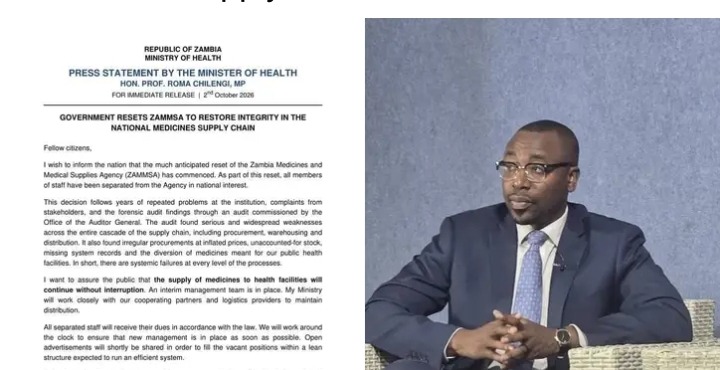
The announcement by the Ministry of Health on 2 October 2026 that the Zambia Medicines and Medical Supplies Agency will undergo a major institutional reset comes after years of documented weaknesses in the country’s medicines supply chain. The immediate question should therefore not simply be who leaves ZAMMSA and who replaces them. The bigger question is: what system replaces the one that repeatedly failed to provide sufficient accountability, visibility and control?
Whether the separation of every individual employee is ultimately justified is a matter that should be handled according to employment law and individual responsibility. But the case for substantial institutional reform at ZAMMSA did not begin this week.
The problems have existed for more than a decade.
A 2012 Auditor-General performance audit identified shortages of essential medicines at health facilities, overstocking and expired medicines. A subsequent parliamentary follow-up found that distribution problems persisted, including difficulties meeting delivery schedules. Another parliamentary review reported expired medicines in 30 of the 40 health facilities inspected and recommended better systems for detecting over-ordering and redistributing excess stock.
ZAMMSA itself emerged from the transformation of Medical Stores Limited. The ZAMMSA Act No. 9 of 2019 expanded the institution’s responsibilities, and the agency formally came into existence in 2021 with responsibility not only for storing and distributing medicines but also for procurement. Government’s own National Health Strategic Plan acknowledged that Zambia had struggled to achieve its targeted availability of essential medicines because of inadequate funding alongside procurement transparency and accountability challenges.
Then came further accountability problems.
The Auditor-General’s report on parastatal bodies found that, as at August 2023, ZAMMSA had not made available audited financial statements for 2018, 2019, 2020, 2021 and 2022. The same audit raised weaknesses involving the management of the Medicines and Medical Supplies Fund and procurement of equipment.
One of the most troubling episodes emerged in 2024.
Parliament was informed that medicines and medical supplies arriving in several consignments had been redirected to a private depot. Ultimately, 61 containers were sitting outside the ZAMMSA central warehouse. Some containers containing IV fluids and syringes had been there since January before the Ministry intervened in July. The then Health Minister described the circumstances as gross mismanagement and negligence and said the matter had been referred for investigation.
The Auditor-General’s 2023 national audit also subsequently identified medicines that had not reached intended stations and discrepancies between quantities dispatched and received.
Against that background, the October 2026 statement should be understood as part of a much longer institutional story. The Health Minister says the latest forensic audit identified irregular procurement at inflated prices, unaccounted-for stock, missing system records and diversion of medicines intended for public facilities. Those are findings reported by the Ministry; the complete forensic report would provide the strongest basis for assessing their scope and attributing responsibility.
The next reform must be digital
Changing management without changing the underlying operating system risks reproducing the same weaknesses with different people.
Zambia is not starting from zero. Electronic Logistics Management Information Systems have been deployed in the health sector for years, and more recent programmes have worked toward integrating eLMIS with ZAMMSA’s warehouse-management systems. But evidence also shows that electronic records and physical inventories have not always matched, demonstrating that simply purchasing software does not create accountability.
What ZAMMSA requires is end-to-end digital traceability.
Every medicine purchased with public money should have a digital journey:
Budget → Tender → Supplier → Purchase Order → Shipment → Customs → ZAMMSA Warehouse → Provincial/District Facility → Clinic/Hospital → Patient-level consumption data.
Each stage should create a timestamped electronic record that cannot quietly disappear.
A shipment should be electronically registered before it arrives. Warehouse receipt should be barcode- or QR-verified. Movement out of the warehouse should require electronic authorization. Vehicles should have dispatch records and, where practical, GPS tracking. Receiving facilities should electronically acknowledge quantities delivered. The system should automatically reconcile what was purchased, what arrived, what entered inventory, what left the warehouse and what was received at the destination.
If 1 million tablets are purchased and only 900,000 enter the warehouse, the system should flag the difference immediately.
If a truck leaves Lusaka for Chipata but its medicines are recorded elsewhere, an exception should automatically appear.
If physical stock differs materially from electronic stock, management and internal audit should receive an alert.
If one supplier’s price is substantially above comparable procurement prices, the procurement system should require additional review before the contract proceeds.
That is what digitization should mean: not removing paperwork simply for convenience, but designing a system in which irregular transactions become increasingly difficult to hide.
Zambia already has evidence that digital logistics can improve visibility. eLMIS was introduced specifically to move away from labor-intensive paper ordering and provide better stock information. UNICEF reported in September 2026 that digital logistics tools are increasingly giving health officials quicker visibility of vaccine stocks, allowing shortages and redistribution needs to be identified faster.
The reform agenda therefore should go beyond restructuring ZAMMSA.
It should create a digitally controlled national medicines supply chain with real-time dashboards available to ZAMMSA, the Ministry of Health, the Auditor-General and other authorised oversight institutions.
And there must be accountability for the data. Digitization without controls simply digitizes bad information. User access should therefore be role-based, transactions should require maker-checker approvals, system changes should leave immutable audit trails, and routine physical counts should automatically be reconciled against electronic inventory.
This is ultimately bigger than ZAMMSA.
When medicine disappears from the supply chain, the consequence is not merely an accounting variance. Somewhere, a clinic has no antibiotics. Somewhere, a diabetic patient cannot obtain insulin. Somewhere, a nurse has to explain to a family why medicine that Government purchased is unavailable.
The institutional reset therefore presents an opportunity to address a problem Zambia has documented repeatedly for more than a decade.
The lasting reform will not be measured by how many people leave ZAMMSA. It will be measured by whether Zambia builds a system in which every medicine, every kwacha and every transaction can be traced from procurement to the patient.
That is the standard a modern public medicines supply chain should meet.
The reset of ZAMSA is welcome it seems to be a complete overhaul to be under taken.I just hope this restructuring shall be done in a transparent and excellent way.
I can’t forget to talk about the interest of the workers for that institution.We have seen restructuring program of government departments and Ministries that took place in 1998 up to 2000 there about.That restructuring was in three phases.It all started with retrenchment of “CDE” Classified Daily Employee, Voluntary Retirement of Civil Servants and finally Retirement of Civil Servants on National Interest.I may say that restructuring program was the waste in the history of our country and that must not happen again. I personally remember one director of a department in one of the Ministries saying “this program is good because us who will remain shall start calling each other by our first names”. And what was observed is those who were retired on National interest were those who were disliked particularly those who belonged to Union Committees.In short there was segregation.
When it came to payments, wrong formula was used and the workers were paid peanuts.All the three categories later found themselves in courts.The High Court ruled in favour of the retirees in all these cases.
From the time of the judgements not all have been paid the difference in full.
It is now more than 26 years the former workers are still waiting for their money and many of them are suffering.Many have died of different causes of death but poverty is one other reason.What really has surprised me is the silence of the people of our country on this matter.The civil society, the church, the parliamentarians and even the general public have seen this to be normal.Governments have changed from MMD the causer to PF and now UPND.
For ZAMSA employees I hope history won’t repeat itself.
I am asking Mr President to critically look on to the plight of these retirees.
A former worker of government must not wait for his or her benefits for over 26 years and and we take it as normal.And with depreciation of our currency over years the value of the money is almost nothing now.Iam asking if all can be paid this year please it’s long overdue.But when one person is asked to report himself to DEC some people think he is troubled a lot and feel so bad that they conduct prayers.Please pray for retirees too.We must be fair with each other.
The most important asset is the people. You can have the best systems and still end up in knots. Any system is only as good as those who run it. The integrity of the system can only hold as long as that of the people running it.
If the people running the system are corrupt, the system will be corrupted, no matter how good it is.