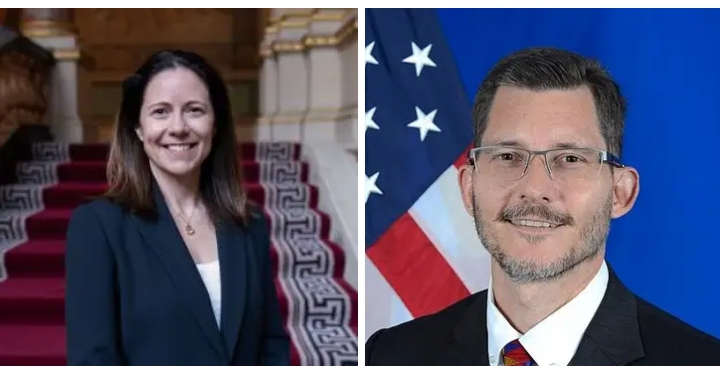
Speak Out, British High Commissioner Urged
Dr Sishuwa writes to the British High Commissioner to Zambia, Rebecca Terzeon:
Dear Rebecca,
I hope you are well. It is clear from what you share on your official account that you are having fun and a good time in Zambia.
With the exit of the @usembassyzambia’s Michael Gonzales, I hope you can step into his shoes of speaking out on issues of corruption and other governance concerns. I read your comment on the constitutional amendment bill last year. While commendable, it was really tame and it is no wonder that our Dear Leader ignored it. If you want our leaders to listen to you, you should be strong and consistent in your messaging.
I sometimes felt that Gonzales was largely a lone voice among your circles when it comes to speaking out on issues of corruption especially in relation to the need for Zambia to be accountable for the money that it receives from the taxpayers of other countries.
The only exception was your Swedish counterpart, a very good person at a human level, who regularly spoke out against corruption in Zambia before he was threatened into loud silence by the Minister of Foreign Affairs.
Such has been his silence that I do not know if he is still in Lusaka. The point is that had more of you joined Gonzales and the Swedish envoy in publicly expressing the importance of fighting corruption, perhaps our Dear Leader and his aides would not have asked the State Department to recall Gonzales two years ago.
Neither would the Ministry of Foreign Affairs threatened the Swedish Ambassador. Fortunately, the US State Department refused to yield to the pressure of the Zambian authorities and Mike is now leaving as originally scheduled, on his terms.
Given the void he is leaving behind, I hope you will consider rising to the occasion. I have closely followed you since arrived in Zambia. It is fair to say that you are, so far, a pale shadow of your predecessors. Fortunately, you still have the time and the opportunity to change the status quo.
Our president listens more to people like you than those who put him in office. As the article on the link below shows, your predecessor @nkwoolley started his career in Zambia as you have done: showing little interest in questions of human rights and democracy.
When I wrote this article, a few of his minders at the High Commission told him to ignore me, hinting I was sponsored by the main opposition party, at the time led by the current president.
Of course, this was not true but it was a tactic used by the regime at the time to discredit my work, one that nearly led to my arrest on a charge of sedition (see the article below) before my academic colleagues forced the government to reconsider
Fortunately, your predecessor had an independent mind. He listened to the advice of his officials and also to what his critics said. He took the substance out of what the critics said and acted on it. Over time, your predecessor steadily grew into his position and went on to play a significant role in the 2021 election. See the article on the link below.
I note from your CV that you share some striking similarities with your predecessor. For instance, as was the case for him, Zambia is your first major duty station. It is therefore tempting to take things easy at first and rely on the use of quiet diplomacy alone. However, that approach should be accompanied by occasional public commentaries. As you know, Zambia is set to hold general elections in August this year. The process leading to this event has been deeply problematic, for reasons explained in the article below and the one mentioned by Mike: the illegal constitutional amendment.
Please do consider, once in a while, lending your voice to the need for a level hearing playing field. Election outcomes are much easier to accept by the parties involved if the contest was fair and the rules of the political game applied to everyone. Please watch closely the behaviour of the actors in key institutions like the electoral body and the courts so that no one is dubiously excluded from the election for purposes of making it easier for the Dear Leader to retain power.
I am sure you have noticed that the Dear Leader is freely campaigning while blocking his opponents from exercising their right to peaceful assembly. This is, from all points of view, most unacceptable. I sometimes ask myself: how does this man find it normal to continue holding public rallies while preventing the opposition from doing the same? I really don’t understand our Dear Leader, Rebecca.
I am sure you have also seen the Public Gatherings Bill that is before Parliament. In fact, the bill is simply one of the many Bills that are set to be rushed through parliament over the course of the next 10 working days before the House stands dissolved on 13 May.
None of the bills are in the national interest. One of them, for instance, seeks to create hefty benefits for a former Chief Justice, similar to the ones that the authorities created for former vice-presidents not long ago. More money in the pockets of the elites, when the correct thing would have been to abolish all existing benefits for constitutional office holders after they leave office.
It really does not make sense to pay these officials, many of whom render dreadful service to the public during their working years, for a lifetime when the civil servant, the heartbeat of the public service, is left to scrounge for a living after retiring, as his or her paltry pension cannot sustain them.
You see how Zambia’s ruling elite takes care of itself, Rebecca, while the very people who put them in power remain rooted in poverty? The leaders of this country disgust me, I tell you.
Anyway, I digressed. I was talking about the Public Gathering Bill. Its proposed text is even worse than the current Public Order Act, created by the British colonial government in 1955. Again, raise your voice on some of these issues.
Trust me, it does not make me happy to appeal to you, an outsider, to say this. But our successive leaders, including the current president, have reduced us to this position because they have little regard for what we, the citizens, say outside elections.
That is why I am reluctantly appealing to you because you, like your predecessors, have more leverage on our leaders than I do. Our leaders are more responsive to public rebuke especially if it comes from people like you.
In any case, many Zambians are now reluctant to express themselves openly on governance concerns for fear of reprisals. They have thus come to largely rely on those of us who are outside the country to give voice to their sentiments, though we too are target for arrest as shown below.
The point is that do speak out, Rebecca. The cancellation of the RightsCon summit must be a wake up call for you and those outside Zambia. That decision should be understood within the broader context of the ongoing deterioration of human rights in Zambia under the Hichilema administration.
This period has been marked by severe restrictions on the rights to peaceful assembly, free speech, and freedom of association, as well as the retention of repressive laws and the introduction of new legislation that undermines human rights.
In addition, there have been frequent arrests of government critics and political opponents on charges such as criminal libel, sedition, unlawful assembly, and violations of broadly defined hate speech laws.
The official justification for cancelling the conference cites concerns regarding the “invited speakers” and “thematic issues.” However, it is plausible that the main motivation was the government’s apprehension that the event would draw international attention to its systematic efforts to undermine human rights. Such scrutiny would have challenged the government’s narrative of an improved human rights environment since Hichilema’s election.
By cancelling the summit, the authorities have inadvertently intensified international focus on the shrinking civic and political space in Zambia. For a country seeking a seat on the UN Human Rights Council, these actions demonstrate its unsuitability for such a role. As under the previous administration, human rights in Zambia remain precarious. The question is: will you, Rebecca, speak out about these continuing violations or will you continue laughing?
Source: https://x.com/ssishuwa/status/2050224639582888220?s=20
They are cultured people to don’t react like you and some primitive people. Don’t you follow the news. Do you see them over reacting in Iran.
Too much Education can render some people irrelevant for use. How can you support such insolence.
And the High Commissioner is supposed to read all this crap, and the crap in the referred to articles? Then she/he has their hands full. Surely can we not fight corruption within ourselves? Do we have to report to London? Mention a specific corrupt deal, I will join you in the fight. So far your cry is there is corruption, no specifics. If you are specific we will take action as we did in 2021. No body, no country owes us a corruption fight.
Forcing foreign entities to fight you political interests, shushu shushu. You’re so irrelevant. Why forcing people to put on other people’s shoes, go and ware them yourself and see if at all you will fit in, damn, you lost it