

🇿🇲 VIEWPOINT | Free Education as Hichilema’s Strongest Re-election Argument
As Zambia moves closer to the August general election, Parliament’s decision to turn free education into law may emerge as one of the defining legislative milestones of Hakainde Hichilema’s first term. Politically, voters may forget speeches, slogans, and campaign promises. But they rarely forget policies that directly changed the lives of their families. Free education has done exactly that.
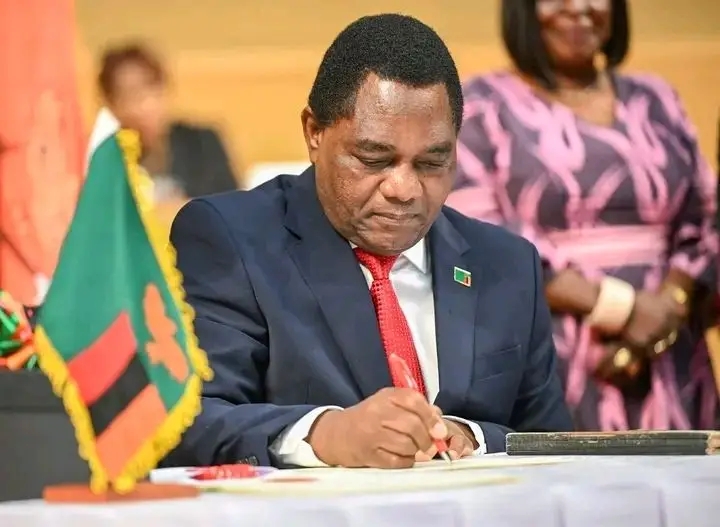
By passing the Education (Amendment) Bill, 2026, lawmakers have now transformed what began as government policy into a legal right. From early childhood to secondary school, children in public institutions will be entitled to free education, effectively shielding the programme from future political reversals unless another law is passed to dismantle it.
This matters more.
Since 2021, the UPND government has faced criticism on load shedding, cost of living, and other pressures. But amid those debates, one programme has remained visible even in the most remote parts of the country: children returning to school. More than 3 million learners are reported to have re-entered classrooms since the introduction of the policy, while over 41,000 teachers have been recruited in what government describes as the largest education hiring drive in Zambia’s history.
These are not abstract statistics.
In many households, free education meant the difference between a child staying home and returning to class. It reduced pressure on struggling families, particularly in rural and low-income urban communities where school fees often forced parents to choose which child could remain in school.
The political significance lies in visibility. Roads, debt restructuring, and macroeconomic indicators matter, but they are not always immediately felt by ordinary citizens. Education is different. A child in uniform is visible. A classroom reopening is visible. A recruited teacher is visible. This is why governments across the world often protect education reforms aggressively once they gain public acceptance.
The legislation also signals an attempt by government to move from policy improvisation to institutional permanence. By embedding free education into law, the state is effectively declaring that access to education should not depend on who occupies State House after 2026. That gives the reform historical weight beyond electoral politics.
Still, the law also raises difficult governance questions.
Expanding access without matching infrastructure creates pressure on classrooms, teachers, desks, sanitation, and learning quality. Zambia’s schools are already experiencing congestion in many areas. Some classes have become overcrowded, and concerns remain over learning outcomes despite rising enrolment. The increase in Grade 12 pass rates from 62.4 percent to above 70 percent will be welcomed, but sustaining quality at scale remains the real test.
The challenge now shifts from access to sustainability.
Free education is politically popular, but it is also financially demanding. Government will need to consistently fund teacher recruitment, school infrastructure, feeding programmes, and learning materials at a time when Zambia is still navigating debt restructuring and fiscal constraints. Once education becomes a right by law, public expectations also become permanent.
But politically, the symbolism is undeniable.
At a time when opposition parties are still struggling to articulate a clear alternative message, the ruling party now heads into the election with a reform it can point to directly. Free education has become more than policy. It has become political identity. For many supporters of the UPND, it represents proof that government fulfilled one of its flagship promises.
The deeper significance may only become fully visible years from now.
Countries are ultimately transformed less by rallies and political slogans than by literacy, skills, and human capital. If implemented effectively, this law could alter the trajectory of millions of children who would otherwise have remained outside the education system. This possibility gives the legislation a weight far beyond the current election cycle.
For President Hichilema, the political calculation is clear.
Infrastructure can be debated. Economic figures can be challenged. But a generation that returned to school under his administration may become the most enduring legacy of his presidency.
© The People’s Brief | Ollus R. Ndomu
At last, pheeewww… I’ve been pushing for this , not one person will overturn this law. Now I can go to sleep