

🇿🇲 ANALYSIS | Sampa Steps Back From Presidential Race But PF’s Identity Crisis is Far From Over
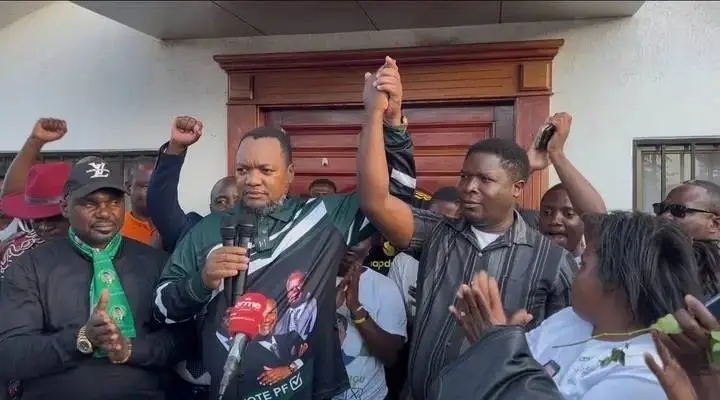
Yesterday’s launch of the PF–Tiyende Alliance marked another attempt by Zambia’s fractured opposition to reorganise itself ahead of the August general election. But beneath the slogans of unity and coalition-building lies a deeper political reality: the former ruling Patriotic Front is still struggling to answer the most important question in opposition politics — who is truly in charge, and where is the party headed?
At the centre of the latest development is Miles Sampa, who yesterday declared, “I’m president of PF until 2028 but I’m not a candidate.” The statement was politically significant because it attempts to separate control of the party from personal presidential ambition, a rare move in a political environment where almost every opposition leader wants to be on the ballot
Sampa’s announcement came during the unveiling of the PF–Tiyende Alliance between his PF faction and Brian Mutale’s Development Freedom Party. Framing the alliance as a step toward opposition consolidation, Sampa argued that “the Zambian people don’t want fragmentation of the opposition they want peace and unity.” He further revealed that he had stepped aside from presidential ambitions “in order to reduce the number of candidates running.”
On the surface, the move appears strategic.
With more than 25 presidential aspirants reportedly preparing for the election, opposition fragmentation has become one of the ruling UPND’s greatest structural advantages. Every additional candidate splits anti-incumbent votes further, especially in urban constituencies and former PF strongholds where loyalty is already divided.
But Sampa’s declaration also exposes the unresolved contradictions inside PF itself.
For months, the former ruling party has existed in a state of political duality, with rival factions battling over legitimacy, court recognition, and control of structures. Even after recent court relief allowed PF activities to resume, the party remains organisationally weakened. What once operated as a dominant national machine is now a fragmented political brand with multiple power centres and uncertain electoral direction.
This is where Sampa’s positioning becomes important.
By remaining PF president while declining to contest the presidency, he is effectively attempting to reposition himself as a coalition broker rather than a direct competitor. It is a tactical shift from candidate to kingmaker. The unanswered question, however, is whether PF members and allied opposition parties are prepared to rally behind a consensus candidate when no obvious unifying figure currently exists.
Historically, PF performed best when it had a singular command structure and a populist centre of gravity. Under Michael Sata, and later Edgar Lungu, the party dominated large sections of what became known as the “green corridor” — the northern circuit comprising Northern, Muchinga, Luapula, and parts of Copperbelt and Eastern Province. Today, that corridor is politically unsettled.
Recent by-elections have already shown signs of shifting loyalties. The UPND has made inroads into areas once considered unreachable, while PF’s internal wars have weakened mobilisation capacity on the ground. Some lawmakers and local structures have quietly aligned with government or adopted survival strategies amid uncertainty over the party’s future.
The timing of the alliance launch is therefore critical.
Parliament is dissolving. Candidate adoptions are intensifying. Smaller opposition alliances are emerging almost weekly. But while coalition announcements create headlines, they have yet to produce a compelling national alternative capable of matching the UPND’s structural dominance in its red bases across Southern, Western, and North-Western provinces, where the ruling party consistently records overwhelming margins.
This is the broader opposition dilemma.
Everyone agrees on the need for unity. Few agree on who should lead it.
Sampa’s decision not to contest could be interpreted as political maturity or strategic retreat depending on perspective. But it also reflects a growing recognition inside opposition circles that another crowded ballot may simply hand the ruling party a clearer path to re-election.
Still, alliances alone do not automatically create momentum.
The opposition’s deeper challenge remains narrative. Beyond calls to “remove UPND,” voters are still waiting for a coherent economic and governance alternative capable of uniting disparate factions into a credible national movement. Without that, coalition politics risks becoming arithmetic without chemistry.
For now, the PF–Tiyende Alliance adds another layer to an already fluid opposition landscape. But whether it becomes the beginning of broader consolidation or merely another temporary arrangement in Zambia’s crowded opposition ecosystem remains uncertain.
What is clear is this: PF is no longer fighting only for power.
It is fighting to redefine itself after power.
© The People’s Brief | Political Desk