By Isaac Simbeye
PRESIDENTIAL CANDIDATES ELIGIBILITY IS CONSTITUTIONAL — Not Administrative
INTRODUCTION
Lately, officials from the Electoral Commission of Zambia (ECZ) have issued a series of announcements regarding what presidential candidates must present for their nomination papers to be accepted. At one point, it was stated that the Commission would only accept presidential candidates whose certificates of adoption were signed by the party’s Secretary General. Shortly thereafter, this position appeared to shift, with indications that only certificates signed by both the party president and the Secretary General would be recognised.
Compounding this confusion, a respected public official at the helm of executive authority publicly asserted that one cannot be a presidential candidate in Zambia unless sponsored by a political party, a development which raise important constitutional questions.
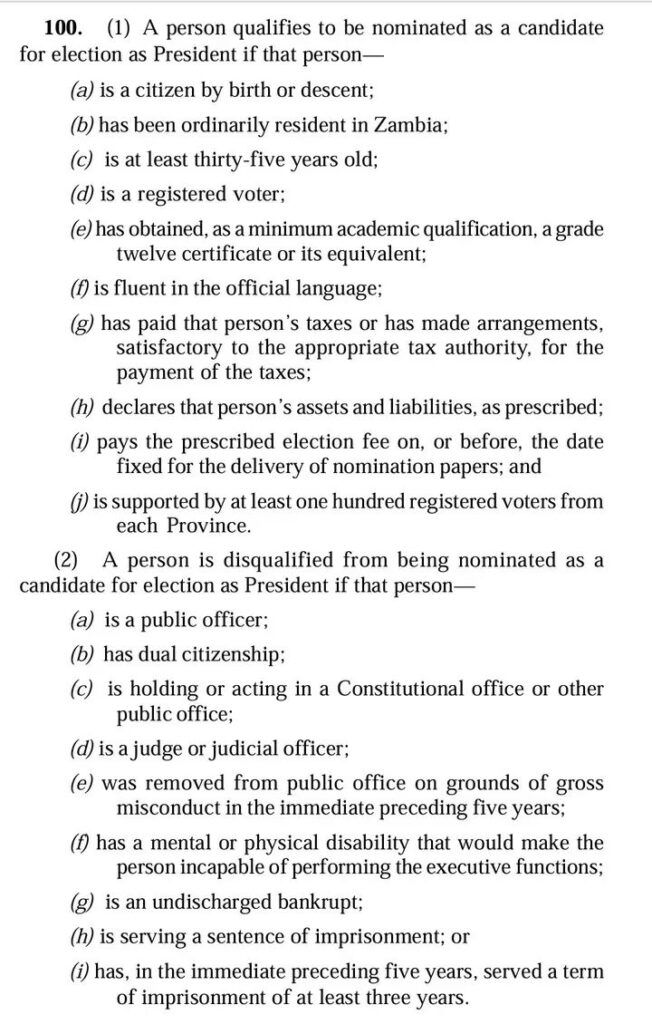
The present write up aims to highlight the position of the constitution on the question of the what qualifications a candidate needs to meet to be eligible for presidential nomination.
DISCUSSION
The qualifications for nomination as a presidential candidate are clearly and exhaustively set out in Article 100 of the Constitution of Zambia (Amendment) Act, 2016. It is submitted that Article 100 is an autonomous constitutional provision, complete in itself and not subject to supplementation by any other constitutional or statutory provision. It prescribes both the qualifications required and the grounds upon which a person may be disqualified from being nominated.
Crucially, the Constitution does not delegate to any institution, including the ECZ, the authority to create, expand, or modify the qualifications for presidential nomination. Any attempt by an institution or public official to introduce additional requirements beyond those expressly stated in Article 100 risks acting ultra vires, contrary to the Constitution, and therefore unlawfully.
It is also clear that the Constitution does not require a presidential candidate to be sponsored by a political party. The constitutional framework expressly accommodates independent candidates. Similarly, the Constitution does not require the presentation of adoption certificates, whether signed by a Secretary General, a party president, or both as a prerequisite for nomination.
Such administrative demands, if enforced, would likely be unconstitutional, as they impose qualifications not contemplated by the supreme law.
CONCLUSION
The Constitution of Zambia remains the ultimate authority on the qualifications for presidential candidates. Article 100 is explicit, exhaustive, and self-contained. Any attempt to introduce additional requirements such as mandatory party sponsorship or specific forms of adoption certificates falls outside the constitutional mandate and risks undermining the integrity of the electoral process.
Relevant authorities are therefore urged to adhere strictly and faithfully to the Constitution, ensuring that the nomination of presidential candidates is conducted in full compliance with the supreme law of the land.