

🇿🇲 WEEKEND DIGEST | Hichilema’s Nomination Day Turned Show of Force
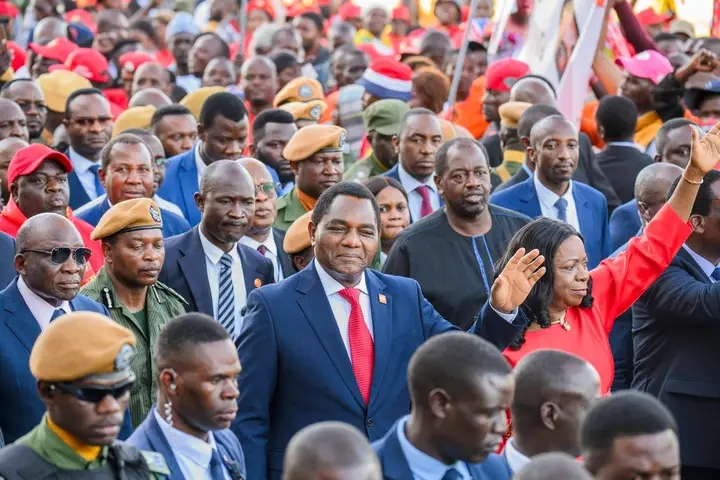
By mid-afternoon Friday, Mulungushi International Conference Centre had already transformed into a sea of red.
Roads leading into the nomination centre were flooded with thousands of supporters clad in UPND regalia, chanting party slogans, waving placards, climbing trees for vantage points, and pressing against security barricades hours before President Hakainde Hichilema arrived to file his nomination papers for the August 13 general election.
The atmosphere was loud. Tense. Electrified.
Supporters began gathering as early as midday despite Lusaka’s cold weather, creating what quickly became one of the largest nomination-day mobilisations seen so far in the 2026 election cycle. By the time the presidential motorcade entered Mulungushi, the grounds had become a full political theatre of whistles, songs, raised fists, sirens, and tightly packed human lines stretching deep into the surrounding roads.
Alongside Vice President Mutale Nalumango, the President formally filed in his nomination before addressing the nation through a message centred on continuity, stability, and democratic order.
“Peace is our greatest inheritance,” Hichilema wrote later. “This election must not divide us. It must strengthen our democracy and unite our people.”
The filing itself was procedural. The optics were political.
Friday’s turnout delivered an unmistakable signal about the ruling party’s organisational depth ahead of the official campaign season. While opposition alliances continue negotiating coalitions and candidate arrangements, the UPND demonstrated something equally critical in electoral politics: mobilisation capacity.
Power in elections is not measured only through statements and alliances. It is measured through structures, logistics, turnout, and territorial control.
That reality is becoming increasingly visible across parts of the Southern belt, where the ruling party is consolidating with minimal resistance. Latest information now indicates that at least seven parliamentary seats have effectively gone unopposed in UPND strongholds after opposition parties failed to sponsor candidates and some independents withdrew from the races altogether.
The implications are significant.
Parliamentary candidates form the operational backbone of presidential campaigns. They mobilise local networks, finance constituency operations, protect polling streams, and sustain visibility on the ground. Where opposition structures fail to emerge, the ruling party gains organisational advantage long before ballots are cast.
Meanwhile, the broader opposition continues facing structural strain.
The expansion of Parliament through the creation of 70 new constituencies has dramatically increased the financial and logistical burden of contesting elections. Political parties must now recruit, sponsor, and sustain more parliamentary candidates, more local government candidates, and larger campaign operations across wider electoral terrain.
For smaller opposition formations already battling resource limitations, the pressure is beginning to show.
And that is the deeper story emerging beneath the rallies and slogans.
The 2026 election is no longer shaping up as a contest of rhetoric alone. It is becoming a test of machinery, endurance, and territorial reach. Friday’s scenes at Mulungushi were not just about a nomination filing. They were an early demonstration of political dominance.
The crowd came before the candidate arrived. The noise remained long after the filing ended. And across parts of the country, the ruling party is beginning to occupy electoral space with little visible resistance.
© The People’s Brief | Ollus R. Ndomu