

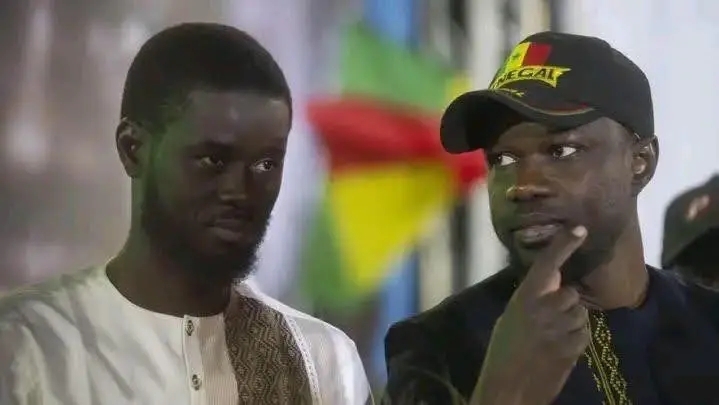
CAN SONKO IMPEACH FAYE? HERE IS HOW IT WORKS IN SENEGAL.
With Ousmane Sonko now sitting as President of the National Assembly and tensions between him and President Bassirou Diomaye Faye far from resolved, the question many Senegalese and other Africans are quietly asking is whether Sonko could ever use his new position to move against the man who fired him. The answer lies in Senegal’s Constitution, and it is more complicated than it looks.
WHAT THE CONSTITUTION SAYS
Under Article 101 of Senegal’s 2001 Constitution, a sitting president can only be held accountable for acts committed in the exercise of his functions, and only in cases of high treason. The bar is deliberately high. To begin impeachment proceedings, the National Assembly must vote by secret ballot, and the motion must secure a three-fifths majority, meaning at least 99 of the current 165 deputies must agree to proceed. If that threshold is crossed, the matter is then referred to the High Court of Justice, the only constitutional body empowered to try a sitting or former head of state.
THE PROBLEM: NOBODY HAS DEFINED HIGH TREASON
Here is where the process runs into a wall. Legal experts have long pointed out that while Article 101 mentions high treason, neither the Constitution nor Senegalese criminal law actually defines what high treason means in concrete terms. Articles 56, 57, and 58 of the Penal Code address ordinary treason, but the constitutional version used for presidential impeachment remains deliberately vague, making it extremely difficult to build a legally airtight case that would survive scrutiny before the High Court.
Senegal already saw this play out in practice. When PASTEF lawmakers attempted to charge former President Macky Sall with high treason over alleged financial mismanagement, including the concealment of an estimated 7 billion dollar debt, the National Assembly declared the motion inadmissible on procedural grounds, blocking it before it could even reach the High Court. The substance of the allegations was never tested because the process itself collapsed on a technicality.
CAN SONKO ACTUALLY DO IT?
On paper, Sonko controls the numbers. PASTEF holds 130 of 165 seats, comfortably above the 99 needed to pass an impeachment motion. As National Assembly Speaker, Sonko also controls the legislative agenda, meaning he can decide when and whether such a motion comes to the floor.
But doing it is a different matter entirely from being able to do it. Impeaching a sitting president on grounds of high treason without a clear legal definition of the offence is a process that could be struck down at multiple stages. Procedural flaws, as Senegal has already learned, can kill a motion before it lives. And even if the motion passed parliament, the High Court would still need to convict based on a charge that Senegalese law has never fully defined.
THE BIGGER PICTURE
What Sonko now holds is not necessarily the power to remove Faye, but the power to make Faye’s presidency extremely difficult. He controls legislation, budget approvals, and parliamentary oversight. In a country already navigating a serious debt crisis and delicate IMF negotiations, that leverage is significant.
Impeachment may be a distant and complex path. But the power to frustrate, block, and publicly challenge a presidency from the speaker’s chair is very real, and Sonko knows how to use a platform.
POWER QUESTION: With Sonko in control of parliament and the constitution offering no clear definition of high treason, is Senegal’s presidency truly protected, or is it more vulnerable than it looks?
Credit: TFY News
TeboPost
Fit to Publish
Faye can dissolve parliament, I think may be
Faye can dissolve parliament, I think may be. Those mp s are also loyal to him, but in politics, anything is possible
Whatever happens, it is the ordinary Senegalese to suffer if the two decide to engage in an unbridled power play.
This is the problem with the so called opposition unity or alliances. At some stage, differences are bound to come in and tear the seemingly united front apart, especially where there are two centres of power.
Closer to home, the Tonse Pamodzi alliance would suffer the same fate if they were (God forbid) to be voted into power. Messrs Mundubile and Zulu can put up a facade of unity as long as they are in opposition but that will evaporate immediately after assuming office. And the major sticking point would be positions in the new government. Zambia would suffer much under such a scenario.