

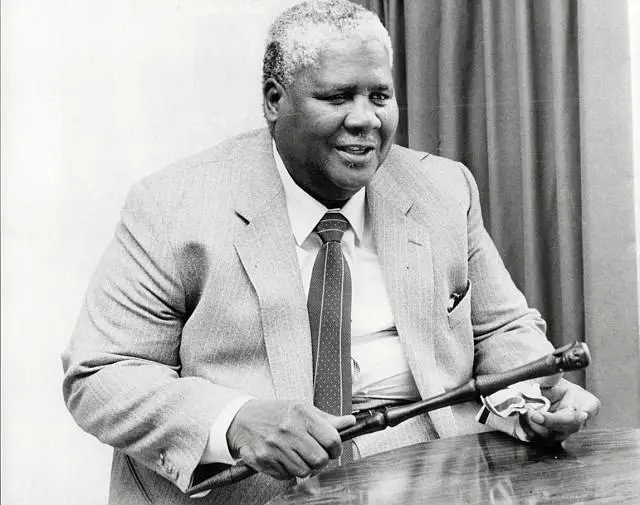
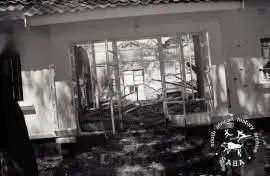
For 3 hours, an attack on Joshua Nkomo’s home raged on…
Extraction of the attackers was done by helicopters outside the Lusaka Golf Club Opposite State House.
….Remaining in Lusaka carried lethal consequences. The apartheid government of South Africa and Ian Smith’s Rhodesian regime viewed Lusaka as an enemy combatant base. They launched devastating cross-border military raids, air strikes, bombings, and covert assassinations inside Zambia. Moving operations closer to frontlines or directly back into their home territories became a necessity to protect leadership and cadres…
The Night Death Came Calling: Joshua Nkomo’s Narrow Escape from Assassination in Lusaka
By Joseph Maonde
In the early hours of April 14–15, 1979, the quiet Lusaka suburb of Lusaka was shattered by gunfire, explosions, and the roar of military vehicles as Rhodesian special forces launched one of the most daring cross-border operations of the liberation war. Codenamed Operation Bastille, the raid was designed to eliminate Joshua Mqabuko Nkomo, leader of the Zimbabwe African People’s Union (ZAPU), whose growing military strength had made him one of the Rhodesian government’s most wanted men.
The decision to target Nkomo came after the September 1978 shooting down of Air Rhodesia Flight 825 and, later, Flight 827 in February 1979, attacks for which the Rhodesian government blamed ZIPRA. As preparations were made for Rhodesia’s internal elections, Prime Minister Ian Smith’s government concluded that removing Nkomo would severely weaken ZIPRA’s command structure and the broader Patriotic Front alliance.
Planning for Operation Bastille was extensive. According to accounts from former Rhodesian Special Forces personnel, Selous Scout operative Chris Gough who had been born in Northern Rhodesia (now Zambia) and held a Zambian passport—was tasked with conducting reconnaissance on Nkomo’s Lusaka residence. Posing as an ordinary resident, Gough reportedly joined the Lusaka Golf Club, situated near Nkomo’s home on Nyerere Drive, enabling him to monitor the nationalist leader’s movements while preparing detailed route maps from the Zambezi River to Lusaka.
To rehearse the assault, Rhodesian forces reportedly constructed a replica of Nkomo’s house near Inkomo Barracks in Rhodesia, where the assault team practiced the operation repeatedly before crossing into Zambia.
The raiding force consisted of members of the Rhodesian Special Air Service (SAS), supported by Selous Scouts, travelling in seven ageing Land Rovers repainted to resemble Zambia Army vehicles. Disguised in Zambian military uniforms, the commandos crossed Lake Kariba aboard the commercial ferry Sea Lion before continuing north along bush tracks toward Lusaka. One vehicle reportedly broke down during the journey, but the remaining convoy reached the capital without attracting serious suspicion, passing through Zambian checkpoints as intelligence officers initially mistook them for genuine Zambian military vehicles.
During the night of April 14–15, the Rhodesian force split into several assault groups. One attacked the Liberation Centre in Kamwala, then headquarters of several Southern African liberation movements. Another moved against Nkomo’s residence near the Lusaka Golf Club, employing automatic weapons, grenades, and explosives in an effort to kill or capture the ZAPU leader.
By dawn, Nkomo’s residence had been reduced to rubble after his security personnel engaged the attackers in a fierce gun battle. Reports quickly spread that the veteran nationalist leader had either been killed or captured. Instead, he had narrowly escaped death, adding yet another remarkable chapter to Zimbabwe’s struggle for independence.
For decades, different accounts have emerged regarding how Nkomo survived.
Immediately after the raid, Nkomo told journalists that he had escaped through a small rear window during the attack. When later questioned again, he famously smiled and remarked that he had “turned into a cat” and slipped away through a tiny window—a humorous response that quickly entered liberation war folklore.
Other participants have offered different versions. Former ZIPRA official Dr Sikhanyiso Duke Ndlovu maintained that ZIPRA intelligence had received advance warning of the impending attack and secretly relocated Nkomo to a safe house at Jasmondene several hours before the assault.
According to this account, Albert Nxele and members of Nkomo’s security detail organised the evacuation, while security officer Joseph Maphosa remained behind to engage the attackers and delay their advance. These accounts, however, remain contested and rely largely on participants’ recollections.
Another longstanding account, widely repeated in Zambia though not conclusively documented, claims that Nkomo escaped into nearby State House through an underground tunnel system reportedly constructed with Yugoslav assistance during President Kenneth Kaunda’s administration. While the existence of secure facilities at State House has often been discussed, historians have not reached consensus on whether such tunnels were used during the raid.
After nearly three hours of fighting, the Rhodesian commandos withdrew. According to Rhodesian accounts, helicopters later extracted elements of the raiding force from the vicinity of Lusaka Golf Club before they returned to Rhodesia. The failure to locate Nkomo reportedly led some members of the operation to suspect that their target had been warned in advance.
The raid exposed Zambia’s vulnerability. Despite improved military preparedness following earlier Rhodesian incursions, Rhodesian special forces had penetrated deep into the Zambian capital, attacked strategic targets located only a short distance from President Kenneth Kaunda’s State House, and successfully withdrawn.
In response, President Kaunda reportedly strengthened security arrangements for liberation movement leaders based in Zambia. Several senior leaders were thereafter accommodated within the secure precincts of State House under enhanced protection, reflecting Zambia’s continuing role as a frontline state in the Southern African liberation struggle.
Joshua Nkomo would survive the assassination attempt and continue playing a central role in Zimbabwe’s liberation struggle. Together with Robert Mugabe, he led the Patriotic Front during negotiations that culminated in the Lancaster House Agreement and internationally recognised independence in April 1980.
Although post-independence relations between ZAPU and ZANU later deteriorated, culminating in the Gukurahundi conflict, the signing of the Unity Accord in 1987 brought the parties together under ZANU-PF. Nkomo subsequently served as one of Zimbabwe’s Vice Presidents and came to be widely regarded as “Father Zimbabwe” for both his contribution to the liberation struggle and his later advocacy of national reconciliation.
Joshua Nkomo died on July 1, 1999, at the age of 82 after battling prostate cancer. He was declared a national hero and buried at the National Heroes Acre in Harare.His Wife was a prominent figure in her own right, famously known as “Mama MaFuyana”. She passed away on June 3, 2003, at the age of 76 and was buried at the National Heroes Acre in Harare.He left four Children Thandiwe Nkomo,Ernest Thutani Nkomo (passed away)Michael Sibangilizwe NkomoLouise Sehlule Nkomo.
Conclusion
The failed assassination in Lusaka remains one of the defining episodes of the Rhodesian Bush War. Operation Bastille demonstrated both the remarkable operational reach of Rhodesian special forces and the resilience of the liberation movements they sought to destroy. The man they crossed international borders to eliminate would instead return to an independent Zimbabwe as one of the principal architects of the nation whose birth they had hoped to prevent.
Author
The author, Joseph Maonde, holds a Bachelor’s Degree in Law, a Master’s Degree in Law, a Master’s Degree in Climate Change and Sustainable Development, and a Diploma in Art and Design. He is a researcher in constitutional law, humanitarian law, investment law, and modern history.
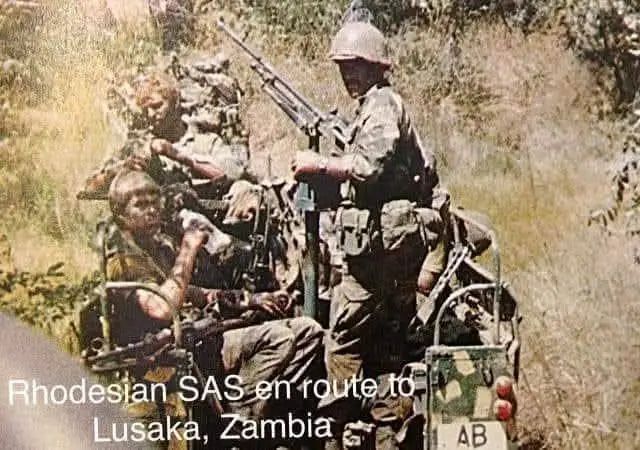
I remember this raid which occurred in the early hours. The night sky was lit by tracer fire and flares. Some Zambians were killed trying to escape the mayhem.
The more plausible explanation is that Mr. Nkomo escaped via the network of security tunnels which were foolishly exposed by the Chiluba regime in an attempt to vilify KK. Interestingly, Mr. Xavier Chungu was the intelligence chief at the time of this disclosure.
Kaunda only supported nkombo because he was related to his wife Betty. Otherwise he was a wrong horse as history shows Mugabe and zanu had more support which formed government after independence while nkombo was more or less sidelined.
ZANU-PF under Robert Gabriel Mugabe won because the Shona group (not the tribe) had and still have numbers advantage. The Ndebeles constitute only about 20% of the Zimbabwean population together with other smaller tribes like the Kalangas of Plumtree, Tongas of Bhinga and small Sotho and Xhosa speaking people of southern matebeleland. So Mugabe had the numerical advantage boosted by some voters from Mozambique at the time. It is also worth remembering that ZIPRA forces had more advanced and formidable fire power than ZANLA forces.