

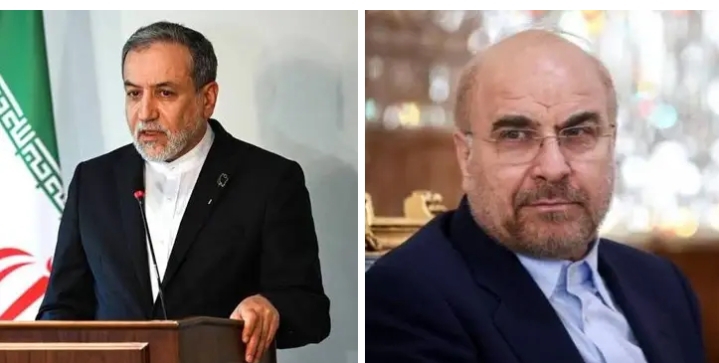
THE NEGOTIATORS WERE MARKED FOR DEATH
The New York Times just confirmed it: while Iran’s own peace negotiators sat across the table from Washington, US officials feared Israel was plotting to assassinate them.
Not during the war. DURING THE TALKS.
The US was so alarmed it secretly asked other Gulf states to warn Tehran that its own delegation might be killed by America’s closest ally. One of Iran’s negotiators, Ghalibaf, had his plane rerouted mid-flight after intelligence showed Israeli jets had entered Iranian airspace to intercept it.
Ask yourself: what kind of state tries to kill the men sent to make peace with it?
Full breakdown — sourced, no speculation — in today’s piece.
The Assassins at the Negotiating Table
How Washington Feared Israel Would Murder the Very Iranian Officials Sent to End the War
By Lim Tean | The Great Game
There is a particular kind of silence that falls over an editorial page when a story confirms something everyone suspected but few dared print. This week, the New York Times broke that silence.
According to the Times, citing current and former American officials, the United States believed Israel might have been plotting to kill Iran’s top negotiators — Foreign Minister Abbas Araghchi and Parliament Speaker Mohammad Bagher Ghalibaf — while Washington was engaged in delicate talks with Tehran this spring to reach an interim peace deal. So alarmed were US officials that they went to other countries in the region and asked them to warn Iran directly that Israel could be targeting its own negotiating team.
Sit with that for a moment. The country brokering the peace was warning the other side that its own ally might murder the men sent to make peace.
What We Know
The war itself began on February 28 with a strike that killed Iran’s Supreme Leader, Ayatollah Ali Khamenei, and a number of senior officials. Killing Iran’s leadership was, by the Times’ account, part of Israeli strategy from the very start. Two other men who might have been useful to Washington at the negotiating table — Ali Larijani, Iran’s top national security official, and Kamal Kharazi, a former foreign minister — were killed in the war’s early days.
But Araghchi and Ghalibaf survived, and by April they had become Iran’s chief interlocutors in the ceasefire talks. That is precisely when American anxiety spiked. The Wall Street Journal had already reported in March that both men were on an Israeli target list, and that Israel removed them from it only as negotiations were being discussed — with the Trump administration, according to the Times, playing an active role in Ghalibaf’s removal by directly asking Israel not to target him.
The threat was not abstract. In April, Ghalibaf flew to Islamabad to meet US Vice President JD Vance. Iran, wary enough to seek outside guarantees, obtained assurances through Pakistani and Qatari intermediaries that Israel would not conduct covert operations against the delegation. Pakistani fighter jets escorted the Iranian aircraft to Islamabad and back. On the return leg, Iranian security forces warned Ghalibaf’s plane that they had intelligence Israel intended to attack it — two Israeli fighter jets had reportedly entered Iranian airspace from the west, near Iraq. The plane made an emergency landing in Mashhad. The delegation drove home overland.
This was, by the Times’ telling, the second time Ghalibaf narrowly escaped death — Iranian officials say he was pulled from rubble both during the June 2025 war and again this year, after Israel struck a bunker meeting of senior officials.
A note on sourcing: the Times’ reporting concerns Araghchi and Ghalibaf specifically. I have seen no comparable, corroborated reporting of a parallel plot against a Pakistani field marshal, and readers should treat that specific claim as unconfirmed unless and until it is independently documented. The story is damning enough on the facts that are established.
The Question This Raises
Washington’s own account, relayed to the Times, is instructive: officials acknowledged that during the height of the war, killing Araghchi and Ghalibaf might have been militarily “legitimate.” It was only once they became negotiators — once they became useful to the American goal of an actual settlement — that Washington started trying to protect them from its own ally.
That is not a minor footnote. It tells you what Israel’s war aims were understood to be, even by the Americans standing next to them. Israeli officials, per the Times, viewed the eventual ceasefire framework as a failure precisely because it fell short of regime change, the destruction of Iran’s proxy network, and serious damage to its missile program — and because it risked unfreezing Iranian assets without, in Israel’s view, meaningfully constraining its nuclear ambitions. In other words: peace itself was the disappointment.
When a state’s own principal ally has to warn the other side, through back channels, that its negotiators may be assassinated — when the destruction of a regime’s leadership has been the stated and executed strategy since the war’s first hour — it becomes very difficult to sustain the polite fiction that Israel’s military posture in this war has been defensive, or that it was ever seriously interested in a negotiated peace rather than a decapitated Iran. A state that keeps finding war necessary, in conflict after conflict, across seven decades, is not a state having a run of bad luck with its neighbours. At a certain point the pattern is the policy.
But this episode e is not really about Iran. It is about what happens to the idea of diplomacy when one of the parties in the room may be trying to kill the other side’s diplomats.
The Middle East does not lack for actors who destabilise it. This latest disclosure adds one more data point to a long ledger on who, again and again, has chosen escalation at the very moment restraint was on offer.