
Election lnternational Observers Are Passive And Toothless in Zambia
By Professor Namukolo Miyanda, Pan-Africanist and Governance Expert
8th August, 2026
In 5 days, Zambia goes to the polls. On 13th August 2026, approximately 8.6 million eligible voters, about 42% of our population, will decide the next 5 years of this country’s social and economic direction.
Let us be candid. The majority have already made up their minds. They remember the last 5 painful years under the UPND regime: the rising cost of living, collapsing small businesses, joblessness among the youth, and a political climate where speaking up has become dangerous.
This is not just another election. It is a barometer. A barometer shows and measures the true state of things. This vote will show and measure whether Zambia is improving or declining economically and democratically. It will indicate the future direction of the country. Will we correct course, or will we continue down a path of economic decline and democratic erosion? The next opportunity to change course will only come in 2031.
Therefore, every eligible Zambian must turn out and vote. Do not hesitate. Do not be discouraged. Do not surrender your ballot to fear. This is a lifetime responsibility. Zambians must be allowed to cast their votes freely, without intimidation, without a police presence designed to disrupt, and without an electoral environment made deliberately unclear and uncomfortable
The vote alone is not enough when the field is tilted, because elections are also judged by those mandated to watch them. Local and international observers have one clear job: to monitor the pre-election environment, polling day, and the tabulation of results. They must sound the alarm early, deter violence, and protect integrity.
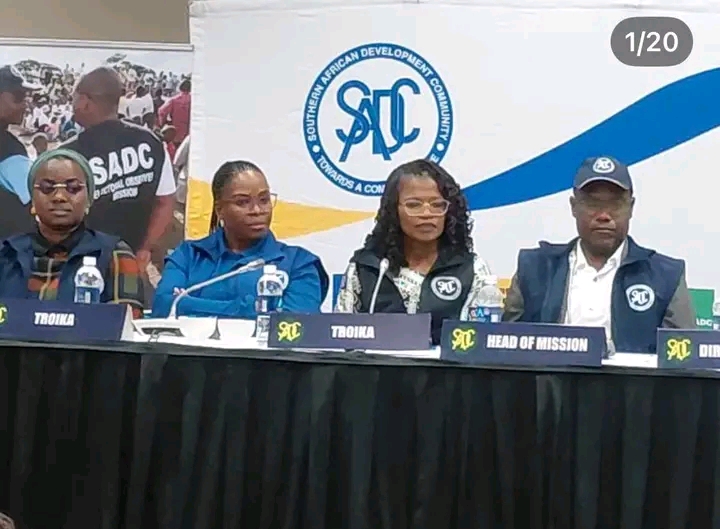
Right now in Zambia, two major missions are deployed: the European Union and the Southern African Development Community. Both are large institutions with experience in Africa. Both have resources, access, and moral authority. Yet so far they have shown an undesirable energy in monitoring elections. They appear toothless and indifferent.
We are seeing it in real time. There is cadre violence linked to the ruling UPND, with video evidence circulating across the digital space. There is a police service that is no longer guaranteeing safety at political rallies, but instead positioning itself to disrupt opposition programs across the country. There are direct threats against musicians and media houses by state agencies working in concert with party cadres.
And the observers are watching. They are watching the police and UPND cadres intimidating opposition political parties, taking notes, and saying nothing. If that is all they came to do, then one must ask: why are they in Zambia at all if they cannot be proactive and firm enough to the extent of their legitimate mandate? Silence in the face of intimidation is not neutrality. It is complicity.
This passivity is not new. We have seen the same pattern across Africa. In Kenya, observers issued late statements after violence had already shaped outcomes. In South Africa, they noted irregularities but failed to confront intimidation in townships early. In Cameroon, Nigeria, and Ivory Coast, observer missions produced technical reports while citizens were being shot at. In Ghana, Mozambique, Tanzania, Zimbabwe, and Uganda, the script has been the same: arrive, observe, describe, and leave, without preventing disputes or fatalities.
The problem is structural. Observers lack enforcement mechanisms. But that is precisely why their role must be to raise alarm early and loudly. If they wait, they delay opposition parties and citizens from making prompt and necessary decisions to protect themselves and the vote. To be an indifferent spectator is to become complicit. Democracy is not protected by press releases after the fact.
We must also be clear on what is at stake. When an electoral process is well managed, overseen closely, and integrity is upheld, it becomes much harder for the final results to be credibly disputed by either party. But when observers allow intimidation to go unchecked, they create the very conditions for post-election conflict and contested outcomes.
Time is short, and the EU and SADC missions in Zambia must stop acting like tourists with clipboards. They must immediately issue a joint statement sternly condemning the recent violence against musicians, political party candidates, and ordinary opposition sympathizers.
They must name it, date it, and reject it. They must publicly call on the Zambia Police Service to return to its constitutional role of protecting all citizens, not disrupting opposition campaigns. And they must appeal to the United Nations and to President Donald Trump to take keen interest in Zambia.
Global attention is one of the few tools we have to induce practical enforcement, safeguard human dignity, and prevent Zambia from sliding into post-election chaos. This is not an invitation for foreign interference. It is a demand for accountability. When domestic institutions are compromised, international witness becomes a form of protection
Zambians will decide their future on 13th August. That decision belongs to no party, no police unit, and no foreign mission. But the world must stop pretending that observing without acting is enough. If the EU and SADC want to protect democracy in Africa, they must speak now, before bodies are counted and before violence is normalized.
To Zambians we say this: turn out. Vote. Protect your neighbour’s right to vote. To observers we say this: do your job. Raise the alarm.
Because when observers choose silence, and when citizens are intimidated, elections stop being about the people. And that is how democracies die.
What do you want the observers to do? Why are they called OBSERVERS? You want them to start giving running commentaries?
Election observers monitor the voting process from start to finish and then compile and publish what they OBSERVED and their conclusion or verdict on the voting process.
It is not the observers’ job to comment on the electoral process as it unfolds.