

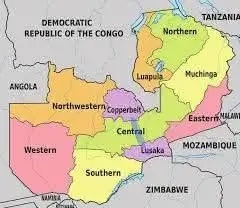
Central Province Is Too Large to Govern Effectively: Why it must be split into two provinces
By George Mtonga
One of the greatest responsibilities of government is not merely to exist, but to deliver services efficiently and fairly to the people. The true measure of governance is not how many ministries, provinces, or districts we have on paper, but whether citizens can access services quickly and whether development reaches every corner of the country.
It is for this reason that I believe the time has come for Zambia to seriously consider splitting Central Province into two provinces.
This is not a political argument. It is an argument about service delivery.
Central Province occupies a unique position in Zambia. It sits at the heart of the country, connects multiple regions, and serves as a critical agricultural, mining, tourism, and transportation hub. Yet its size and diversity have increasingly become a challenge for effective administration.
When a provincial headquarters is responsible for supervising vast territories, monitoring projects across thousands of square kilometers, coordinating disaster response, overseeing schools and hospitals, and implementing national programs across numerous districts, inefficiencies are inevitable.
Government officials spend more time travelling. Citizens spend more time waiting. Development projects take longer to monitor. Problems take longer to resolve.
This is not because public servants are failing. It is because the administrative structure itself is becoming stretched beyond what it was originally designed to handle.
Consider the realities facing Central Province today. The province has experienced significant population growth over the years. New districts have been created. Economic activity has expanded. Commercial agriculture has grown. Mining investments have increased. Tourism opportunities around Kafue National Park and Itezhi-Tezhi continue to attract attention.
Yet the administrative framework remains largely unchanged.
A provincial administration that was once adequate for a smaller population and fewer districts now finds itself responsible for a much larger and more complex region.
The result is predictable.
Remote districts often feel disconnected from provincial administration. Monitoring of government projects becomes more difficult. Response times to local challenges become slower. Provincial leadership must divide its attention among too many competing priorities.
The creation of a new province would not simply create new offices and government positions. It would bring decision-making closer to the people.
It would mean faster oversight of schools and health facilities. It would mean better supervision of Constituency Development Fund projects. It would mean improved coordination during droughts, floods, disease outbreaks, and other emergencies. It would mean greater accountability for public resources.
Most importantly, it would mean that communities that are currently far from the center of provincial administration would have a stronger voice in government planning and resource allocation.
Zambia has done this before.
The creation of Muchinga Province was initially questioned by some, but today few would argue that the province should be abolished. Government services moved closer to the people. Infrastructure investments increased. Administrative attention became more focused.
The same principle applies here.
A second province emerging from Central Province could unlock economic opportunities, create a new growth center, attract public and private investment, and accelerate development in districts that have historically received less administrative attention.
As a country, we must stop viewing provincial boundaries as permanent. Administrative structures should evolve as populations grow and economies change.
The question should never be whether a province has always existed in its current form.
The question should be whether the current arrangement serves citizens effectively.
In my view, Central Province has reached a point where its size, population, and economic importance justify a serious national conversation about creating a new province.
If our goal is to bring government closer to the people, improve accountability, strengthen service delivery, and accelerate development, then splitting Central Province is no longer an idea that should be dismissed.
It is an idea whose time may have come.
George Mtonga, MBA
No one thinks provincial boundaries are permanent. In fact Central Province used to include today’s Lusaka Province until 1975. Sorry, there’s no novelty in your suggestion. Even the old Northern Province used to include today’s Luapula and Muchinga provinces.
Mr. Mtonga, you have not suggested how it should be split. Your suggestion and reasoning would have helped much. From the map above, central province is roughly the same size as north western province or Muchinga province.
The biggest province by land size and ethnic diversity in Zambia is Western Province . If the arguments by Mr. mtonga are to be considered they fall short when one considers western and North Western Provinces in both ethnic diversity and land size.