

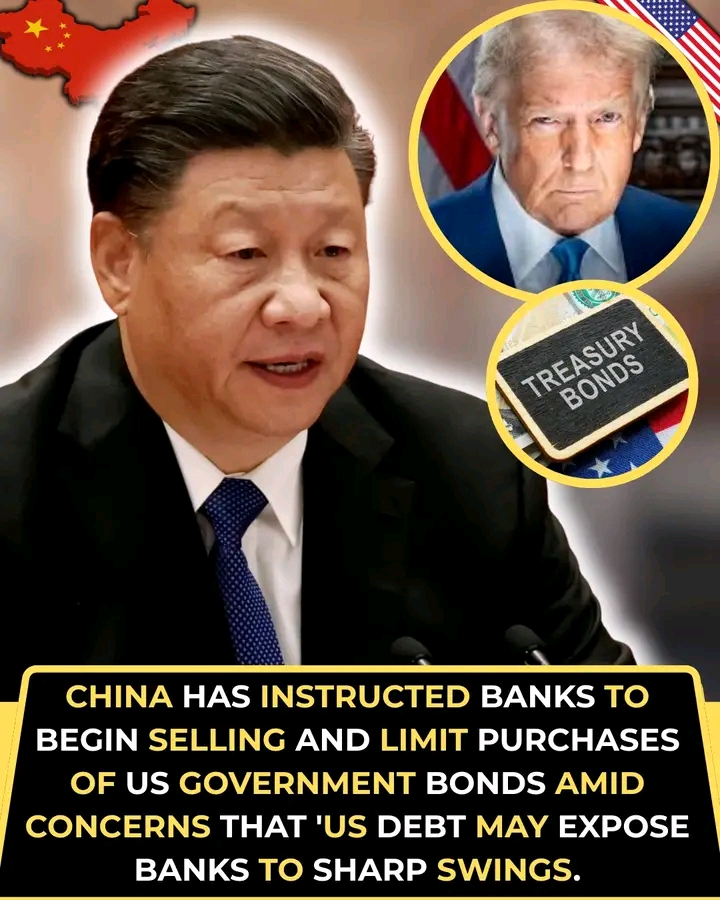
China has reportedly instructed banks to reduce exposure to United States government bonds.
Officials cited concerns that U.S. debt levels and potential volatility could pose risks to Chinese lenders and the broader financial system. The move, if confirmed, would represent a further step in Beijing’s long-term strategy to diversify foreign reserves away from heavy reliance on dollar-denominated assets.
China has been gradually adjusting its foreign reserve composition in recent years, with steady increases in gold holdings, euro and other currency allocations, and reductions in U.S. Treasury positions.
Official data from the U.S. Treasury Department already shows China’s holdings of Treasuries declining from peak levels above $1.3 trillion in the mid-2010s to around $750–800 billion by early 2026. Any accelerated reduction in exposure—whether through outright sales, maturity roll-offs without reinvestment, or hedging—could exert selling pressure on the Treasury market and influence yields.
However, global demand for U.S. bonds remains deep and resilient. Treasuries continue to serve as the world’s premier safe-haven asset, supported by institutional investors, foreign central banks, pension funds, and the dollar’s status as the dominant reserve currency. Even meaningful sales from China would likely be absorbed without dramatic disruption unless accompanied by coordinated moves from other major holders or sudden shifts in risk sentiment.
Central bank portfolio moves are often incremental rather than sudden, driven by a combination of currency strategy, yield considerations, geopolitical hedging, and balance-of-payments needs. Markets will watch closely for confirmation through official data releases, including monthly U.S. Treasury International Capital (TIC) reports, People’s Bank of China balance-sheet updates, and gold reserve announcements.
The report adds to the ongoing debate about the future of dollar-denominated assets, de-dollarization trends, and the durability of the U.S. dollar’s reserve status amid rising great-power competition and geopolitical fragmentation.
References
U.S. Department of the Treasury – Treasury International Capital (TIC) System: Major Foreign Holders of Treasury Securities (monthly reports, 2025–2026)
People’s Bank of China – Foreign Exchange Reserves and Asset Composition Updates (2025–2026)
World Gold Council – Central Bank Gold Reserves: China Tracker (February 2026)
Reuters – China reportedly directs banks to cut U.S. Treasury exposure (February 2026)
Financial Times – Beijing accelerates reserve diversification amid U.S. debt concerns (February 2026)
Bloomberg – Markets on watch for signs of accelerated Chinese Treasury sales (February 2026)