COURT DIDN’T DECLARE SAMPA PRESIDENT
By Isaac Mwanza
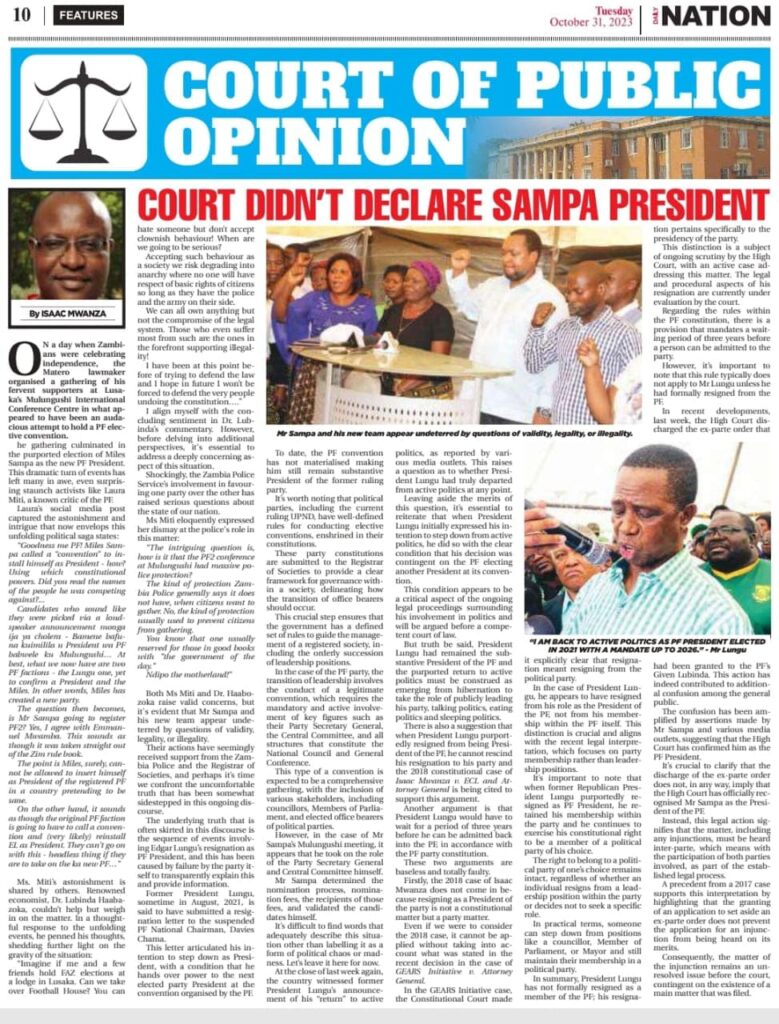
ON a day when Zambians were celebrating independence, the Matero lawmaker organised a gathering of his fervent supporters at the Lusaka International Mulungushi Center in what appeared to have been an audacious attempt to hold a PF elective convention.
The gathering culminated in the purported election of Miles Sampa as the new PF President. This dramatic turn of events has left many in awe, even surprising staunch activists like Laura Miti, a known critic of the PF.
Laura’s social media post captured the astonishment and intrigue that now envelops this unfolding political saga states:
“Goodness me PF! Miles Sampa called a “convention” to install himself as President – how? Using which constitutional powers. Did you read the names of the people he was competing against?… Candidates who sound like they were picked via a loudspeaker announcement monga ija ya cholera – Bamene bafuna kuimilila u President wa PF babwele ku Mulungushi… At best, what we now have are two PF factions – the Lungu one, yet to confirm a President and the Miles. In other words, Miles has created a new party. The question then becomes, is Mr Sampa going to register PF2? Yes, I agree with Emmanuel Mwamba. This sounds as though it was taken straight out of the Zim rule book. The point is Miles, surely, cannot be allowed to insert himself as President of the registered PF in a country pretending to be sane. On the other hand, it sounds as though the original PF faction is going to have to call a convention and (very likely) reinstall EL as President. They can’t go on with this – headless thing if they are to take on the ka new PF…”
Ms. Laura Miti’s astonishment is shared by others. Renowned economist, Dr. Lubinda Haabazooka, couldn’t help but weigh in on the matter. In a thoughtful response to the unfolding events, he penned his thoughts, shedding further light on the gravity of the situation:
“Imagine if me and a few friends hold FAZ elections at a lodge in Lusaka. Can we take over Football House? You can hate someone but don’t accept clownish behaviour! When are we going to be serious? Accepting such behaviour as a society we risk degrading into anarchy where no one will have respect of basic rights of citizens so long as they have the police and the army on their side. We can all own anything but not the compromise of the legal system. Those who even suffer most from such ae the ones in the forefront supporting illegality! I have been at this point before of trying to defend the law and I hope in future I won’t be forced to defend he very people undoing the constitution….”
I fully align myself with the sentiment of Dr. Lubinda’s commentary, especially the last sentence. However, before delving into additional perspectives, it’s essential to address a deeply concerning aspect of this situation.
Shockingly, the Zambia Police Service’s involvement in favouring one party over the other has raised serious questions about the state of our nation. Laura Miti eloquently expressed her dismay at the police’s role in this matter:
“The intriguing question is, how is it that the PF2 conference at Mulungushi had massive police protection? The kind of protection Zambia Police generally says it does not have, when citizens want to gather. No, the kind of protection usually used to prevent citizens from gathering. You know that one usually reserved for those in good books with “the government of the day.” Ndipo the motherland!”
Both Laura and Dr. Haabozoka raise valid concerns, but it’s evident that Miles Sampa and his new team appear undeterred by questions of validity, legality, or illegality.
Their actions have seemingly received support from the Zambia Police and the Registrar, and perhaps it’s time we confront the uncomfortable truth that has been somewhat sidestepped in this ongoing discourse.
The underlying truth that is often skirted in this discourse is the sequence of events involving Edgar Lungu’s resignation as PF Party President, and this has been caused by failure by the PF itself to transparently explain this and provide information.
Former President Lungu, sometime in August, 2021, is said to have submitted a resignation letter to the suspended PF National Chairman, Davies Mwila.
This letter articulated his intention to step down as President, with a condition that he hands over power to the next elected party President at the convention organized by the PF.
To date, the PF Convention has not materialized making him still remain substantive President of the former ruling party.
It’s worth noting that political parties, including the current ruling UPND, have well-defined rules for conducting elective conventions, enshrined in their party constitutions.
These party constitutions are submitted to the Registrar of Societies to provide a clear framework for governance within a society, delineating how the transition of office bearers should occur.
This crucial step ensures that the government has a defined set of rules to guide the management of a registered society, including the orderly succession of leadership positions.
In the case of the PF party, the transition of leadership involves the conduct of a legitimate convention, which requires the mandatory and active involvement of key figures such as their Party Secretary General, the Central Committee, and all structures that constitute the National Council and General Conference.
This type of a convention is expected to be a comprehensive gathering, with the inclusion of various stakeholders, including councillors, Members of Parliament, and elected office bearers of political parties.
However, in the case of Miles Sampa’s Mulungushi Meeting, it appears that Miles took on the role of the Party Secretary General and Central Committee himself.
Miles determined the nomination process, nomination fees, the recipients of those fees, and validated the candidates himself.
It’s difficult to find words that adequately describe this situation other than labelling it as a form of political chaos or madness. Let’s leave it here for now.
At the close of last week again, the country witnessed former President Lungu’s announcement of his “return” to active politics, as reported by various media outlets. This raises a question as to whether President Lungu had truly departed from active politics at any point.
Leaving aside the merits of this question, it’s essential to reiterate that when President Lungu initially expressed his intention to step down from active politics, he did so with the clear condition that his decision was contingent on the PF electing another President at the party convention.
This condition appears to be a critical aspect of the ongoing legal proceedings surrounding his involvement in politics and will be argued before a competent court of law.
But truth be said, President Lungu had remained the substantive President of the PF and the purported return to active politics must be construed as emerging from hibernation to take the role of publicly leading his party, talking politics, eating politics and sleeping politics.
There is also a suggestion that when President Lungu purportedly resigned from being President of the PF, he cannot rescind his resignation to his party and the 2018 constitutional case of Isaac Mwanza v. ECZ and Attorney General is being cited to support this argument.
Another argument is that President Lungu would have to wait for a period of 3 years before he can be admitted back into the PF, in accordance with the PF party constitution.
These two arguments are baseless and totally faulty.
Firstly, the 2018 case of Isaac Mwanza does not come in because resigning as a President of the Party is not a constitutional matter but a party matter.
Even if we were to consider the 2018 case, it cannot be applied without taking into account what was stated in the recent decision in the case of GEARS Initiative v. Attorney General.
In the GEARS Initiative case, the Constitutional Court made it explicitly clear that resignation meant resigning from the political party.
In the case of President Lungu, he appears to have resigned from his role as the President of the PF, not from his membership within the PF itself. This distinction is crucial and aligns with the recent legal interpretation, which focuses on party membership rather than leadership positions.
It’s important to note that when former Republican President Lungu purportedly resigned as PF Party President, he retained his membership within the PF and he continues to exercise his constitutional right to be a member of a political party of his choice.
The right to belong to a political party of one’s choice remains intact, regardless of whether an individual resigns from a leadership position within the party or decides not to seek a specific role.
In practical terms, someone can step down from positions like a councillor, Member of Parliament, or Mayor and still maintain their membership in a political party.
In summary, President Lungu has not formally resigned as a member of the Patriotic Front; his resignation pertains specifically to the presidency of the PF.
This distinction is a subject of ongoing scrutiny by the High Court, with an active case addressing this matter. The legal and procedural aspects of his resignation are currently under evaluation by the court.
Regarding the rules within the PF party constitution, there is a provision that mandates a waiting period of 3 years before a person can be admitted to the party.
However, it’s important to note that this rule typically does not apply to Edgar Lungu unless he had formally resigned from the PF.
In recent developments, last week, the High Court discharged the ex-parte order that had been granted to the PF’s Given Lubinda. This action has indeed contributed to additional confusion among the general public.
The confusion has been amplified by assertions made by Miles Sampa and various media outlets, suggesting that the High Court has confirmed Miles Sampa as the PF President.
It’s crucial to clarify that the discharge of the ex-parte order does not, in any way, imply that the High Court has officially recognized Miles Sampa as the President of the PF Party.
Instead, this legal action signifies that the matter, including any injunctions, must be heard inter-parte, which means with the participation of both parties involved, as part of the established legal process.
A precedent from a 2017 case supports this interpretation by highlighting that the granting of an application to set aside an ex-parte order does not prevent the application for an injunction from being heard on its merits.
Consequently, the matter of the injunction remains an unresolved issue before the court, contingent on the existence of a main matter that was filed.
[Published by the Daily Nation Zambia, October, 2023]