

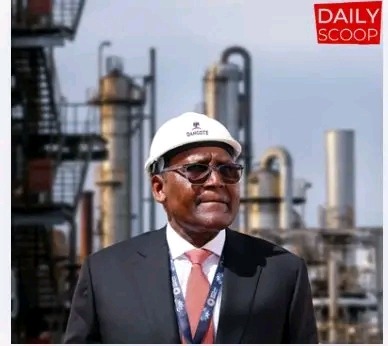
DANGOTE REFINERY IPO DRAWS GLOBAL SUPPORT FOR WIDER AFRICAN OWNERSHIP:
The proposed initial public offering (IPO) of Dangote Petroleum Refinery and Petrochemicals has received strong backing from prominent African and international leaders, who say the move could usher in a new era of wealth creation, industrialisation and economic sovereignty across the continent.
The leaders, speaking at the 2026 ADF Africa Diaspora Leadership Programme Young Global Leaders Convening in Lagos, said the refinery had already demonstrated Africa’s ability to deliver industrial projects on a global scale.
They said the proposed IPO could further broaden participation by allowing ordinary Africans, pension funds, institutional investors and members of the diaspora to acquire a stake in one of Africa’s largest industrial investments.
President and Chief Executive Officer of Dangote Industries Limited, Aliko Dangote, said the central philosophy behind the proposed IPO was to ensure that the wealth generated by the refinery extends beyond its promoters to ordinary Africans.
Speaking during a fireside chat, Dangote said he wanted people from different walks of life, including drivers, cooks and small-scale traders across Africa, to have an opportunity to invest in the refinery and benefit from its success.
“I want drivers, cooks, the woman selling food on the streets of Ghana, Rwanda and South Africa to invest so they can share in this prosperity. We are doing the IPO to pass this prosperity to Africans,” he said.
Dangote said his broader objective was to contribute to the industrialisation of Africa and create opportunities for more people to participate in the continent’s economic transformation.
“I am wealthy, not rich. A wealthy man creates wealth, while a rich man makes money and keeps it for himself,” he said.
He expressed confidence that the refinery could eventually become Africa’s largest company by size and profitability, drawing comparisons with global companies such as Amazon, Microsoft, Tesla and Alibaba, which expanded significantly after accessing public markets.
“By the grace of God, this refinery will be the largest company in Africa by size and profitability,” Dangote said.
He added that the ultimate objective was to reduce investment risks on the continent, attract more capital, create jobs and expand economic opportunities.
“Our job is to derisk Africa, encourage more investors, create jobs and create more opportunities. That is how we will transform Africa,” he said.
Former United States Assistant Secretary of State for African Affairs and Co-Chair of The Africa Center, Ambassador Jendayi Frazer, said the proposed IPO could help broaden ownership of African industrial assets.
Frazer said the initiative had the potential to connect African investment with African production by creating opportunities for pension funds, individual investors, institutional investors, savers and members of the African diaspora to participate in the continent’s growth.
“The refinery connects us all through the proposed IPO that creates broader ownership,” she said.
Frazer also argued that the refinery had implications beyond petroleum production, saying its emergence demonstrated the growing importance of Africa’s industrial and economic capacity.
“Economic power is not only what a country possesses, it’s what it can create, process, finance, transport and sell. Supply chains, energy systems and capital markets shape sovereignty,” she said.
Lagos State Governor Babajide Sanwo-Olu similarly called for a new model of African industrial ownership in which ordinary citizens, institutional investors and diaspora capital could hold stakes in strategic assets.
He said Africa’s next phase of economic growth should not simply be about creating more large corporations, but about creating millions of ordinary shareholders who could participate in the continent’s industrial wealth.
“The next frontier of African scale is not another giant. It is a thousand ordinary owners: the teacher in Enugu, the nurse in New Jersey and the pension fund in Nairobi, each holding a piece of the strategic assets of their own continent,” Sanwo-Olu said.
He praised the scale of the Dangote refinery project, noting that its development required the construction of supporting infrastructure because existing facilities were insufficient for the project’s demands.
“Mr Dangote did not build a refinery. He built a country around a refinery, and then he built the refinery. There was no port that could receive the equipment, so he built a jetty. There was not enough power, so he built a power plant,” he said.
Sanwo-Olu noted that the project had faced significant challenges, including the COVID-19 pandemic and severe currency depreciation, while also overcoming widespread doubts about whether the refinery would ever become operational.
Despite those challenges, he said the project had demonstrated the ability of African entrepreneurs and institutions to undertake projects of global significance.
The proposed IPO is therefore being presented by its supporters not simply as a capital-raising exercise, but as an opportunity to broaden African ownership of strategic industrial assets and allow more citizens to participate directly in the continent’s economic growth.
For its proponents, the ultimate ambition is clear: to transform industrial success into broader ownership, investment, employment and long-term wealth creation for Africans.