

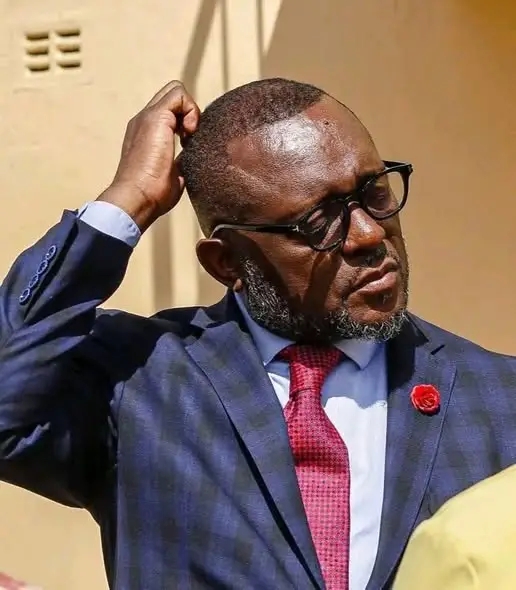
NKOMBO’S LOYALTY CLAIMS TO HH RAISE MORE QUESTIONS THAN ANSWERS
The Editor Zambia
FORMER Local Government and Rural Development minister Gary Nkombo’s insistence that he has always stood firmly with President Hakainde Hichilema should be treated by political observers with a hefty pinch of salt because, in politics, words alone are never enough.
What matters are actions, associations, and political conduct over time.
While Nkombo now loudly proclaims unwavering loyalty to President Hichilema, many within political circles believe his recent behaviour and public statements reveal a completely different story.
The contradictions are too glaring to ignore.
Politics, both in Zambia and across Africa, has repeatedly shown that the loudest declarations of loyalty are sometimes made by individuals quietly preparing political knives behind closed doors.
History is full of trusted lieutenants who eventually became bitter rivals after years of pretending to stand shoulder to shoulder with sitting leaders.
From the famous fallout between Simon Mwansa Kapwepwe and founding President Kenneth Kaunda, to the political hostility that later emerged between second Republican President Frederick Chiluba and his purported uncle Ben Mwila, Zambia has witnessed many political relationships collapse despite years of public unity.
More recently, the sixth republican president Edgar Chagwa Lungu and his for minister Chishimba Kambwili showdown demonstrated how quickly close political alliances can turn into open warfare.
That is why Nkombo’s sudden and excessive praise of President Hichilema, including his insistence that the incumbent will easily triumph in the August 13 elections, is being viewed with suspicion by many seasoned political watchers.
In politics, overpraise itself can sometimes become a warning sign.
The timing of Nkombo’s comments is particularly interesting because they come at a moment when debate surrounding Bill 7 has exposed visible cracks within sections of the broader UPND family.
Rather than calming tensions, some of Nkombo’s interventions have only deepened speculation about his long-term political intentions.
Nkombo’s claim that support for Bill 7 should not be interpreted as hostility towards President Hichilema sounds reasonable on the surface. However, critics argue that the issue is not merely about constitutional reforms but rather a broader pattern of conduct that has consistently raised questions about his political ambitions.
Within political circles, there have long been whispers that Nkombo has quietly positioned himself as an alternative influence centre within the ruling party while publicly maintaining the language of loyalty.
Such allegations may never be openly admitted, but politics often operates through signals, strategic alliances, and subtle manoeuvres rather than direct confrontation.
The reported closeness between Nkombo and individuals perceived to be politically uncomfortable with President Hichilema has only fuelled suspicion further.
In a highly sensitive election season, every political gesture is being scrutinised carefully. What makes the situation even more delicate is that President Hichilema is not an inexperienced politician who can easily fail to detect internal scheming.
President Hichilema has survived one of the toughest opposition journeys in Zambia’s modern political history. He endured arrests, intimidation, repeated electoral defeats, and sustained political pressure before finally ascending to power in 2021.
Such a politician develops sharp instincts for identifying both genuine loyalty and disguised ambition.
The famous phrase “Et tu, Brute?” From Roman political history remains relevant because betrayal in politics almost always comes from trusted insiders rather than declared opponents.
It is, therefore, unlikely that President Hichilema is blindly accepting every public declaration of loyalty without carefully studying the political conduct behind the statements.
This is precisely why many observers believe the President has over the years handled Nkombo with calculated caution despite their long political association.
Nkombo’s defenders argue that disagreement over policy should never be mistaken for rebellion and that democracy requires room for differing opinions. That argument is valid in principle. However, politics is not judged only by formal statements but also by patterns, timing, and relationships.
When a politician repeatedly finds himself at the centre of internal controversy while simultaneously insisting on unquestionable loyalty, suspicion naturally emerges.
The reality is that Zambian politics has never been short of dramatic political divorces. Former allies routinely become fierce enemies once power struggles intensify beneath the surface. Public smiles and emotional speeches often conceal deeper rivalries that eventually explode into the open.
As the August 13 elections draw closer, the UPND leadership will undoubtedly remain alert to any signs of internal destabilisation, factional mobilisation, or hidden succession calculations.
Whether Nkombo is genuinely loyal to President Hichilema or merely engaging in sophisticated political survival tactics remains a matter of public debate.
But one thing is certain: in politics, loyalty is measured less by emotional speeches and more by consistent actions.
And for many observers, Gary Nkombo’s words and actions are simply not tallying.
Does loyalty mean unquestioning agreement to whatever the leader says? Some PF MPs voted for Bill 7, which was praised by UPND. Equally, Mr. Garry Nkombo voted against Bill 7. Both were exercising their rights as constituency representatives NOT party representatives. UPND cannot welcome the votes from PF MPs while condemning Mr. Nkombo’s anti-Bill 7 vote. What is good for the goose is good for the gander.
If Mr. Nkombo is positioning himself for the UPND presidency after Mr. Hichilema’s two terms in 2031, that is alright. It is his constitutional right unless of course UPND are thinking of changing the constitution to allow Mr. Hichilema go for a third term. That would be a huge mistake.