

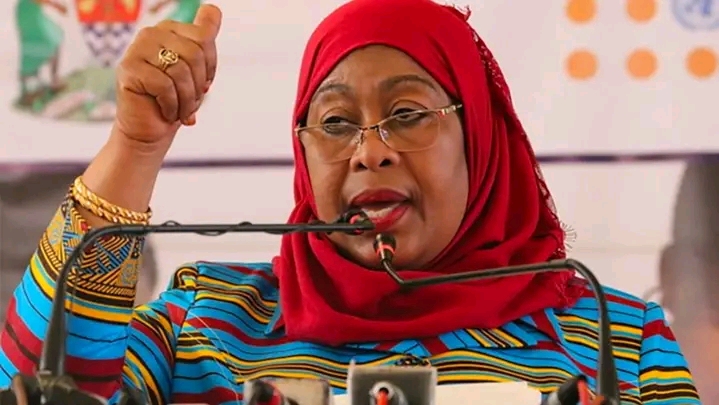
Tanzania, a nation once hailed for its relative stability in East Africa, now finds itself at a crossroads where the very essence of democracy is being questioned.
As the country approaches its October 29 election, President Samia Suluhu Hassan stands poised to seek re-election under circumstances that many observers describe as deeply troubling.
What was anticipated to be a competitive democratic exercise has instead turned into what appears to be a one-woman show, with the president running virtually unopposed.
This stark reality raises critical concerns about the health of democracy in Tanzania and the future trajectory of political governance in the country.
President Samia Suluhu Hassan’s ascent to the presidency in March 2021 was historic. As Tanzania’s first female president, she inherited a nation with a mixed record on political freedoms and human rights.
Her leadership was initially met with cautious optimism, both domestically and internationally. Yet, as the 2025 elections approach, the political landscape reveals a grim picture.
Opposition candidates, who in a healthy democracy would challenge the incumbent and offer alternatives to voters, have been systematically sidelined. Reports of candidates being jailed, disqualified on dubious grounds, or disappearing under suspicious circumstances have cast a shadow over the electoral process.
The disappearance of major political figures removes not only competition but also critical voices that represent diverse viewpoints and the aspirations of the Tanzanian people.
The absence of viable opposition candidates essentially guarantees the president’s continuation in office, but at what cost? Democracy thrives on competition, debate, and the ability of people to choose from a range of options.
When this fundamental principle is compromised, elections lose their meaning and become exercises in formality rather than genuine expressions of the popular will.
Tanzania’s upcoming election threatens to become an emblematic example of this erosion, where the ballot paper no longer reflects choice but a predetermined outcome.
Adding to the troubling picture is the government’s decision to restrict social media platforms until after the elections.
In the digital age, social media serves as a powerful tool for political engagement, enabling citizens to share information, debate policies, and hold leaders accountable.
By shutting down these platforms, the government effectively muzzles dissent and limits access to independent information.
This tactic not only hampers free expression but also undermines transparency, which is vital for a fair electoral process.
When the flow of information is controlled and dissenting voices are silenced, the electorate is deprived of the full scope of perspectives necessary to make informed decisions.
The chilling effect on political discourse can be seen in the broader context of Tanzania’s political environment. Fear has replaced open debate, and suspicion clouds the air.
When opposition figures vanish or face intimidation, it sends a clear message to others that political dissent is unsafe.
This climate discourages participation and weakens the foundations of democratic pluralism.
Moreover, it raises ethical and moral questions about the use of power and the responsibilities of leadership in a society that values justice and fairness.
African proverbs poignantly capture the essence of this predicament.
“The moon shines brighter when stars are not banned,” reminds us that leadership is best when it coexists with others who can shine alongside it. “Justice does not live where only one side is allowed to speak,” and “When only one bird sings, the forest silence becomes suspicious,” both echo the dangers of monopolizing political expression.
These sayings are not just cultural wisdom; they serve as a mirror reflecting the current state of Tanzanian democracy.
At this critical juncture, it is essential to consider the broader implications.
A leader who fears opposition fears her own reflection, the saying goes, implying that true leadership is confident enough to withstand scrutiny and challenge. Fairness, transparency, and respect for diverse opinions are hallmarks of genuine power.
When elections become a solo performance, the audience—the people—are left powerless, and the legitimacy of the government is called into question. The greed for unchecked power ultimately imprisons a nation, stifling progress and breeding discontent.
For Tanzania, the path forward requires a recommitment to democratic norms.
This includes ensuring that all political actors, regardless of affiliation, can participate freely and safely in the electoral process.
It means lifting restrictions on communication channels and fostering an environment where debate and dissent are not only tolerated but welcomed as expressions of loyalty to the nation’s growth and well-being.
President Samia Suluhu Hassan, as the country’s leader, holds significant influence in shaping this future.
True power lies not in silencing opposition but in embracing it as a vital component of governance.
The upcoming election in Tanzania is more than a political event; it is a test of the nation’s democratic resilience.
The sidelining of opposition, the suppression of social media, and the atmosphere of fear threaten to reduce democracy to a hollow ritual. Yet, the spirit of democracy is resilient, and the voices of the people, even when muted, have a way of resurfacing.
For Tanzania to thrive and for its democracy to regain its strength, the leadership must heed the lessons embedded in African wisdom and global democratic principles: fairness, inclusivity, and respect for all voices are the foundation on which true power rests.
If these are ignored, the nation risks imprisoning itself in a cycle of authoritarianism that benefits none but the few.
The time to act is now, before the solo performance becomes a permanent silence.
Some African Leaders are a disgrace.
That’s why at one time in Africa, such used to end up with Bullets in their Heads.
We thought those days are behind us. But who wants to bring such days back?
The disgraced African Leader who has failed to under stand Democracy..Who is crushing all Alternatives and want to compete with himself or herself.
And who said Women make Better Presidents? They are equally evil…
Here is a Tanzania Woman, being a disgrace not just to women , but to all humanity.