

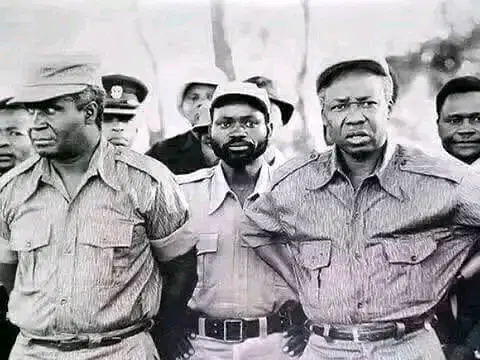
The death of Samora Machel, Mozambique’s first president, on October 19, 1986, remains one of the most poignant and debated events in the history of African liberation.
More than three decades later, the circumstances surrounding the crash of his presidential aircraft near Mbuzini, South Africa, continue to provoke speculation, sorrow, and reflection on the broader geopolitical struggles that defined southern Africa during the late 20th century.
This tragedy did not just mark the loss of a leader; it exposed the fierce and often deadly contest between apartheid South Africa and the liberation movements that sought to dismantle it.
Samora Machel was not merely a political figure; he was a symbol of resilience and pan-African solidarity.
As the founding leader of FRELIMO (Front for the Liberation of Mozambique), he guided the country to independence from Portuguese colonial rule in 1975, becoming its first president.
His leadership was characterized by a firm commitment to Marxist principles, social justice, and the empowerment of the oppressed.
More importantly, Machel was an unyielding opponent of apartheid South Africa, offering support and sanctuary to liberation movements such as the African National Congress (ANC) and the Pan Africanist Congress (PAC).
His stance made him a direct threat to the apartheid regime, which viewed Mozambique’s independent government as an ideological adversary and a logistical base for armed resistance.
The official explanation for the crash, put forth by the apartheid government, was that pilot error caused the Tupolev Tu-134 to stray off course, ultimately leading to the fatal accident.
Their inquiry suggested that navigational mistakes brought the plane into South African airspace, where it crashed into a mountain near Mbuzini, close to the Mozambican border.
This narrative, however, failed to convince many, especially in Mozambique, the Soviet Union, and across African nations.
The mistrust stemmed not only from the political context but also from the nature of the apartheid regime itself—an administration notorious for covert operations, sabotage, and assassination attempts against its enemies.
The theory that gained prominence among critics of the official account is the “false beacon” theory. According to this theory, South African security forces deliberately set up a deceptive VOR (VHF Omnidirectional Range) beacon, broadcasting false navigational signals.
This tactic would have misled the aircraft’s instruments and caused it to veer dangerously off its intended flight path.
Such a sophisticated plot aligns with documented instances of South African intelligence operations during the apartheid era, which included assassinations and destabilization campaigns against neighboring states and liberation movements. While direct proof of this theory remains elusive, it has been bolstered by testimonies from survivors and independent investigators who questioned the integrity of the South African inquiry.
The death of Samora Machel had profound ramifications for Mozambique and the region. Politically, it dealt a severe blow to the nascent Mozambican state.
Machel’s leadership was a unifying force amidst the country’s ongoing civil war between FRELIMO and RENAMO (Mozambican National Resistance), a rebel group that had received covert support from neighboring Rhodesia (now Zimbabwe) and apartheid South Africa. His death exacerbated instability, weakening FRELIMO’s morale and strategic coherence.
Economically, Mozambique was plunged deeper into hardship as the civil war intensified, with infrastructure destruction and displacement of populations.
The loss of Machel also signaled to other liberation movements that their leaders were vulnerable, reinforcing the brutal reality of apartheid’s reach beyond South African borders.
Internationally, the incident heightened tensions between the apartheid regime and the global community.
The Soviet Union and its allies condemned the crash as an act of assassination, framing it within the broader Cold War context of proxy battles in Africa.
The Western world’s response was more cautious, reflecting the complexities of geopolitical alliances and the delicate balance of power during the 1980s.
However, the tragedy galvanized African nations’ resolve to oppose apartheid more vigorously, leading to increased support for sanctions and diplomatic pressure against South Africa.
The legacy of Samora Machel transcends his untimely death.
He is remembered as a visionary leader who embodied the aspirations of African self-determination and unity.
His efforts to promote literacy, healthcare, and social equality in Mozambique set benchmarks for post-colonial governance on the continent.
Moreover, his commitment to pan-Africanism inspired generations of activists and leaders who continue to draw strength from his example.
The unresolved mystery of his death serves as a painful reminder of the high stakes involved in the struggle against oppression.
Reflecting on Machel’s demise, the African proverb cited often rings true: “Until the lion tells his story, the tale of the hunt will always glorify the hunter.” In this case, the “lion” is Machel himself, whose voice was tragically silenced.
Yet, through the memories preserved by his people and the ongoing quest for truth, his story challenges the narratives imposed by those in power.
It compels us to scrutinize history with a critical eye and acknowledge the sacrifices made in the pursuit of freedom.
In recent years, efforts to revisit the crash site and re-examine the evidence have been sporadic but persistent.
Technological advances in forensic science and aviation investigation offer hope that one day a clearer picture might emerge.
Until then, the death of Samora Machel remains a powerful symbol of the complex and often dangerous path toward liberation and justice in Africa.
It reminds us that history is not merely a record of events but a living dialogue between past and present, shaped by courage, memory, and the enduring quest for truth.