

THE NEW MIDDLE EAST: HOW THE OLD ORDER DIED AND WHAT IS RISING IN ITS PLACE
By Lim Tean | The Great Game — Geopolitics for the Masses
An Israeli minister just named the new Middle East on live radio — and he named it in alarm. What Amichai Chikli called the “Türkiye-Qatar-Pakistan axis” is not a threat. It is the architecture of a new regional order. And once you see its logic, you cannot unsee it. Here is what it means — and what it means for America.
The Confession in the Alarm
When Israeli Diaspora Affairs Minister Amichai Chikli went on Israel’s 103 FM radio this week to warn of the rise of a “Türkiye-Qatar-Pakistan axis,” he was not making a prediction. He was issuing a confession. An adversary’s alarm is always the most reliable confirmation that a structural shift has occurred — and what Chikli named in anxiety, we must now examine with clarity.
The old Middle East is gone. What is rising in its place is an architecture that no Western foreign policy establishment has yet fully reckoned with — one in which American primacy has been displaced, Israeli military dominance has been exposed as insufficient, and the two great indigenous powers of the region, Iran and Türkiye, are emerging as the twin poles of a new order.
The Moment the Old Order Broke
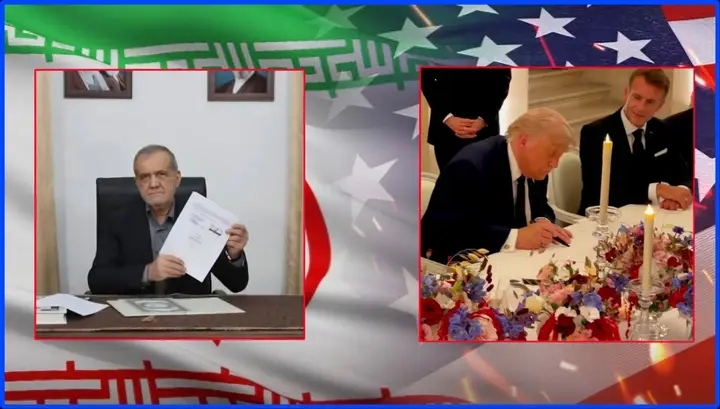
The proximate event was the US-Iran framework agreement — now signed and in force. Trump signing it at the Palace of Versailles during dinner with Macron on Wednesday evening, Pezeshkian signing from Tehran. But the manner of its emergence is as consequential as its content.
Washington and Tehran reached their temporary truce on April 8 through Pakistani mediation. The framework itself was shaped by Pakistan, Qatar, and Türkiye — playing, as one account noted, “different but complementary roles.” Qatar hosted senior Iranian officials and maintained communication channels. Türkiye provided consistent diplomatic backing and called repeatedly for a negotiated resolution. Pakistan’s Army Chief Field Marshal Asim Munir was the crucial bridge, maintaining simultaneous contacts with both Washington and Tehran.
Notice who was absent from this architecture: Israel. Notice also who was absent: the UAE, Bahrain, Saudi Arabia — the traditional American-anchored Gulf states that for three decades defined the regional order alongside Washington.
Netanyahu himself admitted the scale of his marginalisation. At his first press conference in three months, he conceded he did not know what was actually written in the agreement. The leader of the Middle East’s most powerful military, possessor of an undeclared nuclear arsenal, was reduced to a bystander while the region’s future was negotiated without him.
Trump, at the G7 summit in France, publicly described Netanyahu as “crazy” and said “without me, there would be no Israel.” Strip away the Trumpian grandiosity and a devastating strategic truth remains: Israel’s security has never rested on its own foundations, but on American patronage. And that patronage is being fundamentally recalibrated.
For American readers, this demands a moment of honest reflection. The United States spent trillions of dollars and decades of strategic energy constructing a Middle Eastern order anchored on Israeli military dominance and Gulf monarchy stability. That order has not been dismantled by an adversary’s military victory. It has been quietly superseded — by diplomacy conducted through channels America did not control, by actors America did not invite, producing an outcome America did not architect. That is a more profound kind of displacement than defeat in battle.
The Dual-Hegemon Architecture
What is emerging is not a successor Pax — not Chinese, not Russian, not any external power’s regional order. It is something rarer and more durable: a regional order anchored by indigenous great powers.
Iran and Turkey are the twin poles. Between them they possess the military depth, the demographic weight, the geographic centrality, and the independent foreign policy capacity that no other regional actor can match. Iran controls the eastern arc — Iraq, Syria, Lebanon, Yemen — through its network of allied movements and state relationships. Turkey commands the northern tier, projects power into Syria, maintains NATO membership as a strategic hedge, and has emerged as the region’s most consequential diplomatic broker.
This is not a partnership moving in perfect harmony. Turkey and Iran are rival civilisational powers with a long history of strategic friction. The more precise framework is managed bipolarity — two hegemons who converge sufficiently on the containment of Israeli expansionism to cooperate diplomatically, while competing for influence across the Arab world’s contested spaces.
Erdoğan has made Turkey’s position unambiguous. Speaking to parliament, he declared that Israeli aggression in Lebanon and Syria had reached a point where it threatened Turkey directly, and called Israel the single biggest obstacle to regional peace. Turkish Foreign Minister Hakan Fidan, speaking alongside Russia’s Sergey Lavrov in Moscow — a symbolically charged backdrop — welcomed the US-Iran agreement but crucially called for it to evolve into “a structural and lasting security architecture rather than a temporary period of calm.”
That phrase is the key to understanding Ankara’s ambition. Turkey is not interested in episodic crisis management. It is seeking to institutionalise a new regional order in which it is a permanent rule-setter — the Ottoman inheritance reframed for the twenty-first century.
Iran, militarily weakened by the six-week Israeli offensive but diplomatically rehabilitated by the agreement, emerges in a paradoxical position of strength. It has traded military confrontation for international legitimacy, secured the rehabilitation of its economy, and — crucially — retained its regional network intact. The agreement has not dismantled Iranian power projection. It has brought Iran back into the international system while leaving its strategic depth untouched.
Pakistan: The Nuclear Keystone
The actor most consistently underestimated in Western analysis is Pakistan — and yet Pakistan may be the keystone of the entire new architecture.
Pakistan is the only Muslim-majority nuclear power on earth. Its Army Chief personally bridged Washington and Tehran to produce the April 8 truce. It sits at the heart of the Türkiye-Qatar-Pakistan diplomatic axis. And it has recently formalised a defence pact with Saudi Arabia.
That last point demands careful attention — and contains a particular irony for American readers.
Saudi Arabia’s strategic anxiety is acute. If American primacy in the region is receding, Riyadh needs an alternative security guarantee. It needs, specifically, nuclear cover. China has been proposed as one possible guarantor. But Pakistan is the more structurally coherent answer — and the answer whose historical roots run deepest.
Saudi money was instrumental in funding Pakistan’s nuclear programme during the 1970s and 1980s. This was never a secret in strategic circles. Zulfikar Ali Bhutto’s original conception of an “Islamic bomb” was always partly conceived with the broader Muslim world — and implicitly with Saudi Arabia — in mind. The recent Saudi-Pakistan defence pact is not a bilateral footnote. It is the formal institutionalisation of a security relationship whose nuclear dimension has always been implicit.
Here is the American irony: Washington funded, armed, and sustained Pakistan through decades of the Cold War and the War on Terror. American taxpayers financed the Pakistani military establishment that built the Islamic world’s first nuclear arsenal. That arsenal may now serve as the instrument by which Saudi Arabia quietly exits the American security umbrella — replacing it with an Islamic solidarity framework that carries far greater domestic legitimacy in Riyadh than any guarantee from Washington ever did.
History has a sharp sense of irony. America built the tools of its own displacement.
Lebanon: The Proving Ground
Lebanon is not a footnote to this architectural shift. It is its most immediate and visible proving ground — the theatre where the transition from old order to new is being tested in real time.
Israel’s continued strikes on south Lebanon, even after the US-Iran framework was announced, reveal the central tension of this transitional moment. Netanyahu, sidelined from the deal and facing devastating domestic criticism, is using Lebanon as the one theatre where he can still project agency. But in doing so, he is accelerating precisely the dynamic that isolates Israel further from the emerging order.
Erdoğan’s response was explicit and historically significant: Israeli attacks on Lebanon and Syria had reached a point where they threatened Turkey directly, with Ankara’s security now tied to its two neighbouring countries. That is an extraordinary statement from a NATO member — effectively drawing a Turkish strategic red line over Lebanese and Syrian territory. Under the old American-anchored order, no such red line existed. Lebanon was perpetually sacrificed, a weak state with no regional protector capable of imposing real costs on Israeli operations. That calculus has now changed.
Hezbollah emerges weakened militarily but strategically sheltered. Iran’s diplomatic rehabilitation does not require Hezbollah’s disarmament — it requires Lebanon’s stabilisation as a buffer state within the new order. The agreement creates pressure for a ceasefire, not for the dismantling of the network that gives Iran its Lebanese strategic depth. For Israel, this is the core dilemma: military operations in Lebanon that once carried manageable costs now risk triggering a broader regional response that the new architecture makes structurally coherent for the first time.
The Coming Reckoning: Bahrain, UAE and the Abraham Accords
The states facing the most acute strategic exposure in the new architecture are Bahrain and the UAE — the two Arab signatories of the Abraham Accords most deeply integrated into the Israeli-American axis.
They signed those accords in 2020 premised on a specific geopolitical bet: that American military primacy was durable, that Israeli military dominance was unassailable, and that normalisation with Tel Aviv was the winning ticket to regional security and economic modernisation. Every one of those premises has now been shaken to its foundation.
American primacy has visibly receded — demonstrated not by any declaration, but by the simple fact that the most consequential regional agreement in a generation was negotiated without Washington in the lead role, and with Washington explicitly sidelining Israel from the process. Israeli military might, while still formidable, has been shown to have strategic limits. And normalisation with Israel now carries reputational and security costs that were never priced into the original Abraham Accords calculation.
Bahrain and the UAE possess sovereign wealth, infrastructure, and relationships that retain value in any regional configuration. But they are now exposed on multiple flanks simultaneously — caught between an American patron recalibrating its commitments, an Israeli partner increasingly isolated from the new regional consensus, and an emerging order being constructed around axes from which they were conspicuously absent.
Their most likely path is quiet hedging rather than dramatic realignment. Expect both states to begin softening their public identification with Israeli positions, to deepen economic ties with Turkey and expand back-channel contacts with Tehran, and to use their sovereign wealth funds as instruments of strategic repositioning — investments that signal accommodation with the new order without requiring a formal rupture with Washington. Abu Dhabi in particular, will seek to be useful to all sides simultaneously. But the window for comfortable hedging is narrowing. The longer Bahrain and the UAE remain identified with a receding order, the less leverage they will carry when they eventually seek terms with the one that is rising.
Oman and Qatar occupy the opposite end of the spectrum. Oman’s historic role as a quiet back-channel to Iran — it was instrumental in facilitating the early Obama-era nuclear conversations that eventually produced the JCPOA — gives it standing and credibility in the new order. Qatar’s role in the current mediation, hosting senior Iranian officials and explicitly supporting Pakistani-led diplomacy, has purchased it significant goodwill from Tehran. Both states will navigate the transition with relative comfort.
Saudi Arabia’s Inevitable Pivot
Saudi Arabia’s position is the most consequential and the most delicate of all.
MBS built his regional vision on three pillars: American security guarantees, economic modernisation through Vision 2030 anchored in Western and Israeli-adjacent investment, and a forthcoming normalisation with Israel that was to be the capstone of the Abraham Accords architecture. That capstone now looks not merely delayed but structurally implausible.
The pivot toward Iran and the new regional order is not a choice Riyadh makes from strength. It is a response to the collapse of the strategic alternative. The 2023 Beijing-brokered Saudi-Iran rapprochement was the first clear signal. The new architecture now accelerating around the Iran-Turkey axis makes the logic of that pivot not merely rational but increasingly urgent.
Saudi Arabia cannot indefinitely maintain a posture of confrontation with Iran while its American patron visibly disengages, while the new regional order is being built by actors — Turkey, Pakistan, Qatar — with whom Riyadh has workable and historically deep relationships, and while its own population’s Islamic solidarity instincts run counter to alignment with an Israel conducting military campaigns across the Muslim world.
The Pakistani nuclear umbrella is what makes this pivot strategically viable without strategic nakedness. It allows Riyadh to reduce its dependence on American extended deterrence without being exposed — and to do so through an Islamic solidarity framework that carries profound domestic legitimacy in a way that a Chinese or Russian guarantee never could. A Saudi Arabia sheltered by Pakistani nuclear deterrence, reconciled with Iran, and aligned with the Turkey-Qatar axis is a Saudi Arabia that has successfully navigated the transition without catastrophic rupture with anyone.
The pivot will not be announced with fanfare. It will happen gradually — through accumulating diplomatic signals, quiet investment reorientations, and careful distancing from Israeli positions on Gaza, Lebanon, and the broader regional conflict. By the time it is fully visible to Western analysts, it will already be irreversible.
Conclusion: Reading the Tide
What Amichai Chikli named in alarm this week, we should name with analytical precision: the emergence of a new Middle Eastern order anchored by indigenous power, shaped by Islamic solidarity and civilisational assertion, and no longer organised around American primacy or Israeli military dominance.
Iran and Turkey will not always agree. Their rivalry is ancient and will resurface across multiple theatres. But on the foundational question of this historical moment — that the old externally-imposed order must be replaced by one reflecting the region’s own balance of forces — they are aligned. And that alignment, backstopped by Pakistan’s nuclear capability, lubricated by Qatar’s financial diplomacy, and increasingly accommodated by a pivoting Saudi Arabia, is sufficient to constitute a genuinely new architecture.
For America, the lesson is not that it has been defeated. It is that it has been superseded — which is a more permanent condition. The tools America built, the relationships America cultivated, the arsenals America funded across decades of Cold War and counter-terrorism strategy, have been repurposed by actors pursuing their own civilisational interests. That is not a betrayal. It is simply how history works when the tide turns.
The states that bet on the old order — Bahrain, UAE, and above all Israel — now face a reckoning whose full dimensions are only beginning to become visible. The states that positioned themselves wisely — Turkey, Iran, Pakistan, Qatar, and soon Saudi Arabia — will shape what comes next.
History rewards those who read the tide correctly. The tide has turned. The only remaining question is who moves with it — and who insists on standing still as the water rises.