

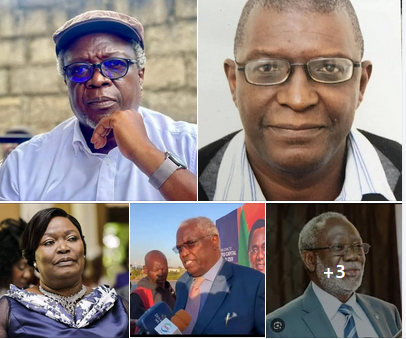
THE PLANNED COUNCIL OF ELDERS CONFERENCE: POLITICAL SOLUTION OR FANNING UNCERTAINTY?
A KBN TV EDITORIAL
As the nation inches closer to the decisive August 13 general elections, the political landscape is fast changing with efforts from those seeking office becoming more aggressive to garner visibility, endorsements, alliances and funding.
Equally, the political backstage is replete with several players positioning themselves as organisers, strategists, supporters and kingmakers. And of course, the scene is not short of chancers watching the wind before deciding which candidate to back.
At the centre of all the maneuvers, one thing has become increasingly clear: everyone is in agreement that the opposition must unite behind a single presidential candidate.
However, the opposition don’t seem to agree on which candidate to support. Even candidates themselves seem to be upbeat about their individual chances but in reality, this is only proving to be a popular ambition than it is an achievable goal.
Clearly, there are too many moving pieces before one could conclude with certainty the feasibility of a single opposition presidential candidate. Furthermore, a potential political landscape altering PF court ruling is on the horizon, and it could bring a new dimension to the prospects of uniting the opposition.
In a speculative turn of events that the court decides to honour contents of the consent judgment entered into between Miles Sampa and the Patriotic Front, would the outcome be a blessing to opposition unity or it will plunge the party further into succession disputes three months to presidential and parliamentary nominations?
Meanwhile, setting aside that speculative court outcome, we must also take keen interest and interrogate the anticipated conference being organised by the Council of Elders.
There are many questions that beg for answers. Who is in the Council of Elders, who is organising and funding the conference, why are they organising it, for whom are they organising and on which ticket are they organising? Until these questions are adequately addressed without any ambiguity, the conference might as well be perceived as forum shopping.
Premised on what we understand, there is now an expanded Council of Elders. This group must be clear whether they are truly representing the wishes of the ordinary voters, or they have engineered a process to project their elitist views on who they think should be the people’s preferred candidate.
While the intention to arrive at a single candidate may be noble, questions are being raised about the electoral college’s integrity. Who selected those to participate as delegates at the conference, what’s the criteria, who tested and approved the criteria, where are they drawing the mandate to convene?
Could there be a predetermined outcome of who the expanded Council of Elders want to install as their own preferred candidate through a sanitised process?
To shield themselves from allegations of biases, the expanded Council of Elders must strive to ensure the process is more transparent than one shrouded in speculative narratives.
Given the list of presidential candidates they have shortlisted for the planned conference, we understand they have Mr. Given Lubinda, Dr. Fred M’membe, Mr. Makebi Zulu and Mr. John Sangwa. Others like Dr. Bwalya Ng’andu whom they have been courting, may not be available for the assignment.
Hypothetically speaking, one might wish to put this process to a simple test and ask a question. If for example Makebi Zulu or John Sangwa wins, would Dr. Fred M’membe accept to rally behind either of them given his years of preparedness and investment into building the Socialist party brand over the years? The answer could be, he is most unlikely to backdown.
Potentially, that’s the challenging reality the expanded Council of Elders organised conference faces regardless of who is involved. It’s a dilemma they have to confront. In fact, the outcome may breed more confusion than the answers they are trying to engineer.
The other consideration is the fact that the original Council of Elders which included Justice Lombe Chibesakunda, Reverend Edith Mutale, Prince Akashambatwa Mbikusita Lewanika, Bishop Lordwell Siame and others, made an effort to meet nearly every known opposition political leader to try and bring them to a round table of common understanding.
Save for Prince Akashambatwa Mbikusita Lewanika, it’s not very clear if the rest of the original Council of Elders are still part of the process and current effort to host an elective conference. Again, speculation is rife that factors may have arisen for the original Council of Elders to distance themselves from the upcoming elective conference.
The expanded Council of Elders thererefore, which includes Dr. Neo Simutanyi, Mr. Brebner Changala, Mr. Gilbert Temba, from OCIDA, Dr. Emily Sikazwe, Mr. Fackson Shamenda and Dr. Brian Mushimba, among others, seem to have initially tried the conclave idea which collapsed, and are now actively seeking funding to host this conference which many hope will include every known political party leader including Brian Mundubile, Harry Kalaba, Sakwiba Sikota, Chishala Kateka, Kasonde Mwenda, Andyford Banda and others.
If any opposition party leader is sidelined or are not part of the process, then the primary objective of the conference to unite the opposition remains elusive.
At this stage, we are even hesitant to comment on reports that some individuals prominently known as political players, could have suddenly found themselves in the expanded Council of Elders. If true, the development fuels speculation of biases and eats at the very expected credibility of the expanded Council of Elders and its conference. One can’t be both a player and referee at the same time!
Of course we also understand that there are those who might be skeptical about the process and have intentionally opted not to be part of the conference of elders for fear of rubber-stamping an elitist preferred candidate of the expanded Council of Elders who might not necessarily represent the wishes and choice of the citizens.
In the meantime, one should not look at the planned conference in isolation. You need to take a very holistic picture and ask, what do you do with candidates such as Brian Mundubile, who are not participating in the Council of Elders conference, yet are receiving daily endorsements across the country after holding an elective general congress with participation from 10 registered political parties and 8 civil society organisations?
Does the Council of Elders carry a more befitting mandate than what a total of 18 organisations represented at the Tonse Alliance Congress?
What do you do with Dr. Fred M’membe, who, though being one of the shortlisted candidates, was already chosen as a presidential candidate for the People’s Pact Alliance. What do you do in an event that the outcome of the expanded Council of Elders elective conference does not favour him? How will the People’s Pact feel about the confidence they expressed in Dr. M’membe if he chooses to rally behind someone else?
What do you do with President Harry Kalaba whose party fulfilled the Constitutional requirement to hold a general party conference and endorsed him as the Citizens First flag bearer and yet he is not participating in the Council of Elders elective conference?
Shouldn’t the primary consideration of all these factors be a starting point? Does the Council of Elders have preference for a political party or a particular candidate? Unless there is a special reason, why would you ignore the widespread and countrywide endorsements of Brian Mundubile and the sentiments by former Minister Yamfwa Mukanga?
Why would you ignore the Citizens First structures and visibility to start a process of choosing a candidate to marshal nationwide resonance two months before nominations?
These questions require answers and can not be wished away. While we wish the expanded Council of Elders all the best in their efforts, they must keep this at the back of their minds: are they finding a workable political solution or fanning political confusion and uncertainty? Only time will tell.
Where were this council of elders when people were being gassed? That is the time the nation needed elders to stand up and be counted. Some where even sitting on the bench acquitting the gases!!
Council of hh haters. Loosers, not only you have the right to Zambia, it’s everybody called Zambian
Let each political party contest the election to gauge its popularity. Most of these so called opposition parties exist in name only. Bringing them under the umbrella of opposition alliance will only inflate their ego. They will start claiming that without our support so and so would not have made it. More than half of them will get less than 1,000 votes country wide.
This desperation to get the opposition to field one candidate is worrisome. No one is talking about what agenda a united opposition candidate has for Zambia. The overriding concern is to get UPND out. This is a very narrow and meaningless objective. After you get rid of UPND, then what?
It is a recipe for chaos.
Let the council of the elder useless people form they party and pick a candidate among themselves.This is the group of people who never planned in there life no wonder they are still talking politics.
It’s really a fluid situation. A lot of moving pieces.
We wish the Council of elders all the best..
This is an election like no other. The Main opposition Patriotic Front still in Legal Limbo , and chances of getting back on the ballot are all but gone. Meanwhile other Opposition Political Parties are wandering about like headless chickens.
That Hon Justice Chinyama will finally make a favourable Ruling to the PF is wishful thinking. I don’t share that hope. The decision to schedule the Judgement for 25th February,2025 may be the result of the complaint made to the Judicial Complaints Commission over the conduct of Hon Judge Conceptor Chinyama than a serious attempt to finally have closure on the case..But we wait for 25th February, 2025. A deferment is very possible. The judgement may not be ready, the hon Judge may fall Ill, or there will be a bereavement…or a conference of Judges in Livingstone or Siavonga.
Or the judgement will be very vague , or that the matters are constitutional and beyond the jurisdiction of the High Court.
Any thing is possible in our Courts.
I don’t have any hope that we will have closure on 25th February, 2025. Absolutely no Hope.