

THE PRICE OF VICTORY: PROFESSIONALISM IN POLITICAL CAMPAIGNS ISN’T EXPENSIVE—IT’S ESSENTIAL
David T. Zyambo | 15 February, 2026
LUSAKA — Since August 2025, after transitioning from two decades of corporate strategy to the engine room of political strategy for a Zambian presidential candidate, I have collided daily with a persistent, expensive myth: the belief that elections are won solely by the loudest voices in the streets. For years, the “cadre” has remained the undisputed central figure of our campaigns—a grassroots engine whose value is measured in lung capacity and physical presence.
However, the boardroom taught me that volume is not the same as value. As the August 13th election approaches, we must face an uncomfortable truth: the world has moved on, and Zambian politics must move with it. We are living in a new Information Age, where the “political amateur” is being sidelined by a specialised architecture of data, psychological branding, and narrative control. These are not merely individual consultants; they are “Control Towers”—sophisticated operations that run like high-tech war rooms.
For those accustomed to traditional campaign spending—where money goes toward fuel, t-shirts, and chitenges—the cost of these professional operations can look like financial recklessness. To the uninitiated, paying millions for a “Control Tower” feels like buying air, but these operations transform political guesswork into a high-precision engine of victory by replacing “gut feelings” with deep-dive voter mapping, subconscious branding, and and 24-hour narrative dominance.
People are not used to paying for “thinking”; they are used to paying for “things.” When they see a multi-million Kwacha fee for a “campaign strategy,” they don’t realise they aren’t paying for a document—they are paying for the intelligence that ensures their other millions spent on chitenges, t-shirts, and fuel actually result in votes.
In reality, it is simply the price of modern competition.
To understand why this level of professional investment is a necessity, we must look at the 2012 re-election of Barack Obama. It remains the gold standard for transforming a political movement into a precision machine. That year, the Obama campaign raised $1.1 billion.
The strategy was surgical. More than half of that total—over $600 million—was funnelled directly into media and advertising. This was not a blind spending spree; it was an investment in an “information advantage.” In this new era, information is the most valuable currency on the ballot. By utilising heavy data analytics, the campaign “optimised” its reach, identifying precisely which demographic needed to see which specific message.
The comparison to the US is not about direct equivalence. The Zambian electorate is not the US electorate; we operate in a transitional democracy with distinct cultural nuances, infrastructure gaps, and voter behaviour. The lesson here isn’t to copy US tech—it’s to adopt their rigour.
Rigour means moving away from guesswork and acknowledging that the Information Age has changed how voters think. Even where regionalism and tradition hold weight, professional strategy provides the tools to navigate these complexities scientifically. Whether the voter is in Washington DC or a small-scale farmer in Namwala, they both respond to a message that feels tailored to their specific reality.
While the streets of Zambia still pulse with the traditional energy of rallies and regalia, the true battle for August 13th is being fought in the ‘Control Towers.’ The win will not go to the loudest party, but to the one that uses the most precise data to master the science of voter persuasion.
Our country reached its own turning point in 2021. The UPND’s victory, secured by a margin of nearly one million votes, was not merely a result of public sentiment. It was the product of a “Control Tower” philosophy.
A common misconception in Zambia is that “media” is just social media, and that social media is irrelevant because “the village doesn’t have the internet.” This is a dangerous misunderstanding of how modern voter outreach works.
In 2021, the UPND did not just post on Facebook; they used analytics to drive a sophisticated hybrid machine. While the youth in Lusaka and the Copperbelt were mobilized via targeted digital content, that same data informed the “offline” campaign. Data told the campaign which specific villages were undecided, what their local concerns were, and which radio stations they listened to at 06:00.
By winning the “digital airwaves” through the youth, the campaign created an echo effect. Young people in the cities became the most trusted information source for their families in the villages. A WhatsApp message in Lusaka became a conversation over a meal in a remote district. This “pavement media” bypassed state-controlled TV, turning personal connections into the primary source of truth. The professional strategy didn’t just “support” the win; it manufactured the network that permeated every corner of the country.
The most successful campaigns in 2026 won’t dismiss the cadre; they will professionalise them. By transitioning from the ‘loudest voices’ to a strategic presence, the Hybrid Architecture ensures the passion of the streets is guided by the intelligence of a Control Tower—surgically deploying energy to key swing blocks and ensuring that every Ngwee spent on the ground results in a vote.
Scepticism toward high-level consultancy fees usually stems from a misunderstanding of the product. You aren’t paying for “posters”; you are paying for the strategic resilience required to survive the onslaught of state machinery. Effective professionals build movements like “Bally Will Fix It”—initiatives that penetrate partisan noise to reach the subconscious of the swing voter. By managing Hakainde Hichilema’s image with the same rigour a global corporation manages its flagship brand, they turned the candidate into a symbol of economic restoration that resonated everywhere—from a smartphone in Rhodespark to a transistor radio in the remote valleys of Mafinga.
Many believe the “Bally Will Fix It” brand was an organic creation of the streets—coined by cadres on the ground. In truth, it was the result of a data-driven strategy. Internal analytics revealed a critical reality: over 70% of Zambia’s population is under the age of 30, and in 2021, over 55% of the eligible electorate was under the age of 35. To reach this majority, the campaign needed more than a slogan; they needed a brand that humanised the candidate and signalled a “New Dawn” for a generation facing record unemployment. By adopting “Bally”—a slang term for “father” used by urban youth—the strategists resonated strongly with the country’s most significant voting bloc.
As August 13th approaches, political parties face a definitive choice. They can rely on the chaotic, unquantifiable energy of the streets, or they can use the science of persuasion to turn that energy into a precision instrument of victory.
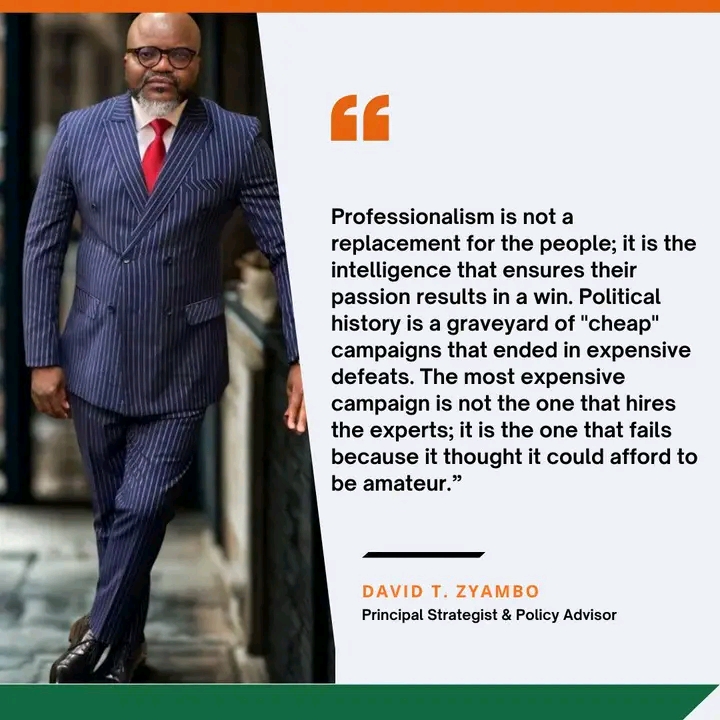
Professionalism is not a replacement for the people; it is the intelligence that ensures their passion results in a win. Political history is a graveyard of “cheap” campaigns that ended in expensive defeats. The most expensive campaign isn’t the one that hires the experts; it’s the one that fails because it thought it could afford to be amateur.