

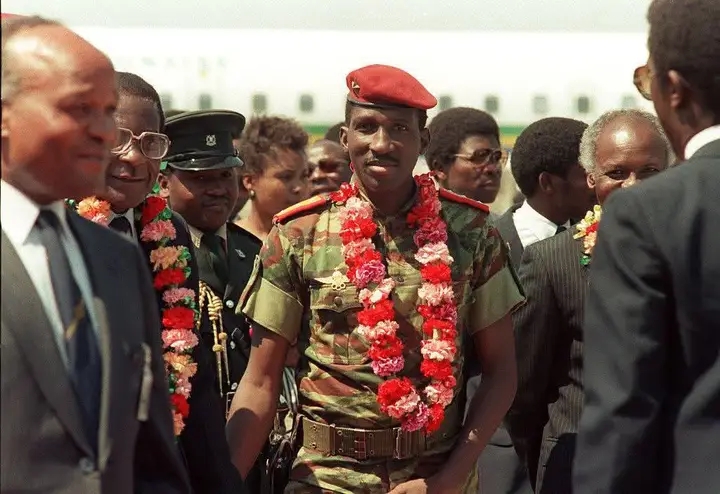
THOMAS SANKARA
He was the most dangerous kind of leader.
Not because he was violent. Because he was right.
His name was Thomas Sankara. Born December 21 1949 in Yako in present day Burkina Faso. He was a military officer who read voraciously, played guitar, rode a bicycle and believed with everything in him that Africa’s poverty was not accidental. It was manufactured. By colonialism. By corruption. By leaders who served foreign interests instead of their own people.
In 1983 at just 33 years old he came to power in Burkina Faso through a military coup.
What he did in the four years that followed is still studied in universities across the world.
He renamed the country. It had been called Upper Volta, a name given by French colonisers. He called it Burkina Faso. It means the land of upright people in the local languages.
He banned first class air travel for government ministers. If the people cannot afford it neither can their servants. He sold the government’s entire fleet of Mercedes Benz cars and replaced them with the cheapest car available in Burkina Faso at the time, the Renault 5. He took a salary of 450 dollars a month and declared that his most valuable possession was his bicycle.
He launched a vaccination campaign that immunised 2.5 million children against meningitis, yellow fever and measles in a single week. In four years he doubled the number of children in schools. He redistributed land from feudal landlords to peasant farmers. He planted 10 million trees to fight desertification. He built roads, railways and houses using local labour and local materials.
He banned female genital mutilation. He appointed women to senior government positions at a time when that was almost unheard of in West Africa. He said the revolution and women’s liberation go together.
He refused to pay what he called illegitimate debt to Western creditors. He stood at the Organisation of African Unity and told other African leaders to follow him. He said debt is a cleverly managed reconquest of Africa. He said if Burkina Faso alone refuses to pay the debt we will not be praised. But if all of Africa refuses together nobody can punish us.
Nobody followed him.
The West was watching. France especially. Because Sankara was not just transforming Burkina Faso. He was an example. And examples are contagious.
On October 15 1987 Thomas Sankara walked out of a meeting at the National Revolutionary Council headquarters in Ouagadougou. Gunmen in military uniform were waiting. He was shot at least twelve times in the chest, legs and head.
He was 37 years old.
The man who ordered his assassination was Blaise Compaoré. His closest friend. His brother in revolution. The man who had stood beside him for years.
Compaoré immediately restored relations with France. He immediately began paying the debts Sankara had refused to pay. He ruled Burkina Faso for 27 years under corruption and repression until the people finally rose up and drove him out in 2014.
In 2022 a military tribunal convicted Compaoré of murder in absentia. He was living comfortably in Côte d’Ivoire. He has never been punished.
Sankara has no statue in any Western capital. No international airport is named after him. The countries that fund democracy promotion across Africa had nothing to say when he was killed.
But in Burkina Faso they finally built him a memorial in 2025. On the exact spot where he was murdered.
And across Africa young people who were not yet born when he died are wearing his face on their t-shirts.
Because the most dangerous thing you can do to an idea is kill the person who had it.
It just makes the idea louder.
Man so fine. Oh my goodness, I’m crushing on a dead man. He come get steeze too. I don’t know why I wasn’t born when you were alive. I would have been your number 1 fan.
© SallyWrites