

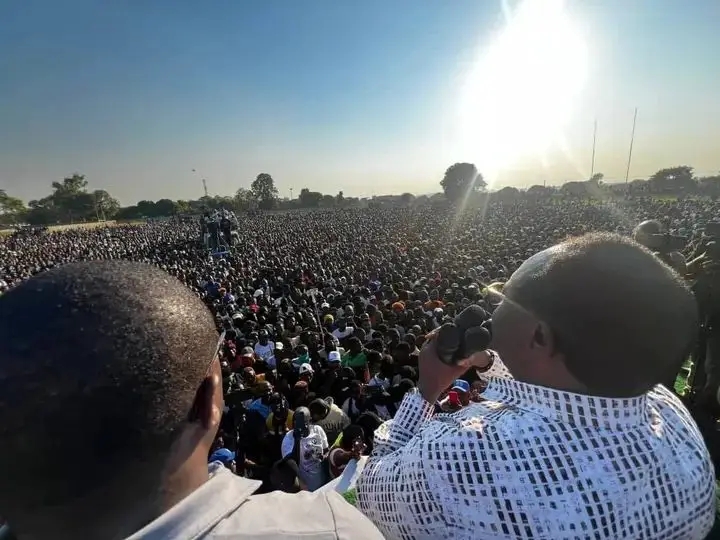
CONTEXT: What Mundubile’s Copperbelt Message Really Means
Every election has a constituency that politicians believe can shift the outcome. For Brian Mundubile and the Tonse Alliance, that constituency may well be the Copperbelt’s Jerabos.
At his campaign launch in Kitwe on Saturday, the National Reconciliation Party for Unity and Prosperity (NRPUP) candidate delivered what was arguably the most politically charged mining message of the campaign season so far. Standing before a large crowd at KPF Grounds, Mundubile promised to return Senseli Mine, Kikonge and various mining dumpsites to small-scale miners who have long argued that they were pushed out of opportunities that rightfully belonged to local communities.
“Without beating about the bush, when we are elected, we’ll give you back Senseli Mine, Kikonge and all the dumpsites,” Mundubile declared to loud cheers.
The reaction was immediate. Across social media, many former Patriotic Front supporters celebrated the remarks as a pledge to restore economic opportunities for ordinary youths. On the Copperbelt, where unemployment remains a major political issue, the promise tapped into long-standing frustrations among small-scale miners who feel excluded from the wealth generated by Zambia’s mining industry.
Yet the statement also exposes one of the clearest policy contrasts emerging in the 2026 election campaign.
For the UPND government, the past five years have largely been defined by efforts to restore formal regulation within the mining sector. Authorities repeatedly argued that illegal mining activities had grown into a national security concern, attracting criminal syndicates, dangerous working conditions, tax leakages and growing foreign involvement. Last year, government deployed defence and security personnel to parts of North-Western Province following an illegal gold rush that drew thousands of people into uncontrolled mining activities. Similar operations were undertaken elsewhere as authorities sought to bring mining activities under formal licensing systems.
Government’s argument has been straightforward: mineral resources must create wealth, but wealth must be generated within a framework governed by law, safety regulations and taxation.
Mundubile’s message approaches the issue from a different direction. Rather than focusing primarily on regulation, his rhetoric centres on access. The former Leader of the Opposition is speaking directly to citizens who believe Zambia’s mineral wealth has become concentrated among large corporations, politically connected businesses and foreign investors while surrounding communities remain poor. His appeal is less about mining policy documents and more about economic ownership.
The challenge, however, lies in implementation.
Promises to “give back” mines and dumpsites inevitably raise questions about legal ownership, licensing frameworks, environmental obligations and investor confidence. Modern mining operations function within regulatory structures that govern who can mine, where they can mine and under what conditions. Any future administration would need to explain how such transfers would occur without creating uncertainty in a sector that currently anchors Zambia’s economic recovery strategy.
The same debate extends to Mundubile’s promise that 50 percent of mining contracts should go to local suppliers. Politically, it is an attractive proposition. Economically, it reflects a growing conversation taking place across Africa about local content and ensuring citizens benefit more directly from natural resources. The question is not whether local participation should increase. The question is how such targets would be achieved while maintaining competitiveness, investment flows and production growth.
What makes the Copperbelt particularly important is that mining has never been merely an economic issue. It is also an emotional and political one. Entire communities were built around mines. Families measure prosperity through access to mining jobs. Political fortunes often rise and fall alongside perceptions of who controls mineral wealth.
This helps explain why Mundubile’s remarks resonated so strongly among sections of the electorate. He was not simply talking about dumpsites. He was speaking to a broader feeling among many unemployed youths who see mineral wealth around them but struggle to participate in it.
Whether voters ultimately embrace that vision remains uncertain. Elections often reward powerful messages. Governing requires workable policy.
For now, what happened in Kitwe reveals an important reality about Zambia’s 2026 campaign. The battle for the Copperbelt may not revolve around ideology. It may revolve around a far simpler question: who should benefit from Zambia’s minerals, and how?
That debate is only beginning.
For corrections, partnerships, advertising inquiries, opinion submissions and story tips, contact the People’s Brief editorial team at editor.peoplesbrief@gmail.com. We welcome evidence-based debate, diverse perspectives and thoughtful contributions that help readers understand Zambia’s political, economic and democratic future.
© The People’s Brief | Ollus R. Ndomu
Mundubile is reading from a tired script. How many Jerabos are there who will even vote? What was the reputation of the Jerabos before the dumpsites were ” taken away” from them? Not very impressive.
The Dean Mungomba phenomenon beckons.
Shawi Fawazi, chelilwa, masiye and chapamo myst be jumping in jubiletion,another opportunity for uncontrolled cash flow on the horizon. But not for the whole copperbelt residents, for non jerabos your women are to be abused by big headed law breaking jerabos once again. The streets ll see the return of the youngson and the like. The choice is all yours.