

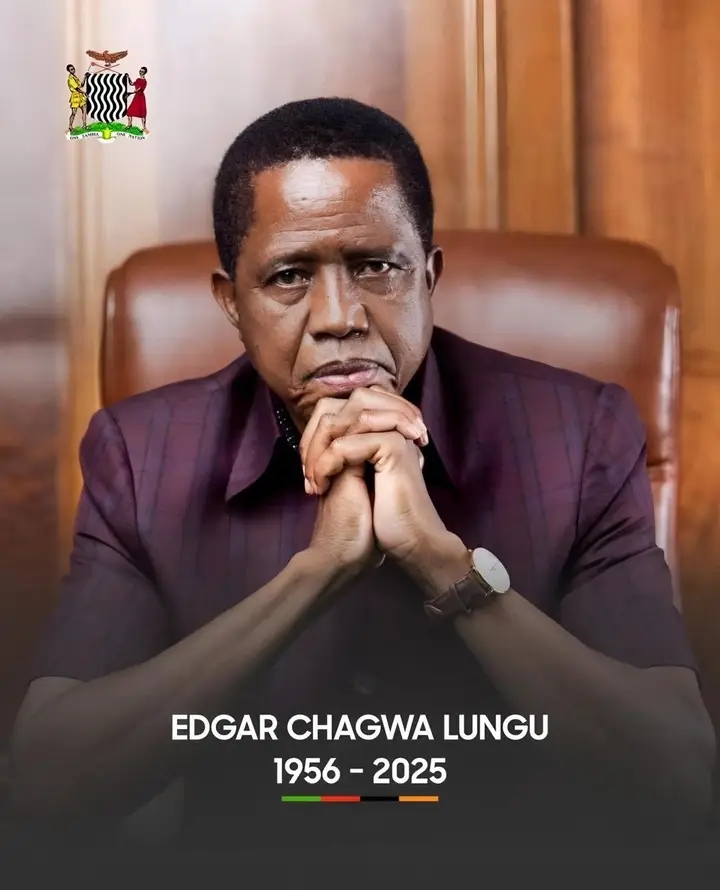
WHY EDGAR LUNGU’S IMAGE MATTERS TO THE OPPOSITION IN THE 2026 ELECTIONS
David T. Zyambo | 15 June 2026
Today’s public remarks by Nevers Mumba require a direct response. Mr. Mumba has questioned why the opposition and the Patriotic Front continue to feature the face of the late former President Edgar Lungu in their political campaigns, going so far as to claim the MMD did not campaign with Frederick Chiluba’s image, UNIP did not use Kenneth Kaunda’s, and the UPND did not utilize Anderson Mazoka’s likeness. He went on to mischaracterize the opposition as appealing to “the spirits of the dead.”
My question is, what is actually stopping UNIP, MMD, or any other party from using the faces of their former leaders? Absolutely nothing.
You simply cannot compare Edgar Lungu to Kaunda, Chiluba, or Mazoka. The facts do not match. Kenneth Kaunda was long retired from party politics when he passed away, and Frederick Chiluba was also retired, with the MMD having already transitioned through Levy Mwanawasa and Rupiah Banda before his death. Anderson Mazoka was never even the President of Zambia; when he died in 2006, the UPND was an opposition party that had to quickly market a new, living face to prove they could win state power from scratch.
Edgar Lungu’s position was entirely unique. He was not a retired bystander. He was a former Head of State who remained at the absolute center of active politics, serving as the substantive leader of both the Patriotic Front and Tonse Alliance; he was the primary anchor of the opposition’s momentum up until his final days.
Let’s strip this conversation of all superstition and look at the issue solely through the lens of political management. The real reason this issue draws criticism from Nevers Mumba and his alliance partners is not spiritual; it is entirely a question of voter loyalty, party identity, and keeping a political movement intact.
When a leader dies while actively heading a political movement, their likeness ceases to be just a photograph. It becomes a visual representation of the contemporary mandate and the promises made to the electorate.
The opposition is not “appealing to spirits of the dead” as Nevers Mumba puts it. They are preserving the institutional identity and grassroots momentum that their active leader was building up until his final days. Nevers Mumba and his alliance partners are raising these objections because they recognize that Edgar Lungu’s image still commands immense grassroots loyalty, and they want the opposition to voluntarily dismantle its most recognizable symbol and influential political asset.
This approach is standard practice across the world. Political parties consistently use the face and legacy of a leader who died in active politics to secure voter loyalty and keep their support base together.
When President Michael Sata died in office in October 2014, he was the active leader of the ruling party. During the emergency January 2015 presidential election, the party heavily relied on Sata’s face and slogans on campaign regalia alongside his successor to lock in the grassroots vote. It was correctly understood as common-sense political continuity, not spiritualism.
We see the exact same thing all over the world. Following the assassination of U.S. President John F. Kennedy in November 1963 during his active re-election bid, his successor, Lyndon B. Johnson, and the Democratic Party heavily utilized his image, voice, and photographs throughout the 1964 campaign to consolidate voters around the Kennedy mandate. Similarly, when Hugo Chávez passed away while serving as President of Venezuela, his successor, Nicolás Maduro, ran a campaign centered almost entirely on Chávez’s image, printing his iconic portrait on millions of campaign materials to maintain the movement’s core identity—a practice that continues today.
Consider the irony here—when Nevers Mumba took over the MMD presidency, he had every opportunity to align himself with the image of Levy Patrick Mwanawasa, who is widely regarded as our finest president since Kenneth Kaunda. But we all know the political realities that prevented him from doing so.
When a commander falls in the middle of a battle, a disciplined army doesn’t throw away his banner; they lift it higher to win the fight. Likewise, when a leader passes away at the helm of a political party, their legacy and image belong to the movement and the voters who invested in that vision. If the current leadership of the MMD or UNIP have failed to keep the names of their own founders relevant to the modern Zambian voter, that is an internal branding failure. They cannot rewrite the universal rules of political campaigning simply to pressure the opposition into abandoning its own leader.
lungu’s image and legacy matter a lot in the campaign. it represents the worst choice we can ever make. never again kaponya in the presidency