

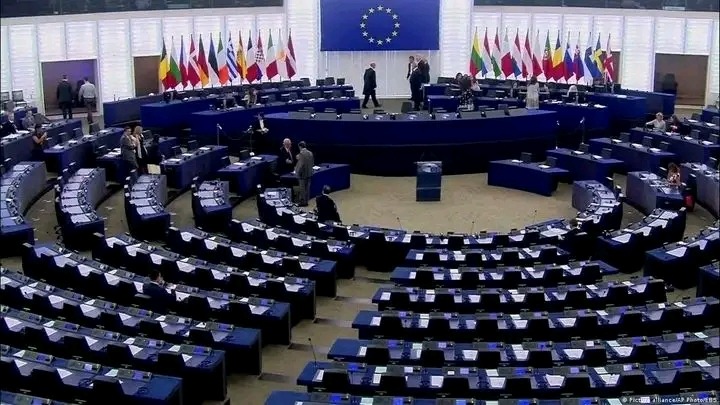
5 REASONS THE EU RESOLUTION CANNOT, BY ITSELF, DEPRECIATE THE ZAMBIAN KWACHA
By Shadrick Lusambo – CA(ZM) , Financial Analyst
There is a growing argument on social media that the European Parliament’s resolution on Zambia could weaken the kwacha.
I think we need to separate political concern from economic causation. This is where most Zambian political commentators lack relevant knowledge.
On 17 September 2026, the European Parliament adopted a resolution concerning Zambia’s post-election situation and the killing of Mutotwe Kafwaya. That is a significant diplomatic development.
But economically irrelevant at this point. We must understand that a parliamentary resolution does not automatically translate into a weaker currency I thought this should be basic knowledge but for whatever reasons most of our political commentators don’t seem to understand this and this is what worries me.
Here are five reasons you should consider before anyone scares you.
- THE RESOLUTION DOES NOT CREATE DEMAND FOR US DOLLARS
A currency depreciates when, among other factors, demand for foreign currency becomes stronger relative to its supply.
For example, If Zambian companies suddenly need significantly more dollars to import fuel, machinery or other goods, that can put pressure on the kwacha. This is in-fact what I said would happen after elections that’s why you are seeing a minor change in kwacha as the political mode begins to shift after the recent general election. Nothing strange just normal economic system.
Secondly, If foreign investors withdraw money from Zambia and convert billions of kwacha into dollars, that can also put pressure on the currency
But the European Parliament passing a resolution does neither of those things automatically because there is no direct foreign-exchange transaction created simply because members of the European Parliament voted on Zambia.
I think as Zambians we must understand that a political statement is not the same thing as a foreign-exchange shock.
- THE RESOLUTION HAS NOT IMPOSED ECONOMIC SANCTIONS ON ZAMBIA
This distinction is extremely important. And I say this because the European Parliament resolution is a political and human-rights resolution. It is not, in itself, an announcement that Zambia has been cut off from European markets, foreign investment, trade, development finance or international banking.
Those would be materially different events.
If Zambia were subjected to significant financial sanctions, restrictions on international transactions or major suspension of external financing, then we would have to assess the potential consequences for foreign currency inflows.
But that is not what the resolution itself does.
That’s why, saying: “The EU passed a resolution, therefore the kwacha will depreciate” is not only ridiculous but gross lack of understanding of basic economic principles.
Such a statement skips several economic steps that would first have to occur for the kwacha to depreciate.
- THE KWACHA IS BEING SUPPORTED OR PRESSURED BY MUCH BIGGER FUNDAMENTALS
The Bank of Zambia itself shows us what has recently driven the currency.
During the first quarter of 2026, the kwacha appreciated by approximately 14.8% against the US dollar. The Bank of Zambia attributed that sharp appreciation largely to strong foreign-currency inflows from the mining sector and foreign financial institutions.
That tells us something fundamental.
The major forces moving the kwacha are things such as: copper export receipts, mining-sector dollar inflows, foreign investment, demand for imports, interest rates, international reserves and market liquidity.
Those forces are far larger than a a single EU parliamentary resolution standing alone.
- ZAMBIA CURRENTLY HAS IMPORTANT EXTERNAL BUFFERS
As of the IMF’s May 2026 assessment, Zambia’s gross international reserves had risen to approximately US$6.4 billion, equivalent to around 4.4 months of prospective imports. Sadly this is something most our political commentators spilling fear don’t seem to understand.
You will recall that Zambia also recorded a K4.1 billion trade surplus in July 2026, with exports of approximately K29.7 billion compared with imports of K25.6 billion.
Why does that matter?
It matters because a country’s currency is ultimately affected by its ability to earn and attract foreign currency. This substance cannot be wiped out by a single EU resolution.
If mines continue exporting copper, exporters continue bringing dollars into Zambia, reserves remain healthy and foreign investment continues, a political resolution by itself does not remove those dollars from the economy.
The EU resolution can make a good headline but the reality is that currencies respond to economic flows, not headlines alone.
- THE REAL RISK IS NOT THE RESOLUTION. IT IS WHAT COULD FOLLOW IT
This is probably the most important point I would like many Zambians to understand.
The resolution itself is unlikely to be enough to materially depreciate the kwacha. But I would be failing in my duties as an analyst if I don’t mention that political developments can become economic developments. We have seen this a lot.
For example, if the situation eventually resulted in:
- Substantial foreign investors withdrawing capital
- Important development financing being suspended
- Serious deterioration in Zambia’s access to international financing
- Major damage to investor confidence;
- Reduced foreign direct investment; or
- Significantly weaker relations with major economic partners,
then the conversation changes.
Those developments could affect the supply and demand for foreign currency. And that could eventually affect the kwacha.
But notice the difference: The resolution would not be depreciating the kwacha. The depreciation would come from the economic consequences that might follow if the political situation materially changed trade, investment, financing or capital flows.
THE BOTTOM LINE
We must be careful not to turn every political headline into an exchange-rate forecast.
I agree that the European Parliament resolution deserves serious discussion. Its allegations, Zambia’s responses, questions of governance and the international reaction should all be examined on their evidence.
But economically, there is currently an important distinction that we must not ignore:
- A European Parliament resolution is not the same thing as sanctions.
- It is not capital flight.
- It is not a fall in copper exports.
- It is not the withdrawal of US$6 billion from Zambia’s reserves.
- And it is not automatically a foreign-exchange crisis.
The kwacha will ultimately respond much more strongly to what happens to copper, exports, foreign investment, reserves, government finances, inflation, interest rates, imports and confidence in the economy.
So watch the politics. But when analysing the kwacha, follow the money.
Because: POLITICAL HEADLINES MAY MOVE SENTIMENT. MONEY FLOWS MOVE CURRENCIES.
Stay informed, don’t be misled