

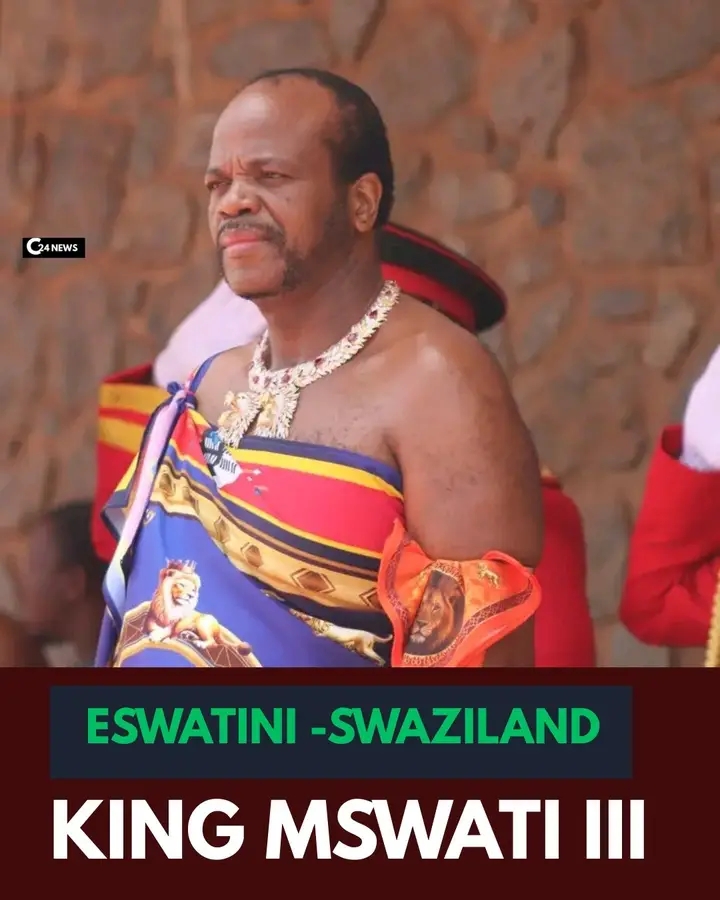
🟥THIS IS KING MSWATI III
The King of Eswatini, formerly Swaziland. He has been in power for 40 years.
Eswatini is the only absolute monarchy in Africa. This means King Mswati III holds most of the power in the country. He is not a ceremonial leader like most kings around the world. The government answers to him and he has the final say on major decisions.
Eswatini also has a Prime Minister but this Prime Minister is appointed by the King and can be removed by the King. The constitution says the Prime Minister is chairman of the Cabinet and leader of Government business in Parliament. That means the Prime Minister is formally the head of government, but in practice executive power is concentrated in the King.
The King is the Commander-in-Chief of the Defence Forces and also the Commissioner-in-Chief of the police.
He has the power to
▪️appoint ministers and judges.
▪️sign bills into law
▪️dissolve Parliament
▪️receive foreign envoys and appoint diplomats
▪️issue pardons
▪️reduce sentences issued by judges
▪️declare a state of emergency
▪️confer honors
▪️establish commissions
▪️order a referendum.
Virtually all senior government officials are appointed by the King, even though the constitution says some appointments must be made in consultation with the Prime Minister.
Eswatini has a parliament with two houses: the Senate and the House of Assembly. Members of the House are elected, but they do not belong to political parties. Political groups are exist in Eswatini but they are historically not permitted to participate in elections. The King also appoints a significant number of Parliamentarians.
So you can see that most of the power is in the hands of the King.
But it was not always like this. When the country became independent in 1968, it was set up as a constitutional monarchy with a multi-party parliamentary system
.
In 1973, Mswati’s father, King Sobhuza II, suspended the constitution, banned political parties, and took full control of the country. From then on, Swaziland became an absolute monarchy. But not everyone folded. Over the years people resisted and protested.
So in 2005, a new constitution was created after many years of pressure from the international community, workers’ unions, and pro-democracy groups. They wanted an end to the system where the king had ruled by decree since 1973.
The constitution came into force in 2006 and is still in place today. It includes a bill of rights, with freedoms like speech and equality for women.
However, as I showed you earlier, power still remains with the king. Political parties are still not allowed to take part in elections, and the king still has strong authority over how the country is run.
King Mswati III was born in 1968 and became king in 1986 after his father died. He has several wives, as polygamy is part of royal tradition in Eswatini.