

ANALYSIS | The New Voters’ Register & an Old Political Geography
Zambia’s 2026 electoral register is not merely a voter database. It is an early political map of where power may rise, where it may decline, and where the next presidential election could quietly be decided long before polling day.
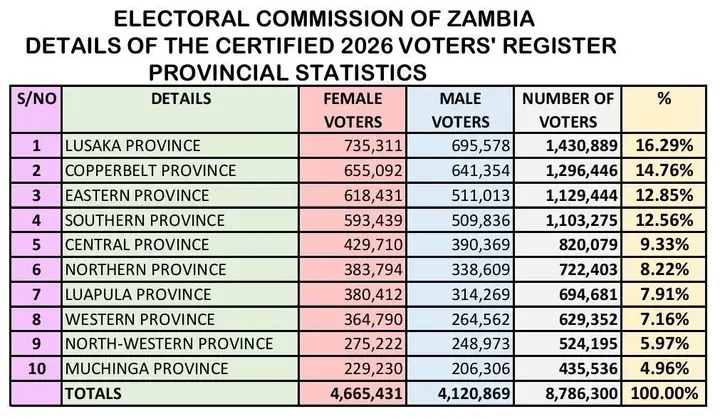
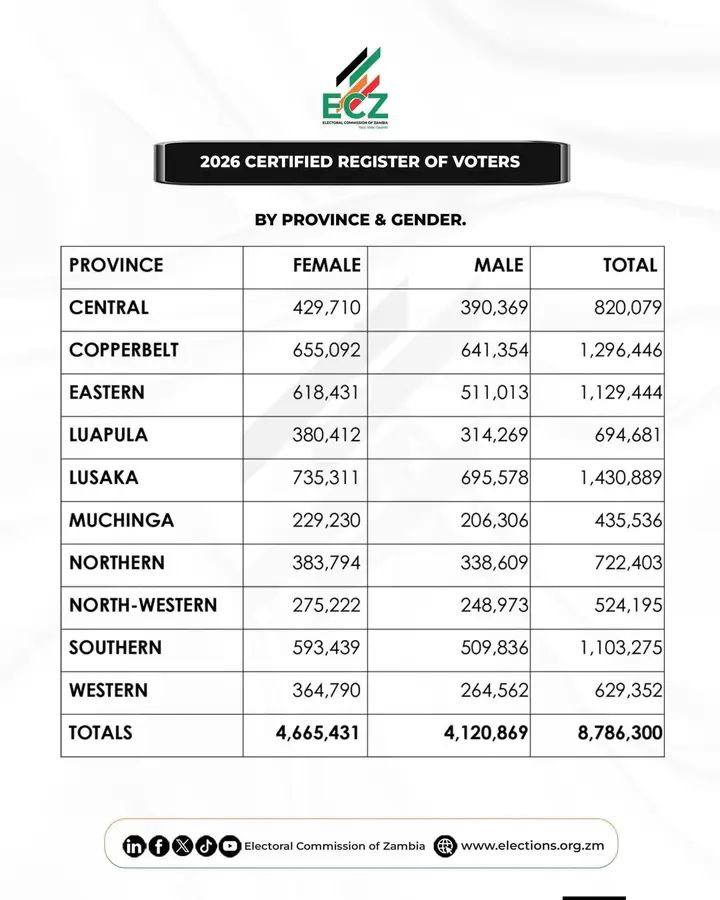
The Electoral Commission of Zambia (ECZ) has certified 8.78 million voters ahead of the August general election. Lusaka Province alone now holds over 1.43 million voters, followed by Copperbelt with 1.29 million, Eastern with 1.12 million, and Southern Province crossing the one million mark at 1.10 million. Beneath these numbers lies a more consequential political story: the consolidation of UPND dominance in its traditional red bases, the fragmentation of the Patriotic Front’s green corridor, and the growing importance of urban swing provinces where elections are increasingly won or lost.
The 2021 presidential election established two clear political belts. The UPND swept Southern Province with 91.8 percent of the vote, North-Western with 87.5 percent, and Western Province with 82.3 percent. Those margins were not ordinary victories. They were electoral walls. Hakainde Hichilema also crossed the 50 percent threshold in Lusaka, Copperbelt and Central Province, giving him the urban and economic centres required for a national victory.
By contrast, Edgar Lungu and the PF retained dominance across the northern corridor, particularly Muchinga, Luapula, Northern and Eastern provinces. In Muchinga, Lungu secured 61.8 percent. Luapula gave him 60.9 percent. Northern Province stood at 56.3 percent while Eastern Province delivered 54.2 percent. The 2021 election therefore reflected Zambia’s familiar electoral geography: the red bases in the south and west against the green bases in the north and east.
But 2026 is not 2021.
The first major difference is political structure. In 2021, PF remained a relatively intact machine behind an incumbent president. Today, the opposition landscape is fractured into multiple centres of gravity. The PF itself remains divided between rival factions, legal disputes, competing power centres, and unresolved succession battles following the death of former president Edgar Lungu. Tonse Alliance has attempted to emerge as a broader anti-UPND vehicle, but even within the opposition, over 25 presidential candidates have reportedly paid nomination fees or declared interest. The opposition’s greatest challenge is no longer simply mobilization. It is consolidation.
This matters because Zambia’s electoral system rewards unity more than noise.
Even a small erosion in PF’s traditional green bases could prove costly in a fragmented race. The by-election trends of the last two years already suggest movement beneath the surface. UPND has steadily made inroads into parts of Northern, Eastern and Muchinga provinces, not necessarily by dominating, but by reducing PF margins while consolidating its own national coalition. Politically, reducing your opponent’s dominance from 65 percent to 52 percent in a stronghold can be as strategically important as winning a swing province outright.
The second major shift lies in demographics and urban concentration. Lusaka and Copperbelt now carry enormous electoral weight. Combined, the two provinces account for nearly 2.73 million registered voters. In 2021, Hichilema won Lusaka with 53.6 percent and Copperbelt with 56.3 percent. Those victories were decisive because urban voters often shape national momentum, media narratives, turnout enthusiasm, and middle-class political discourse.
What makes Lusaka particularly significant is that it is no longer merely a battleground province. It is becoming a national mood indicator. Economic pressure, employment levels, fuel prices, cost of living, and governance perception are often felt first and discussed loudest in Lusaka. A ruling party that retains Lusaka and Copperbelt while maintaining dominance in the southern red belt enters any election with a formidable arithmetic advantage.
Meanwhile, Southern Province itself has quietly become even more consequential. ECZ figures now place Southern above one million registered voters. In practical terms, Hichilema’s strongest political base has grown numerically while remaining structurally loyal. Western and North-Western provinces also continue to expand steadily, reinforcing the demographic strength of the UPND coalition.
The opposition’s calculation therefore becomes increasingly difficult. To overcome UPND’s southern and western dominance, it would need overwhelming turnout and near-total consolidation across the northern corridor while simultaneously reclaiming urban voters in Lusaka and Copperbelt. At present, there is little evidence of such cohesion.
Yet the ruling party also faces its own risks.
Incumbency creates expectations. The same urban voters who embraced UPND in 2021 over economic frustrations may become more demanding in 2026. Rising costs of living, youth unemployment, debt pressures, and governance controversies remain politically potent issues. The UPND’s advantage lies in infrastructure visibility, free education, expanded CDF, and macroeconomic stabilization messaging. The opposition’s opportunity lies in converting economic frustration into a unified national message. So far, however, the opposition appears louder on emotion than on policy coherence.
There is also the question of voter psychology after Edgar Lungu. In many PF strongholds, the former president was not merely a politician. He was an emotional centre of political identity. His absence creates uncertainty over succession, loyalty, and voter transferability. History across Africa shows that personality-driven parties often struggle after losing a unifying figure. PF faces such a transition phase in opposition.
Still, elections are rarely decided purely by arithmetic. They are decided by organization, turnout, emotional momentum, elite endorsements, media narratives, and the ability to convince undecided voters that change or continuity serves their interests better.
For now, the numbers suggest one reality: UPND enters the 2026 election cycle with structural electoral advantages anchored in expanding red bases, urban control, and a fragmented opposition landscape. But Zambia’s electoral history also shows that political ground can shift quickly when economic anxiety, elite fractures, and public sentiment collide.
The map is changing. The question is whether the opposition can reorganize before the numbers harden into inevitability.
© The People’s Brief | Ollus R. Ndomu