Mbinji Mufalo writes …
Beyond the Number – What 77 Bills really mean
Few issues have generated as much social media commentary in Zambia’s 2026 pre-elections legislative season as the claim that “77 Bills in one sitting is simply too much.” At face value, the number sounds alarming, almost tailor-made for social media outrage. To some, it suggests an overburdened Parliament, rushed lawmaking before elections, and inadequate scrutiny.
A closer examination of the 77 Bills before the National Assembly of Zambia tells a very different story. One that is less about legislative excess, and more about scrutiny burden, governance priorities, and public interest.
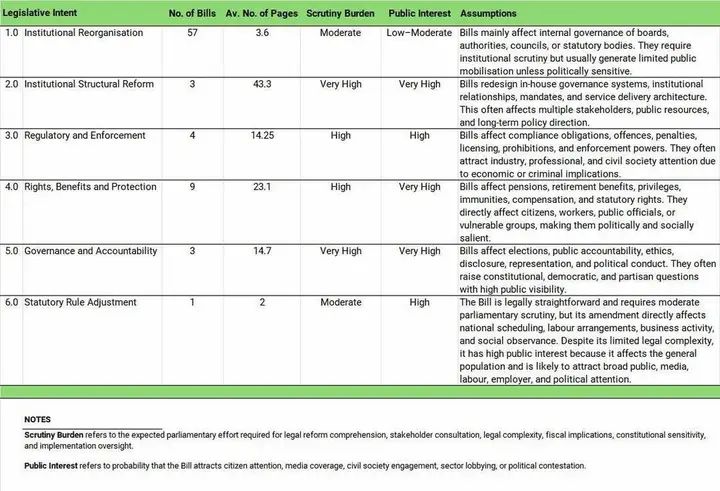
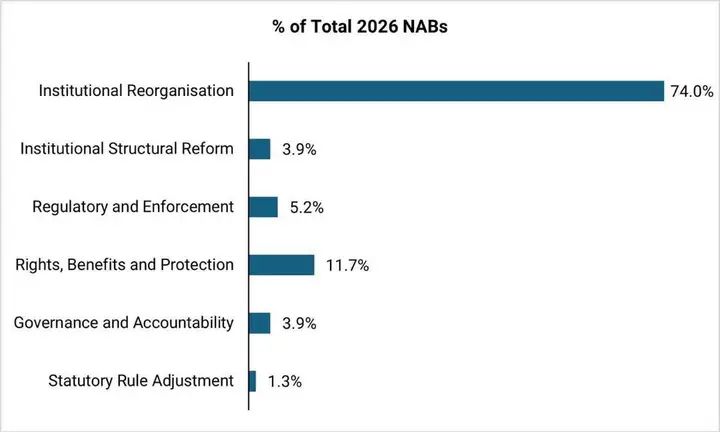
…The first finding immediately challenges the “77 Bills” narrative. Of the 77 Bills, 57 Bills (74.0%) fall under Institutional Reorganisation. These Bills mainly reorganise existing public institutions through board restructuring, and other governance adjustments.
More importantly, these 57 Bills average only 3.6 pages each.
This single statistic changes the conversation. A three-page amendment revising the composition of a statutory board cannot reasonably be treated as equivalent to a forty-page sector reform Bill. Yet on social media, both are casually counted as “one Bill.” That is how legislative noise is manufactured. One headline, one post, and one incomplete statistic at a time.
…Scrutiny burden is the expected parliamentary effort required for legal reform comprehension, stakeholder consultation, legal complexity, fiscal implications, constitutional sensitivity, and implementation oversight. And public interest, is the probability that a Bill attracts citizen attention, media coverage, civil society engagement, sector lobbying, or political contestation.
While Institutional Reorganisation Bills dominate numerically, they carry only a moderate scrutiny burden and generally attract low to moderate public interest. They mainly affect revision of composition of boards, commissions, authorities, and statutory bodies.
…The real story of the 77 Bills is not that Parliament has “too many Bills.” The real story is that Parliament is processing a legislative programme made up largely of short institutional amendments, with only a small number of structurally transformative, politically sensitive, or rights-based reforms.
So when critics say, “77 Bills in one year is excessive,” the better question is not how many Bills? The better question is. “How much scrutiny does each Bill demand, and how deeply does each Bill touch public life?”
Perhaps the problem was never 77 Bills. Perhaps the problem was counting Bills without reading them.
That, ultimately, is what lies beyond the number and what 77 Bills really mean.
Veritas est adaequatio rei et intellectus.
Kozo.