

🇿🇲 ANALYSIS | Mundubile–Makebi Pact Reshapes Opposition Terrain, But Does It Change the Electoral Math?
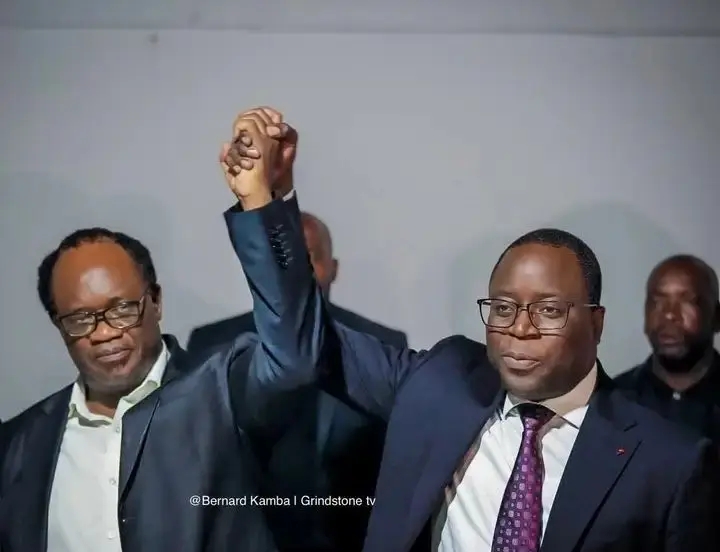
The announcement of a political pact between Brian Mundubile and Makebi Zulu marks one of the most consequential opposition realignments since the fragmentation of the Patriotic Front began after 2021. Coming just months before the August elections, the agreement seeks to consolidate sections of the PF green bases under the Tonse Alliance umbrella, with Makebi emerging as Mundubile’s running mate in what appears to be an attempt to stabilise opposition politics around a single presidential ticket.
Politically, the symbolism matters immediately.
For months, the opposition space has suffered from what many insiders privately describe as “presidential inflation” — too many candidates, too many alliances, and too little consolidation. More than 25 presidential aspirants have paid nomination fees with the Electoral Commission of Zambia, while opposition messaging remained fragmented between economic grievances, Edgar Lungu’s burial dispute, and internal succession battles. The Mundubile–Makebi arrangement therefore represents an acknowledgement that fragmentation was becoming electorally suicidal.
The strategic calculation is straightforward. Mundubile brings institutional visibility through the Tonse Alliance framework and his long parliamentary experience. Makebi brings emotional capital within PF circles, especially among supporters who see him as one of the most vocal defenders of former President Edgar Chagwa Lungu during the burial impasse and wider legal battles involving the party. Together, they are attempting to create a bridge between PF loyalists, Tonse structures, and sections of the anti-UPND vote searching for coherence.
But the central question remains: does this materially change the electoral arithmetic?
At present, the answer is uncertain.
Zambian elections are historically won through regional consolidation before national expansion. The UPND perfected this formula over two decades, building overwhelming dominance in the red bases of Southern, Western, and North-Western Provinces before expanding into urban and central regions. PF under Michael Sata and later Edgar Lungu did the same in the northern corridor: Luapula, Northern, Muchinga, Copperbelt, and parts of Eastern Province.
The challenge facing Mundubile and Makebi is that the PF green bases are no longer politically intact.
By-elections over the past two years have revealed shifting loyalties, declining organisational cohesion, and growing UPND penetration into areas that were once treated as guaranteed PF territory. Even where resentment against government exists, fragmentation inside PF has weakened mobilisation capacity. Rival factions, court battles, defections, and uncertainty over legitimate structures have all eroded confidence among grassroots supporters.
This means the pact may consolidate emotion faster than it consolidates machinery.
Another complication is timing. Campaign season is effectively already underway. Parliament is dissolving. Candidate adoptions are intensifying. Political structures on the ground are largely established. Alliances formed too close to elections often struggle with operational integration, deciding candidate sponsorships, coordinating campaign messaging, distributing resources, and resolving internal suspicions among competing camps.
There is also the manifesto question.
So far, the emerging opposition coalition still appears more united by resistance to UPND than by a clearly articulated governing philosophy. This has been the recurring weakness of the opposition since 2021. The ruling party, despite economic pressures and criticism over governance issues, still possesses identifiable flagship programmes: free education, debt restructuring, infrastructure expansion, and large-scale recruitment in health and education.
The opposition, by contrast, has not yet fully crystallised a compelling alternative economic vision capable of dominating the national conversation. Voter frustration alone rarely guarantees regime change unless accompanied by a credible governing proposition.
The ideological chemistry of the new pact also raises questions. Tonse remains a coalition of diverse political interests rather than a deeply institutionalised party. Makebi himself is more known as a legal and political combatant than as a grassroots mobiliser. His visibility is strongest in legal and media spaces. Translating that visibility into electoral mobilisation across provinces is a different challenge entirely.
Still, dismissing the pact entirely would be politically careless.
Opposition politics often changes rapidly once perceptions of momentum emerge. If the alliance succeeds in stabilising PF structures, reducing parallel candidacies, and emotionally reactivating the northern corridor, it could create a more competitive race than current numbers suggest. Elections are not decided only by party structures. They are also shaped by turnout psychology, elite defections, economic mood, and campaign momentum in the final weeks.
For now, however, the pact appears more defensive than transformational.
It may stop further fragmentation.
It may restore some morale.
It may consolidate sections of the anti-UPND vote.
But whether it can fundamentally alter the national electoral map, particularly against a ruling party that still dominates its traditional red bases with near-hegemonic margins, remains the larger unanswered question.
The opposition has finally started consolidating.
The real test is whether consolidation has come early enough to matter.
© The People’s Brief | Political Desk
To some of us this merger is not effective. HH and UPND will still win by landslide.
From my own survey, finally I have today heard people in my town talking about the Elections on 13th August,2026. This speaks Volumes.
Iwe ka Impala
These two idiots have the same supporters and therefore, the same electors.Unless you think everyone one of them will vote twice
Dull chap!
The same group of thieves who caused the country to go bankrupt are attempting to return and plunder the treasury once more.Their businesses cannot thrive without the fraudulent government tenders and contracts they have been signing without adhering to proper procedures.They are exploiting a small number of uneducated voters without providing any substantial messages for the nation.HH has closed them from looting public resources
Ifwe na HH we are busy planning and strategizing for 5mil votes, these others are busy talking about uniting, even after 5 years.
So HH is miles away, untouchable.
Just wait when its time for power sharing how this pact will dissolve faster than ice on a hot day.