

BY Given Mutinta
THE SYMBOLISM OF ARCHBISHOP EMERITUS MPUNDU’S SENDOFF
Archbishop Emeritus Telesphore George Mpundu was put to rest today on May 21, 2026 at the Cathedral of the Child Jesus, Pope Square.
His funeral Mass, like many Catholic rites, was imbued with profound symbolism, offering a visual language that speaks to faith, hope, and the journey of the soul.
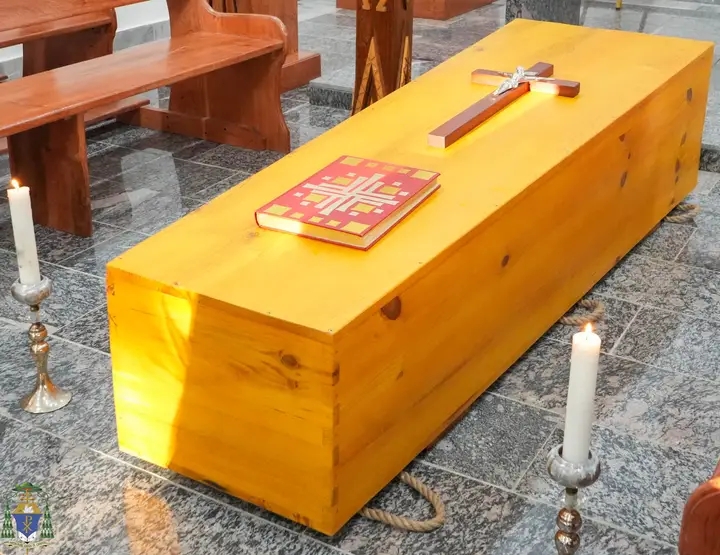
Archbishop Emeritus Mpundu is resting in a brightly coloured, golden-yellow wooden coffin.
The choice of simple wood, with its visible grain and knot details, signifies the naturalness of human life and the earth from which we come and to which we will return, as echoed in the biblical phrase “dust thou art, and unto dust shalt thou return” (Genesis 3:19).
The golden-yellow hue is particularly significant, representing divinity, resurrection, and the glorious light of heaven.
In Catholic iconography, gold is often associated with God’s glory and the eternal kingdom.
It suggests that Archbishop Mpundu’s earthly journey is not an end, but a transition towards a life of divine radiance.
The simplicity of the coffin’s construction is a testament to humility, a virtue highly prized in Christian life, suggesting that earthly possessions and status hold little importance in the face of eternal judgment.
The dark gray, speckled floor beneath the coffin provides a sober contrast, grounding the symbolic richness of the coffin in the reality of earthly mortality.
It represents the darkness of death and the passage through the underworld, from which the soul ascends towards the light of heaven.
Positioned towards the head of the coffin, the wooden cross with a metallic crucifix attached is perhaps the most potent symbol in Christian funerary rites.
The cross itself is the universal symbol of Christianity, representing Jesus Christ’s sacrifice on the cross for the redemption of humanity.
It signifies suffering, death, and ultimate victory over sin and death through the Resurrection.
The metallic crucifix, a representation of Christ’s suffering and death, serves as a reminder of the central tenet of the Catholic faith: that Christ’s passion and death paved the way for eternal life.
For a bishop like Archbishop Mpundu, who dedicated his life to serving God and his flock, the cross symbolizes his own commitment to following Christ, sharing in His suffering, and aspiring to His glory.
It is a visual testament to his faith and his hope in the Resurrection.
The placement at the head of the coffin signifies that Christ leads the way, guiding the deceased into the presence of God.
Next to the cross lies the Book of Gospels, or Evangeliary. This sacred book contains the accounts of Jesus Christ’s life and teachings, as recorded by the four evangelists: Matthew, Mark, Luke, and John.
Its presence symbolizes the centrality of the Word of God in the life of Archbishop Mpundu and in the Catholic faith.
The Gospels are the foundation of Christian belief and practice, offering salvation and eternal life to those who believe and live according to Christ’s teachings.
By placing the Book of Gospels upon his coffin, the Church signifies that Archbishop Mpundu’s life was guided by the teachings of Christ, and that his hope for eternal life is rooted in the promises of the Gospel. It represents the spiritual nourishment and guidance he received and imparted throughout his ministry.
It also signifies that his ultimate judgment will be based on the divine word he so faithfully preached and lived.
The lit white candles in ornate silver candle holders flanking the coffin are also deeply symbolic.
White symbolizes purity, innocence, and the light of Christ. Candles represent the eternal light of God, and their flame signifies the presence of the Holy Spirit, the divine spark that animates life and guides the soul.
In Catholic tradition, candles are lit during prayer and liturgy to signify prayer and worship.
During a funeral Mass, they represent the prayers of the faithful for the deceased, as well as the hope that the deceased will be welcomed into the eternal light of heaven.
The ornate silver candle holders suggest reverence and dignity befitting a holy person, reflecting the value the Church places on the faithful departed.
The illumination from the candles symbolizes the hope of resurrection and the eternal life that awaits the believer in God’s presence, dispelling the darkness of death.
Together, these elements create a powerful visual narrative of the Catholic understanding of death not as an end, but as a transition, a hopeful journey towards reunion with God, guided by faith and love.