

🇿🇲 ANALYSIS: Energy Reckoning and Mining Realignment in Hichilema’s Pre-Dissolution SONA
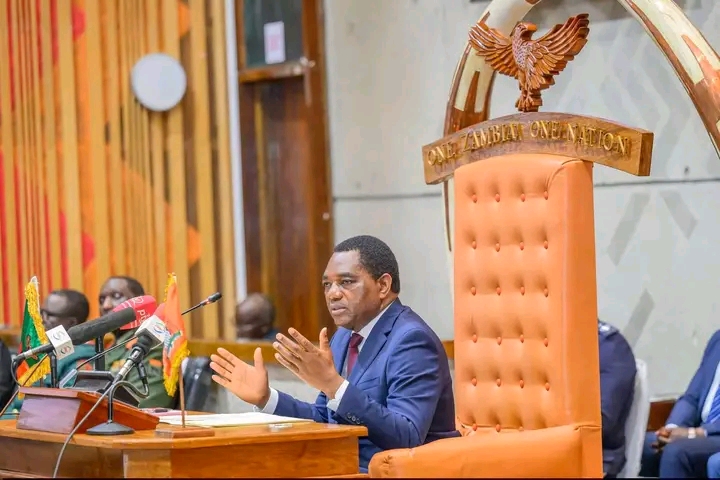
President Hakainde Hichilema’s Friday address to the National Assembly was constitutionally anchored in Article 8 values. But politically, it was something else. It was the President’s first term final national values speech before Parliament dissolves in May. It was part report card, part confession, part economic positioning ahead of August 13.
Two sectors defined the subtext of the speech: energy and mining. Both have shaped the political temperature of this administration. Both are now central to the 2026 narrative.
♎ The Energy Reckoning
The President did not dodge the crisis. He named it bluntly.
He described the blackout period as “the decapitation of the generating capacity because of the trial drought.” That was not poetic language. It was admission. Zambia’s hydropower backbone collapsed under severe climate shock. More importantly, Hichilema acknowledged structural neglect:
“As a nation for decades, the energy sector has been neglected.”
That sentence carries historical weight. Zambia built its electricity architecture around hydro dependency without serious diversification for decades. The drought exposed that fragility. What many citizens interpreted as incompetence was, in fact, long-standing structural vulnerability meeting climate reality.
Then came the apology.
“Madam Speaker, once more, we take this opportunity to apologize to the people of Zambia for the pain they endured during the difficult times with electricity shortages.”
Presidents rarely apologize in Parliament. This was calculated humility. He went further: “On behalf of those who sat in the chair, I say today, I want to apologize for not having taken proactive measures.”
This apology extends accountability beyond his tenure. It reframes the crisis as systemic rather than partisan.
The political pivot was transparency: “We acknowledged that we had a problem in electricity… We don’t want to hide. We don’t want to conceal a problem. We want to acknowledge a problem and deal with it.”
The communication failure of the energy crisis was not absence of action. It was absence of visible narrative. Solar projects, clean coal expansion, open access frameworks, emergency imports, and private participation reforms were underway. But they were poorly explained to households experiencing 18-hour load shedding.
Now the message is clearer: loadshedding hours are being “drastically reduced” and in some locations “completely ending.” Nearly 60,000 new connections were completed even during crisis conditions. Connection fees have been reduced in peri-urban and rural areas. Solar plants and clean coal diversification are being institutionalised.
Energy was President Hichilema’s weakest political flank. His address attempted to close that vulnerability before election season intensifies.
⬆️ Mining: From Recovery to Strategic Positioning
If energy was apology, mining was assertion. The President declared that in just over four years, Zambia has attracted: “Well over $12 billion” in mining investment.
This figure is not trivial. It coincides with global copper demand surging due to artificial intelligence infrastructure, electric vehicles, defence supply chains, green transition commitments, and power grid upgrades. Copper is no longer just a commodity. It is geopolitical infrastructure.
The global copper rush is real. AI data centres require massive energy and copper wiring. EV manufacturing multiplies copper demand. Renewable grids demand more transmission capacity. Zambia sits on one of the largest untapped copper endowments globally.
The President’s message at Indaba earlier this month was blunt: “All minerals are critical minerals.” This Parliament address aligned with that strategic repositioning.
Copper production has rebounded. Investment pipelines are expanding. Local content is being formalised under Statutory Instrument No. 68, which prioritises Zambian suppliers in mining procurement.
But mining is not just copper.
January’s Kikonge gold rush episode revealed another dimension. When informal gold discoveries triggered chaotic migration and unregulated activity, the military intervention caused a rapid exodus. That incident exposed both opportunity and governance gaps. Gold rushes can stimulate rural economies. They can also trigger lawlessness and fatalities.
The President acknowledged the need to strengthen the regulatory framework to promote: “Safe mining, secure, legal, structured, sustainable mining practices to avoid the needless loss of life.”
Language choice here was not accidental. It directly addresses the artisanal surge and the Kikonge-type volatility. At the same time, he announced projected job creation in Sinda’s phosphate project:
“Mark my words, we will have over 5,000 to 10,000 jobs in Sinda.” This settles in like a campaign-grade language. But it is tied to mineral diversification strategy.
🔖 The Global Context
The copper rush is not sentimental. It is structural. China continues dominating smelting capacity. The United States is launching critical mineral supply chain initiatives. Gulf investors are entering African mining jurisdictions. Europe is accelerating energy transition policies. AI buildout in the US and Asia is increasing copper wiring demand exponentially.
Zambia is now positioned not as a distressed miner, but as a stabilised supplier in a tightening global supply market. This matters for the Kwacha. It matters for reserves. It matters for bond inflows. It matters for fiscal space.
Mining is financing macroeconomic recovery. The IMF programme concluded. Inflation has returned to single digits. The currency is strengthening. Bond auctions are oversubscribed. Those trends are not independent of mining recovery.
🔴 The Political Subtext
President Hichilema’s address was not just a constitutional speech on national values. It was a framing speech.
– Energy: apology and correction.
– Mining: momentum and opportunity.
– Diversification: value addition instead of raw exports.
– Governance: regulatory tightening after Kikonge chaos.
– Election: implicit request for continuity.
The President also took time after the address to mingle across the aisle. Opposition members engaged cordially. The visual matters. Stability matters in investment cycles.
Zambia is entering an election year with:
– Single-digit inflation
– Strengthening currency
– Rising copper demand
– Increased mining investment
– Diversification of energy sources underway
The vulnerabilities remain. Energy diversification is not complete. Gold regulation must mature. Local value addition still lags. Mining revenues must translate visibly into jobs and social outcomes.
But structurally, the trajectory has shifted. The President’s first term pre-dissolution address was less about national values in theory and more about economic legitimacy in practice.
Energy was the scar. Mining is the engine.
The August election will test whether voters see those two stories as credible enough to renew the mandate.
© The People’s Brief | Analysis —Ollus R. Ndomu; Gathering —Chileshe Sengwe
I want free education into law NOW, before parley is dissolved