

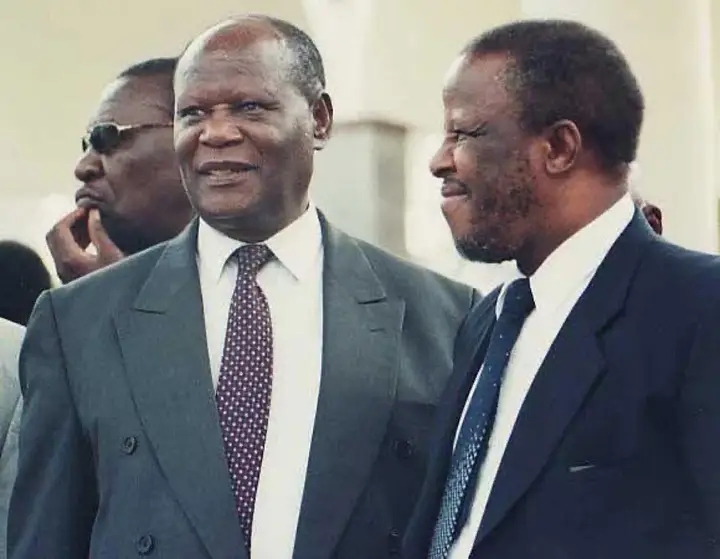
BOTSWANA POWER GAME: MASIRE BACKED MOGAE IN SECRET SUCCESSION PLAN
Botswana’s reputation as one of Africa’s most stable democracies nearly unravelled in the early 1990s, when the ruling Botswana Democratic Party (BDP) was torn apart by an intense internal succession battle that would ultimately reshape the country’s leadership.
The crisis began with a land scandal in 1991, when allegations of irregular allocations in Mogoditshane prompted President Ketumile Masire to launch a formal commission of inquiry. What followed sent shockwaves through the political elite.
The findings implicated then Vice President Peter Mmusi and influential BDP secretary-general Daniel Kwelagobe, accusing them of poor judgement and questionable conduct. The fallout was immediate and explosive. Parliament descended into heated debate, students took to the streets in protest, and trade unions joined the growing public outcry. Both men eventually resigned, leaving a power vacuum at the top of government.
Suddenly, Botswana’s ruling party faced its most serious crisis since independence. Attention turned to who would succeed Mmusi as vice president and eventually take the presidency itself.
Political heavyweights such as Ponatshego Kedikilwe and Mompati Merafhe were widely tipped as frontrunners. But President Masire surprised many by selecting a quiet, highly respected technocrat: Festus Mogae.
Unlike traditional party insiders, Mogae had built his reputation in economics and governance, serving as an IMF executive director and later governor of the Bank of Botswana. Calm, apolitical, and deeply trusted, he was seen as the ideal stabilising figure amid rising factional warfare.
Inside the BDP, rival camps were already locked in bitter conflict—often referred to as the “Big Two” versus the “Big Five.” Legal disputes, suspensions, and explosive party congresses exposed deep fractures within the ruling elite, with the organisation appearing dangerously split.
While others fought for influence, Mogae remained deliberately detached, avoiding factional battles and maintaining a low profile. That restraint would prove decisive..
By 1995, Masire had settled on Mogae as his preferred successor. But there was a problem: Mogae lacked a strong internal power base and risked losing a contested leadership race.
The solution was controversial but effective. Masire quietly championed constitutional amendments introducing automatic presidential succession, reducing the likelihood of internal party contestation.
Critics within the BDP argued the reforms concentrated too much power in the presidency and effectively allowed a sitting leader to handpick a successor. Despite resistance, the amendments were passed in 1995.
On 1 April 1998, Masire stepped down. Mogae was sworn in as President of Botswana in a smooth, orderly transition that won international praise for its calm and constitutional nature.
But behind the scenes, it had been a carefully managed political engineering process—one born out of crisis, factional war, and elite compromise.
Mogae’s rise underscored a defining truth about Botswana’s political system: its stability was not accidental, but deliberately constructed, protected, and negotiated by a leadership elite determined to avoid chaos at all costs.
In the end, the quiet technocrat became the country’s steady hand at the helm.