

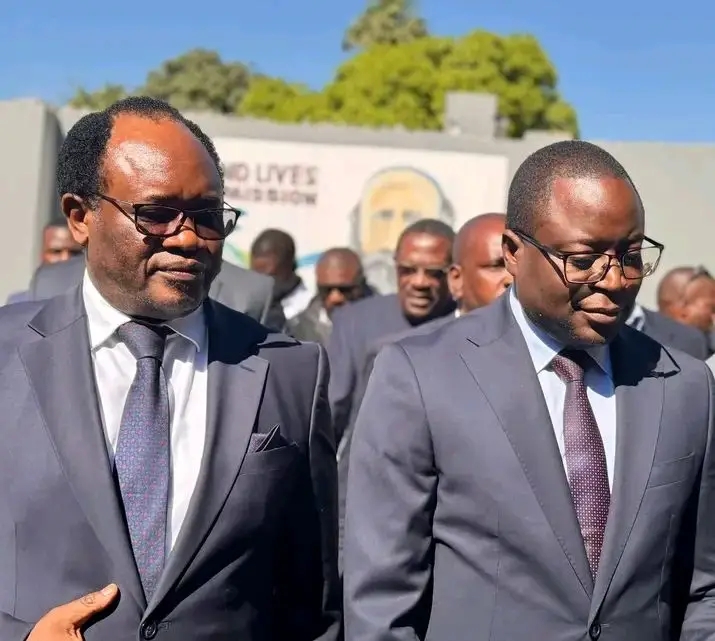
BRIAN MUNDUBILE THE SURPRISE GALLOPING HORSE IN THE 2026 PRESIDENTIAL RACE.
There are politicians who inherit moments, and then there are politicians who manufacture them. Love him or hate him, Brian Mundubile belongs to the second category. In a political environment where most leaders were still mourning the collapse of the PF and praying for a miracle resurrection, Mundubile was already drawing a new map of survival. That alone tells you something important: the man understands political timing.
And politics, at its core, is timing.
I have always maintained that I am a systems guy. I enjoy studying how systems work because the micro is often a reflection of the macro. That is why I have repeatedly argued that President Hakainde Hichilema is largely a systems leader. His political strength lies in understanding institutions, systems, processes, and how to bend them to his advantage. It is methodical, calculated, and long-term.
Mundubile understood very early that trying to fight HH using the same battlefield was a losing game, at least in the short term. You cannot out-system a man who thrives on systems. So instead of competing at the macro level, Mundubile went microscopic. He abandoned the idea of fighting for the ruins of the PF and instead focused on building influence brick by brick, relationship by relationship, structure by structure.
That is where many missed the plot.
When most people realized PF was collapsing, their instinct was emotional attachment. They clung to the party name, the nostalgia, the memories of power, hoping somehow the old machinery would resurrect itself. Many politicians remained frozen in that phase. They waited. They complained. They fought internal battles. They hoped.
Mundubile moved.
He correctly calculated that many of his colleagues would hold onto the PF label until there was almost nothing left to hold onto. And that is exactly what happened. While others were still debating court cases, legitimacy, and party ownership, Mundubile quietly started building something else entirely. That is why today some of those who once looked politically senior are now merely playing second fiddle.
The man stopped focusing on the collapsing system and started focusing on human infrastructure.
He went to chiefs.He went to church leaders.He went to fellow MPs.He reached out to opposition politicians.He built trust networks.He built loyalty.He built availability.
That is politics at its rawest form.
Because in politics, relevance is not given; it is manufactured.
And once Mundubile secured support from these critical players, he did something even smarter: he made himself both valuable and available at the exact same time. That combination is deadly in politics. A lot of politicians are available but not valuable. Others are valuable but inaccessible. Mundubile positioned himself as both.
So when Tonse needed someone to lead, there he was — prepared, organized, acceptable, and already carrying the backing of key players around him. His colleagues naturally rallied behind him because he had done the groundwork long before the public even noticed.
That is not luck.That is tactical discipline.
While the Pamodzi Alliance still looked back hoping the PF would somehow rise from the ashes, Tonse under Mundubile was already creating momentum. Slowly but strategically, the Tonse Alliance started looking more viable, more coordinated, and more politically alive than those still trapped in nostalgia politics.
By the time church leaders and traditional leaders began publicly pushing for opposition unity, Mundubile was already operating from a position of strength. He reportedly had structures functioning in eight out of the ten provinces. Meanwhile, others were still trying to figure out the next step.
At that point, reality became unavoidable.
The Pamodzi camp had little choice but to acknowledge that BM8 had done his homework and deserved to take the lead role in the alliance arrangement. Politics has no permanent sympathy for those who delay adaptation. The faster strategist almost always wins the internal battle.
And people should not make the mistake of underestimating the remaining PF structures. In many traditional strongholds, those structures are still deeply rooted. With proper coordination and disciplined leadership, they can still create serious political surprises for many who currently think the opposition is weak.
However, there is still one major challenge facing the Tonse-Pamodzi Alliance: integration.
At the top, the alliance appears solid, united, and energetic. But beneath the surface, the structures have not yet fully merged into one coherent machine. Political marriages are easy to announce but difficult to operationalize. Building trust, coordination, messaging discipline, and structural harmony across camps takes time.
The truth is brutal.
That cohesion will probably only solidify if the alliance wins power. If they lose, the alliance risks collapsing into factions, blame games, and bitter internal divisions between the two camps.
But regardless of what happens in the future, what cannot be denied is the sheer tactical sophistication behind this political maneuver.
Just a few weeks ago, many people genuinely believed the UPND had no meaningful opposition. Today, complacency would be dangerous. UPND can no longer afford to relax because the opposition has managed to create something politically significant in a remarkably short time.
Building a movement this quickly is not child’s play.
It requires planning.It requires discipline.It requires sacrifice.It requires strategic coherence.
And importantly, it requires people willing to work behind the scenes without demanding daily applause.
Some of the unsung architects of this movement deserve mention. People like Sean Tembo, despite currently being outside the alliance framework, played a notable role in shaping opposition conversations and momentum at critical stages. Then there is Chris Zumani Zimba, who has remained deeply involved in political strategy and planning. Emmanuel Mukandila has equally worked tirelessly in ensuring this political project gains traction.
In the background, influential figures such as Madam Mumbi Phiri, Madam Jean Kapata, several church leaders, and traditional leaders consistently pushed one central message to the opposition camps: unite or perish.
And that pressure mattered.
Because what we are witnessing is not ordinary politics. It is actually unprecedented in the Zambian political landscape.
It usually takes years — sometimes decades — for politicians without an established ruling party machinery behind them to build this kind of influence. Yet within a relatively short period, figures like Mundubile and Makebi Zulu have managed to command national political attention and shape opposition discourse in ways many long-standing opposition leaders have failed to achieve.
That alone should force analysts to pay attention.
Look at figures such as KBF, Harry Kalaba, or Fred M’membe. They have all been active in opposition politics for years, yet the BM8 and MZ8 political momentum currently appears far more energetic and influential. That does not happen accidentally. It speaks volumes about how deliberate, calculated, and strategic this political ticket has been.
People can downplay it all they want, but the reality is staring everyone in the face:
This is PF 2.0.
And it is arriving with force.
The opposition has managed to rebrand old political energy into a new political vehicle with renewed urgency and clearer coordination. Whether one agrees with them or not is irrelevant. Ignoring them would be politically foolish.
If the Tonse-Pamodzi Alliance maintains its current momentum, continues presenting itself as a united front, and avoids self-destruction, then it absolutely becomes a serious contender. Personally, I would cautiously give them around a 45% chance of success.
Yes, it is still a steep climb.
But it is no longer impossible.
Their biggest opportunity lies in presenting a message centered on unity, healing, reconciliation, and national restoration while deliberately avoiding violence, bitterness, and tribal politics. Zambians are exhausted by division. Any political movement that convincingly speaks to healing and national cohesion will find fertile ground.
There is still only a narrow path to victory for them.
But narrow paths have changed history before.
And if this alliance remains brave enough, disciplined enough, and strategic enough to stay united, then Zambia may be heading into a far more competitive political contest than many initially imagined.
Galloping to nowhere bwana, no plan. I will not vote for someone who says he will rule for the sake of Lungu
Dreaming is free
The author is a great dreamer. And he should continue dreaming dreams that have very opposite meaning. After 13th August, the author shall know the truth and stop dreaming
Let the Author dreams till Jesus Christ comes.
Those 2Makebi&Mundubile are Dead alive politically.
Truly the author of this trash ,is a big dreamer, the earlier he wakes up from his dream the better for him
Not matter , how you push your image about Mundubile ,nothing changes about, him ,the many past PF gabbages and scars he is connected to
Remain his greatest undoings,in the eyes of many voters
Its ,like ,putting and pouring ,a bitter old wine ,into a new Bottle, it will, still taste bitter,so is Mundubile,he remains ,the manifestation of PF